What Is Data-Centric Security: A Technical Reference
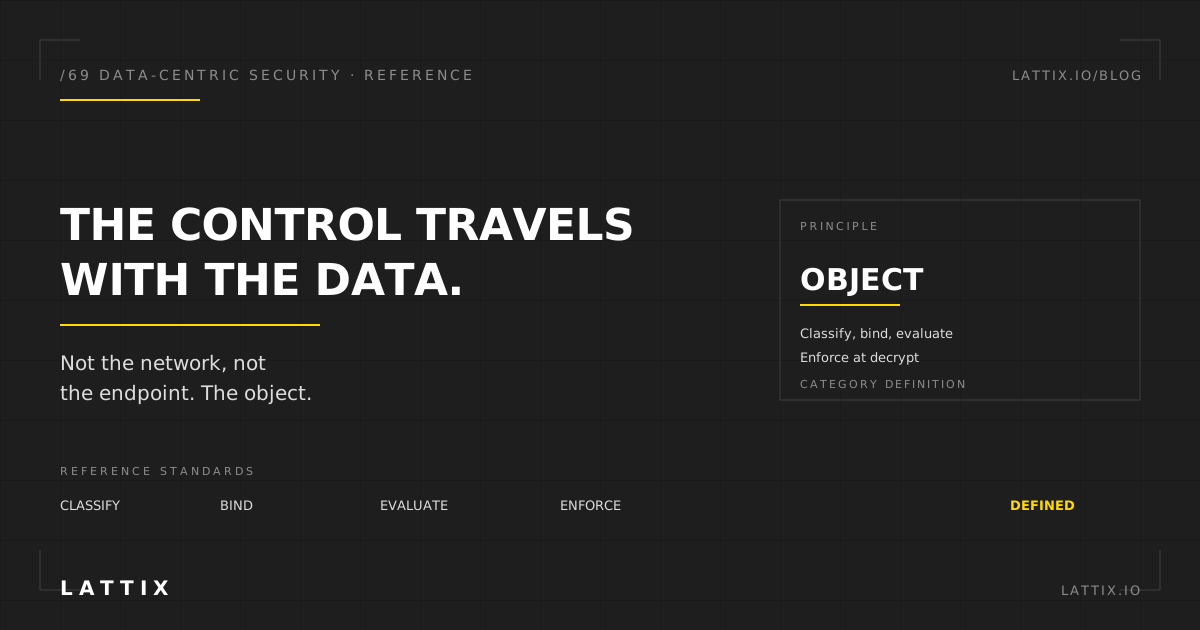
Data-centric security is a security model that attaches protection to the data object rather than to the systems, networks or devices that hold it. Each object carries its own classification, its own access policy and its own cryptographic protection, and every attempt to read it triggers a fresh authorization decision. The object stays governed when it is copied, forwarded, synchronized to unmanaged storage or ingested by a model. Perimeter and endpoint controls protect locations. Data-centric security protects the object, so the control survives the loss of the location.
The four mechanisms of data-centric security
Data-centric security is built from four mechanisms. Each one is necessary and none is sufficient alone.
Classification assigns attributes to the object: sensitivity, jurisdiction, owner, permitted purpose, retention, releasability. Classification produces the vocabulary that every later decision references. Without it, a policy has no subject matter to reason about.
Cryptographic binding encrypts the payload and ties the access policy to the key material, so editing the policy invalidates the binding and the key request fails. Without binding, a policy is advisory metadata that any holder of the file can strip with a text editor.
Policy evaluation happens at a policy decision point (PDP), which evaluates attribute-based access control (ABAC) rules across the requester, the device, the environment, and the object itself. Without a decision point, access reduces to static group membership fixed at the time of distribution.
Enforcement happens at a policy enforcement point (PEP) that releases or withholds key material at decrypt time. Without an enforcement point, a decision is a recommendation. Placing the enforcement point at decrypt is what makes the control independent of the application, the storage tier and the transport in the path.
A fourth-and-a-half property makes the model auditable rather than merely restrictive: content identifiers and lineage records turn each decision into a queryable event, so an organization can answer who opened a specific object, under which policy version, and why the answer was allow or deny. Classification practice is treated as the entry point to this model in Data Classification as the Foundation of Zero Trust.
How a security policy travels with the data
A security policy travels with the data when the policy is stored inside the protected object and cryptographically bound to the key that decrypts it. The object becomes a self-describing container: ciphertext, integrity hashes, the policy statement, and a binding value computed over that policy with the data encryption key.
Copying the object copies the policy. Emailing it, syncing it to unmanaged storage, writing it to removable media, or passing it into a retrieval pipeline carries the policy along unchanged, because the policy is bytes inside the file rather than a row in a system the file has left behind.
Two properties make travelling policy meaningful rather than decorative. First, the key is not present in the object in usable form; it is wrapped to a key service, so possession of the file is not possession of the plaintext. Second, the policy is evaluated fresh on each request against current attributes, so a revocation, a clearance change or a jurisdiction change reaches objects that were distributed months earlier. The mechanics of that binding are covered in What Is Trusted Data Format: A Technical Reference.
What technologies implement data-centric security
Several distinct technology categories carry the label. They enforce different things and stop in different places.
| Technology | What it enforces | Where it stops |
|---|---|---|
| Classification and labeling | Nothing on its own; it produces the attributes other controls reference | A label is advisory until some control reads and acts on it |
| Data loss prevention (DLP) | Blocks or quarantines matching content on egress paths under inspection | Paths outside inspection, and content already encrypted by the sender |
| Data security posture management (DSPM) | Discovery, classification and exposure reporting for data at rest | Reports posture; does not make an access decision at request time |
| Digital and information rights management (DRM, IRM) | Per-document usage rights checked by a cooperating application | Enforcement depends on the rendering application honoring the rights |
| Tokenization and format-preserving encryption | Substitution of sensitive field values so downstream systems never hold them | Protects fields inside pipelines, not whole documents in circulation |
| Key management, BYOK and HYOK | Custody of key material and the ability to withdraw it | Withdrawal is coarse, typically per key or per tenant rather than per object per request |
| Object-level encryption with bound policy (TDF, ZTDF) | An access policy carried inside the object and evaluated at every decrypt | Requires reachable decision and key services; does not govern released plaintext |
| Confidential computing | Isolation of data in use from the host operator and hypervisor | Protects the compute boundary, not the object once results leave it |
Data-centric security technologies compose. DSPM finds and classifies, classification supplies attributes, object-level encryption binds those attributes into the object, and a decision point evaluates them per request. Treating any one of them as the whole model is the common implementation error. Key custody choices in particular are load-bearing, and are examined in Key Management for Data-Centric Security.
Data-centric security compared with perimeter and endpoint security
| Question | Perimeter security | Endpoint security | Data-centric security |
|---|---|---|---|
| What is protected | The network boundary and the paths crossing it | The device and the processes running on it | The data object |
| Where the control lives | Firewalls, gateways, proxies, segmentation | Agents, endpoint detection, disk encryption, posture checks | The object's own policy and its key binding |
| When the decision is made | At connection time | At process or file event time | At every decrypt request |
| Effect when the object leaves the estate | Control ends | Control ends at the managed device boundary | Control travels with the object |
| Effect of a stolen valid credential | Attacker inherits the network reach of that credential | Attacker inherits the device reach of that credential | Attacker still faces per-object policy evaluation |
| Revocation after distribution | Not applicable | Possible on managed devices only | The next decrypt request is denied |
| Evidence produced | Flow and connection records | Process and file event records | Per-object decisions with reasons and policy version |
| Primary failure mode | One trusted path is enough for an attacker | One unmanaged device is enough for an attacker | Availability of the decision and key services |
Perimeter and endpoint controls are not obsolete and data-centric security does not replace them. Segmentation still limits reconnaissance, and endpoint telemetry still detects the intrusion that precedes exfiltration. The difference is scope of failure: when a network control fails, everything reachable through it is exposed at once, while when an object-level control is bypassed the loss is bounded to objects whose policies actually evaluated to allow.
What data-centric security does not solve
Data-centric security has real boundaries, and a reference that omits them is a sales page.
Data-centric security does not protect plaintext after authorized release. Once an authorized user decrypts an object, the rendered content can be photographed, retyped, screen-captured or summarized. Object-level control governs the release, not what a legitimate holder does afterward.
Data-centric security does not remove the availability dependency. Decisions and key unwrapping require a reachable service. Offline and disconnected operation requires deliberate pre-provisioning, and defaults are fail-closed, which means a service outage denies access rather than granting it.
Data-centric security does not fix bad attributes. A policy that references a stale clearance, an over-broad group or an incorrect classification will be enforced faithfully and wrongly. Attribute governance is the operational cost of the model.
Data-centric security does not retroactively protect data already distributed in the clear. Objects encrypted and bound from creation are governed; copies made before adoption are not.
Frequently asked questions
What is data-centric security?
Data-centric security is a model that protects the data object itself rather than the network, device or application holding it. Each object carries a classification, an access policy and cryptographic protection, and every read requires a fresh authorization decision. Because the policy is bound into the object, protection continues after the object leaves the environment that created it.
What technologies implement data-centric security?
Classification and labeling produce attributes. DLP inspects egress paths. DSPM discovers and reports exposure. Rights management applies per-document usage rules inside cooperating applications. Tokenization protects fields. Object-level encryption formats such as TDF bind a policy into the file. Confidential computing isolates data in use. A complete implementation composes several of these rather than choosing one.
How can security policies travel with the data?
A policy travels with data when it is written inside the encrypted object and cryptographically bound to the key that opens it. Altering the policy breaks the binding and the key request fails. Because the key is wrapped to a key service rather than stored in the file, opening the object requires a live decision against current attributes, wherever the copy has travelled.
How is data-centric security different from perimeter security?
Perimeter security decides at connection time who may reach a location, and the decision covers everything inside that location. Data-centric security decides at decrypt time who may open a specific object, and the decision covers that object only. When a perimeter control fails, everything behind it is exposed. When an object-level control is evaded, the exposure is bounded to individual objects.
Is encryption on its own data-centric security?
No. Conventional encryption enforces key possession: whoever holds the key decrypts, anywhere, indefinitely, with no further check. Data-centric security enforces a policy bound to the object and evaluated at each request, which adds revocation after distribution, per-request conditions such as device posture and geography, and a record of each decision. Encryption is the mechanism; bound policy is the control.
How Lattix implements this model
Lattix implements data-centric security as cryptographic enforcement at the object. The Lattix policy decision point evaluates ABAC across subject, device, environment and geography, purpose of use, network posture, risk and data-object attributes, then returns a signed, short-lived decision carrying allow or deny, the reasons, the policy version hash and the object identifier. The policy enforcement point acts at decrypt time, so enforcement survives whatever service sits in the path. Defaults are fail-closed and revocation propagates to deny. Content identifiers and Merkle-tree lineage make decision history queryable. The same posture deploys across cloud, regional hub, tactical edge and air-gapped environments. How this model sits inside a broader zero trust programme is covered in Data-Centric Security vs Zero Trust: How the Two Relate.