What Happens to DLP Controls After the File Is Downloaded
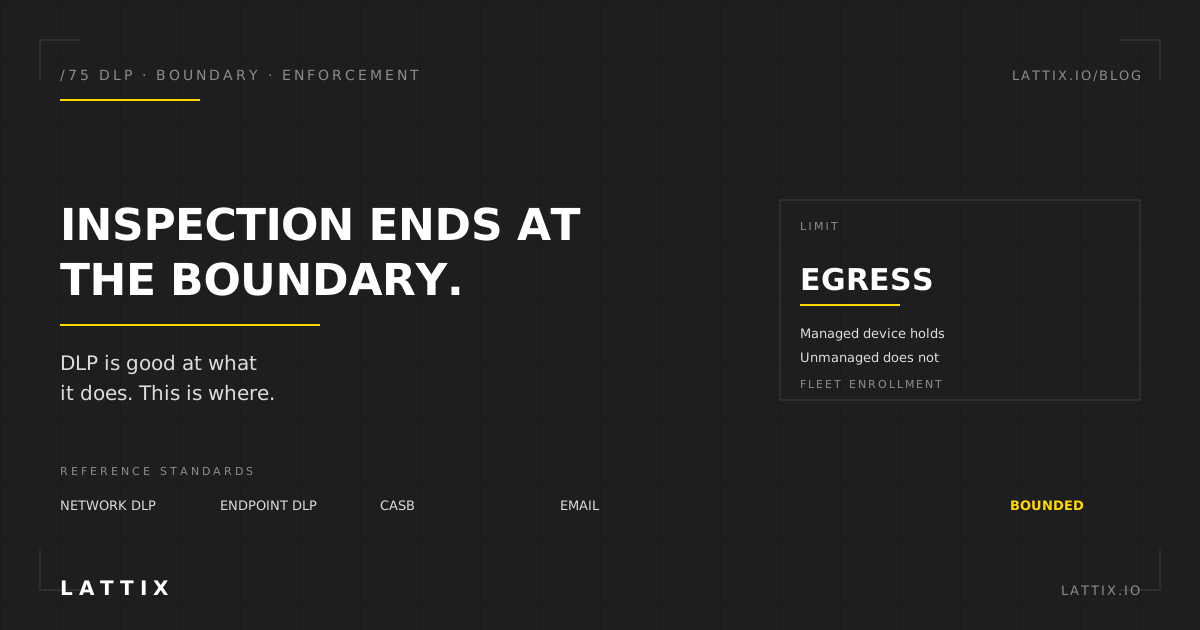
DLP controls stop enforcing when a file reaches a device or account the organization does not operate. Data loss prevention acts at boundaries: mail gateways, web proxies, endpoint agents, and cloud application interfaces. A download that completes to an unmanaged endpoint has crossed the last boundary the organization controls, and the file becomes ordinary plaintext on a disk. It can then be copied, forwarded, synchronized or re-shared with no inspection. DLP can log that the download happened and block the next one. DLP cannot govern the copy that now exists, because no DLP enforcement point sits in the paths that copy will take.
What DLP does well
Data loss prevention detects, monitors and protects data in use, in motion and at rest, using content inspection and contextual analysis under centralized management. That description follows the definition recorded in the CNSSI 4009 national information assurance glossary, and DLP performs each part of it competently.
DLP is the best available control for content inspection. Pattern matching, exact data matching against known record sets, document fingerprinting and optical character recognition on images identify regulated content that no other control category examines at the same depth.
DLP is effective at egress control on operated paths. Mail flow, web upload, removable media, printing, instant messaging and sanctioned cloud applications can all be inspected and blocked before a transfer completes, which prevents the single most common cause of data loss: an ordinary employee sending the wrong file to the wrong place.
DLP produces the evidence auditors ask for. Records of matched content, blocked transfers, policy versions and user justifications map directly onto regulatory expectations for demonstrating that egress is controlled.
DLP also performs discovery. Scanning file shares, endpoints and repositories for regulated content builds the inventory that other controls depend on.
None of these strengths is diminished by the boundary this page describes. DLP does its job. The question is what remains in force once the job is finished.
Where each DLP enforcement point ends
DLP is not one control. It is four or five deployment models with different reach, and each ends at a different place.
| DLP deployment | What it inspects | What it enforces | Where its enforcement ends |
|---|---|---|---|
| Network DLP | Traffic crossing monitored egress paths | Block, quarantine, encrypt or log a transfer in progress | Traffic that does not traverse the monitored path, and payloads it cannot decrypt or parse |
| Email DLP | Message bodies, attachments and recipients in the operated mail flow | Block, quarantine, redirect, apply encryption, or warn the sender | The recipient's own mail system, and every forward that occurs there |
| Endpoint DLP | File operations, clipboard, screen capture, printing and removable media on managed devices | Block or allow the operation on that device | The device boundary; an unmanaged or personal device runs no agent |
| Cloud and API DLP | Content and sharing configuration inside sanctioned cloud applications | Revoke a share, quarantine a file, block an upload, alert on external sharing | The moment content is exported from the application into local storage |
| Discovery DLP | Data at rest in scanned repositories | Nothing directly; it flags, moves or triggers remediation | Repositories outside the scan scope, and copies made between scans |
Endpoint DLP deserves specific credit, because it is the deployment model that continues to act after a download onto a corporate machine. An endpoint agent can block copying the downloaded file to removable media, uploading it to a personal cloud account, printing it, or pasting its contents into a webmail form. That is real post-download enforcement, and it is the correct control for that scenario. The condition is that the device must be enrolled and running the agent. A contractor's laptop, a partner's workstation, a personal phone and a customer's machine run no agent, and endpoint DLP has no presence there.
What happens to a file after the download completes
A completed download changes the file's status in three ways at once.
The file becomes plaintext with no attached policy. Whatever classification label the source system displayed is now, at most, a metadata property that any application may drop on save, and no control reads it at open time.
The file moves onto paths the organization does not observe. Personal cloud sync, consumer messaging apps, removable media on an unmanaged machine, a partner's internal file share and a subcontractor's email system are all normal onward paths, and none of them contains a DLP inspection point belonging to the originating organization.
The file becomes indistinguishable from any other file. Re-saving it under a new name, converting it to another format, extracting the relevant rows into a spreadsheet, or pasting the sensitive paragraph into a chat message produces derived content that no longer resembles the original object in any registry.
Can DLP protect data after it leaves the organization
DLP cannot protect data after it leaves the organization, with one bounded exception. The exception is endpoint DLP on a device the organization manages, which continues to enforce file operations after a download because the enforcement point is the agent on that device rather than a network boundary. That protection ends at the edge of the managed fleet.
For every other case, the mechanism is unavailable rather than merely weak. Enforcement requires an enforcement point in the path. When a partner opens a file on their own laptop, the path runs between their disk and their application, and the originating organization has no component in it. This is a property of boundary-based architecture, not a deficiency in any product. A control cannot act where it is not present.
One further limitation is worth naming because it is often misread as a product failure. DLP inspects content it can read. A file that the sender has already encrypted with a tool the DLP system cannot decrypt is opaque, so the policy decision degrades to a coarse allow or block on the fact of encryption itself. Blocking all encrypted attachments breaks legitimate business, and allowing them creates an uninspected channel. The comparison of how other control categories handle this is in DLP, DRM, DSPM and Data-Centric Security: What Each One Enforces.
What extends protection past the download
Protection continues past a download only when the control travels inside the file rather than sitting in the path. That means encrypting the object before distribution, binding an access policy to the key material, and requiring a fresh authorization decision at every open.
Under that model the download is no longer the end of enforcement. The recipient holds ciphertext, and each attempt to open it produces a request that current policy evaluates: the requester's attributes, the device posture, the jurisdiction, the purpose of use, and the object's own attributes. Because the decision is made per request, access can be withdrawn after distribution, which is the capability boundary controls structurally cannot provide. The mechanism is described in How to Revoke Access to a File Someone Already Downloaded.
This layer sits alongside DLP rather than displacing it. DLP prevents the transfer that should never have happened and produces boundary evidence. Object-level enforcement bounds the consequences of transfers that happen anyway, including the ones nobody observed. The category is defined in What Is Persistent Data Protection.
Frequently asked questions
Can DLP protect data after it leaves the organization?
Not in general. DLP enforces at boundaries the organization operates, and a completed download to an unmanaged device or external account has already crossed the last such boundary. The exception is endpoint DLP on a managed device, which continues to control file operations locally. Outside the managed fleet, no DLP enforcement point exists in the path, so no enforcement occurs.
What are the limitations of traditional DLP?
Traditional DLP is limited to inspected paths, cannot read content already encrypted by the sender, ends at the managed-device boundary, and has no reach into derived copies or reformatted extracts. It also carries an operational cost in false positives, which pushes teams toward monitor-only rules. These are architectural characteristics of boundary inspection, not defects in particular products.
Does a sensitivity label keep working after a file is downloaded?
A label alone does not. A label is metadata, and metadata is advisory unless some control reads it and acts on it at open time. Labels that trigger encryption with a bound policy do continue to work after download, because the enforcement then comes from the key release decision rather than from the label. The distinction is between labeling and cryptographic enforcement.
Does endpoint DLP solve the post-download problem?
Partially, and only on managed devices. An endpoint agent can block copying a downloaded file to removable media, uploading it to personal cloud storage, printing it, or pasting from it. That is genuine post-download enforcement. It does not extend to contractors, partners, customers or personal devices, which is where most external sharing risk sits.
Should an organization replace DLP with object-level encryption?
No. The two address different failure modes. DLP prevents an unwanted transfer at a boundary and produces the audit evidence that boundary controls are working. Object-level encryption with bound policy limits what a completed transfer is worth, on paths no boundary observes. Removing DLP would give up prevention and evidence at exactly the point where prevention is cheapest.
How Lattix works alongside DLP
Lattix operates after the point where DLP enforcement ends, and does not replace it. The Lattix policy decision point evaluates ABAC across subject, device, environment and geography, purpose of use, network posture, risk, and data-object attributes, then returns a signed, short-lived decision carrying allow or deny, the reasons, the policy version hash, and the object identifier. The policy enforcement point acts at decrypt time, so a downloaded object stays governed on paths no gateway observes. Defaults are fail-closed and revocation propagates to deny. Content identifiers and Merkle-tree lineage make post-download access history queryable per object. Classification produced by existing DLP discovery scans is consumed as policy input rather than rebuilt.