Posture Is Not Enforcement: What DSPM Can and Cannot Do
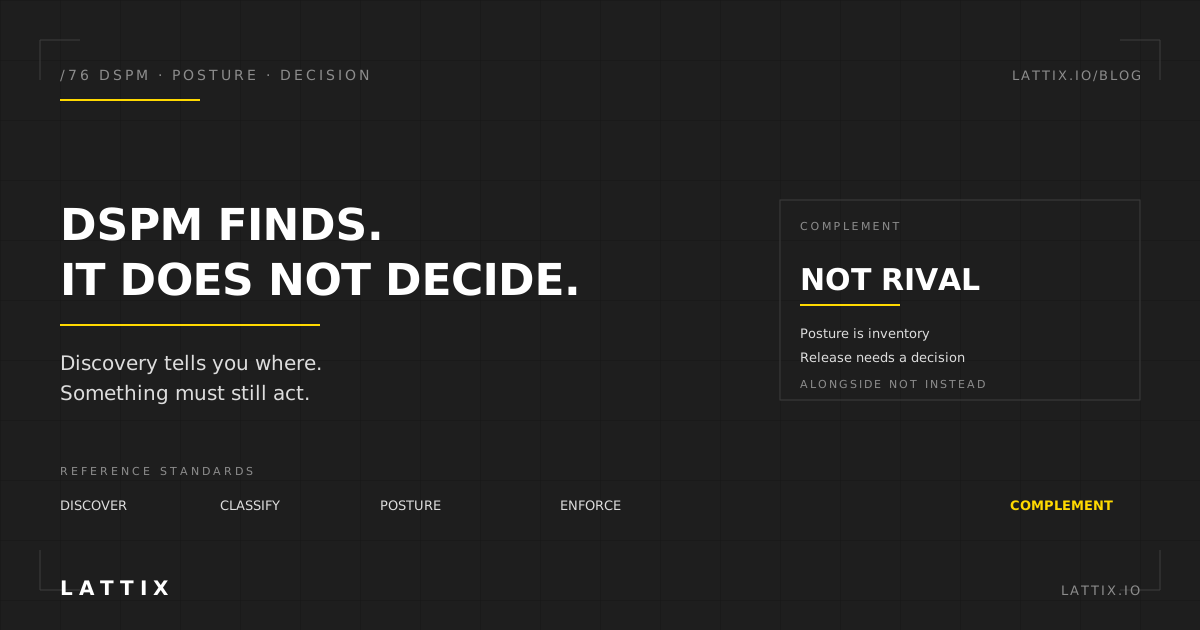
Data security posture management (DSPM) discovers, classifies and reports; it does not decide access. DSPM finds data stores across cloud and on-premises estates, classifies what they hold, maps who can reach them and how data flows between them, and prioritizes the resulting exposure findings. Those outputs describe risk accurately. None of them intervenes at the moment a requester asks for an object, because DSPM does not sit in the request path. Enforcement requires a component that does sit in that path and returns allow or deny. DSPM and an enforcement layer are complements, not substitutes.
What DSPM discovers and reports
DSPM answers the inventory question, and the inventory question comes first. Gartner introduced the term in its 2022 Hype Cycle for Data Security, and the category grew because organizations could not reliably say where their sensitive data was after a decade of cloud expansion.
A DSPM platform typically delivers five outputs. Discovery locates data stores across cloud services, SaaS applications, databases, object storage and on-premises file systems, including shadow copies nobody registered. Classification determines what each store holds and at what sensitivity. Access and flow mapping shows which identities can reach which data and how data moves between systems. Risk prioritization ranks findings so that the publicly readable bucket holding regulated records surfaces above the empty test database. Remediation support drives corrective action, usually by changing permissions, alerting owners, or opening tickets in other systems.
Those outputs are prerequisites for every other data control. A policy cannot reference a classification that does not exist, an enforcement layer cannot protect objects nobody has found, and a DLP rule cannot match records that were never fingerprinted. Organizations that skip discovery build enforcement on assumptions about their own estate.
Posture and enforcement compared
| Question | Posture management (DSPM) | Enforcement layer |
|---|---|---|
| When it runs | On a scan or streaming assessment cycle | At every access request |
| What it produces | An inventory, an exposure map, a risk ranking | An allow or deny decision for one requester and one object |
| Where it sits | Alongside the data estate, reading configuration and content | In the request path, between the requester and the plaintext |
| What it changes | Configuration, permissions, ownership and remediation backlog | Whether this specific access completes, right now |
| Scope of coverage | The estate it is connected to scan | Every object it protects, including copies outside the estate |
| Effect on a copy that left the estate | None; the copy is no longer in scan scope | Policy is evaluated wherever the copy is opened |
| Evidence produced | Point-in-time posture, coverage and trend reporting | Per-request decisions with reasons, policy version and object identifier |
| Failure mode | Findings that no one remediates; visibility mistaken for control | Availability of the decision service; quality of the attributes supplied |
The distinction is not a criticism of DSPM. A posture tool that intervened in every read would be a different product with different latency, availability and failure characteristics. The error is organizational rather than technical: treating a completed DSPM rollout as though the data is now protected, when what has been achieved is that the data is now known.
How DSPM combines with encryption and access control
DSPM combines with encryption and access control by supplying the attributes those controls evaluate. The combination works in a defined sequence, and each step consumes the previous one's output.
- DSPM discovers and classifies. The scan produces the authoritative list of stores, objects and sensitivity levels, including the ones nobody expected.
- Classification becomes attributes. Sensitivity, owner, jurisdiction, regulatory scope, permitted purpose and retention are normalized into the vocabulary policies reference. Classification practice at this level is covered in Data Classification as the Foundation of Zero Trust.
- Encryption binds the attributes into the object. Objects are encrypted with an access policy bound to the key material, so the classification travels with the data instead of remaining a row in the DSPM database.
- Access control evaluates the policy at request time. A policy decision point applies attribute-based access control (ABAC) across subject, device, environment, purpose and object attributes, and a policy enforcement point releases or withholds the key.
- Decisions feed back into posture. Access records and denials tell the DSPM programme which stores are actually used, which classifications are wrong, and where over-permissioning persists in practice rather than in configuration.
Each layer covers a gap the others leave. DSPM sees the estate broadly but shallowly in time. Encryption with bound policy sees one object deeply and continuously, including after that object leaves the estate. Access control decides. Running any one of them alone leaves either unknown data, unprotected data, or ungoverned access.
What DSPM cannot do
DSPM has real boundaries, and naming them is what makes a posture programme succeed rather than stall.
DSPM does not make an access decision. It reports that a store is over-permissioned; it does not deny the request that exploits the over-permissioning. The remediation loop runs at human or workflow speed, and the request runs in milliseconds.
DSPM does not follow data out of the estate it scans. Once a file is downloaded to a personal device, emailed to a partner or copied to an unconnected environment, it is outside scan scope and outside every DSPM finding. The same boundary applies to boundary-based inspection, as described in What Happens to DLP Controls After the File Is Downloaded.
DSPM does not provide continuous assurance at request granularity. Findings reflect the state at scan time. A permission changed after the scan, or a copy created between scans, is invisible until the next cycle.
DSPM does not fix classification quality on its own. Automated classifiers produce false positives and false negatives, and a wrong classification propagated into an enforcement policy produces confident, incorrect denials and confident, incorrect approvals.
DSPM does not remediate by itself in most deployments. It changes configuration through integrations and opens work for owners. Findings that no one closes leave the posture unchanged and the report accurate.
Extending data protection beyond DLP and DSPM
Extending data protection beyond DLP and DSPM means adding a control that is present at the moment of access rather than at a boundary or on a scan cycle. DSPM establishes what exists. DLP governs the paths the organization operates. Neither is present when a partner opens a downloaded file on their own laptop.
The layer that covers that case binds an access policy into the object cryptographically and evaluates it at every decrypt. Because the decision happens per request against current attributes, three capabilities become available that posture and boundary controls structurally cannot provide: access can be withdrawn after distribution, conditions such as device posture, geography and purpose of use can be enforced at the moment of use, and each access produces per-object evidence rather than per-path evidence.
Deploying that layer does not require replacing anything. DSPM continues to supply classification, DLP continues to inspect operated paths, and the enforcement layer consumes the attributes both produce. The category is defined in What Is Persistent Data Protection, and the four-way positioning of these controls is in DLP, DRM, DSPM and Data-Centric Security: What Each One Enforces.
Frequently asked questions
Does DSPM enforce access control?
No. DSPM discovers data stores, classifies contents, maps permissions and prioritizes exposure findings. It is not positioned in the request path, so it cannot return allow or deny when a user or service asks for an object. DSPM drives enforcement indirectly by changing configuration and permissions through other systems, which happens at remediation speed rather than request speed.
How does DSPM combine with encryption and access control?
DSPM supplies the classification and ownership attributes that policies reference. Those attributes are bound into encrypted objects, so classification travels with the data. At each access request, a policy decision point evaluates attribute-based rules and an enforcement point releases or withholds the key. Access records then flow back into the posture programme as evidence of which classifications and permissions are wrong in practice.
Is DSPM a replacement for DLP?
No. DSPM assesses data at rest across the estate and reports exposure. DLP inspects content on egress paths and blocks transfers at a boundary the organization operates. They answer different questions, produce different evidence, and fail in different ways. Organizations commonly run both, with DSPM supplying the classification that makes DLP rules accurate.
What does DSPM miss that an enforcement layer catches?
DSPM misses everything outside its scan scope and everything that changes between scans, including copies that have left the estate entirely. An enforcement layer positioned at decrypt evaluates policy wherever a copy is opened, denies requests that current policy no longer permits, and records each decision against the object identifier rather than against a storage location.
What should an organization deploy first, DSPM or enforcement?
Discovery first, in most programmes. Enforcement built on unknown or wrongly classified data produces incorrect decisions at speed, which is worse than knowing the inventory is incomplete. The practical pattern is to run DSPM to establish classification coverage on the highest-value data, then apply object-level enforcement to that subset while discovery continues across the rest of the estate.
How Lattix works with DSPM
Lattix provides the enforcement layer that consumes DSPM output rather than duplicating it. The Lattix policy decision point evaluates ABAC across subject, device, environment and geography, purpose of use, network posture, risk, and data-object attributes, then returns a signed, short-lived decision carrying allow or deny, the reasons, the policy version hash, and the object identifier. The policy enforcement point acts at decrypt time, so protection continues on copies that have left the scanned estate. Defaults are fail-closed and revocation propagates to deny. Content identifiers and Merkle-tree lineage make decision history queryable per object, which returns real access evidence to the posture programme. Deployment spans cloud, regional hub, tactical edge and air-gapped environments with no posture change.