Sovereign Data Architecture at Mid-2026: Policy Bound to the Object
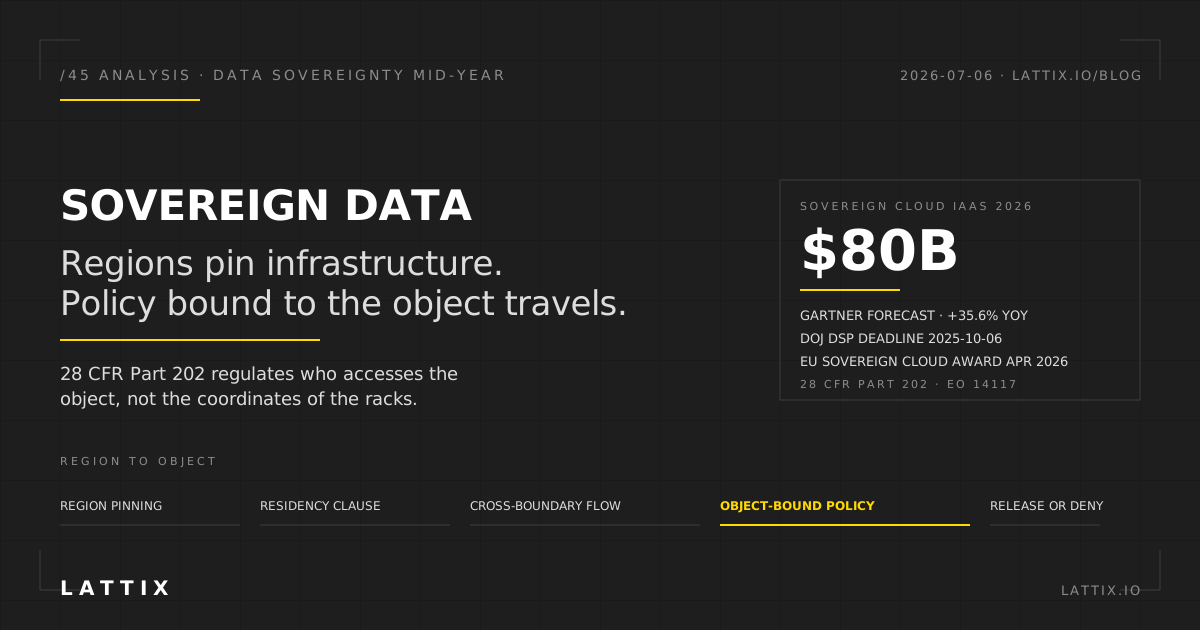
July 2026 marks the first mid-year in which data sovereignty operates as enforced law on both sides of the Atlantic rather than as procurement preference. The Department of Justice's Data Security Program at 28 CFR Part 202 passed its final compliance deadline on October 6, 2025, and DOJ's National Security Division now states plainly that it will pursue enforcement against violations. In April, the European Commission awarded EUR 180 million in sovereign cloud contracts to four European providers, and in June it published the Cloud Sovereignty Framework that scored them.
The money followed the law. Gartner forecasts worldwide sovereign cloud infrastructure spending at $80 billion in 2026, a 35.6 percent jump over 2025, with European spending growing 83 percent year over year. Governments and regulated industries are the primary buyers. The mid-year question is not whether sovereignty pressure is real. It is whether the architectures being purchased actually deliver it.
Residency Is a Property of Infrastructure, Not Data
The dominant sovereignty pattern in mid-2026 remains region-pinning: select a sovereign region, sign a contractual residency clause, and declare the data sovereign. The Commission's framework formalizes this instinct. Its SEAL-2 tier certifies providers whose legal and operational posture protects customer data under EU law without additional technical measures by the customer.
That certification describes the container, not the contents. The moment an object leaves the certified region, through replication, an analytics export, a partner transfer, or an AI training pipeline, every control the region provided stays behind. Residency clauses govern where infrastructure sits. They say nothing about what a specific object may do once a query, a sync job, or a coalition partner pulls it somewhere else. Lattix Technologies has made this argument before in the multi-cloud context: sovereignty that depends on the perimeter dissolves at the first cross-boundary flow.
The unresolved CLOUD Act question makes the point sharper. European analysts note that no 2026 development repeals the extraterritorial reach of US law over US-headquartered providers, which is why Brussels is weighing restrictions on hyperscalers for sensitive government workloads at all. A control that evaporates under a foreign legal order was never a control. It was a promise.
What 28 CFR Part 202 Actually Tests
The DOJ rule is the cleanest demonstration that regulators have moved past residency. The Data Security Program does not ask where bulk US sensitive personal data is stored. It asks who can access it, and it prohibits or restricts access by covered persons tied to China, Cuba, Iran, North Korea, Russia, and Venezuela regardless of where the data physically resides.
The compliance machinery that took effect on October 6, 2025 confirms the object-level framing. Covered entities engaging in restricted transactions must run risk-based data flow verification, vendor identity verification, annual independent audits, and annually certified written policies. Civil penalties reach the greater of $377,700 or twice the transaction value per violation, and willful violations carry criminal exposure up to $1 million and 20 years.
None of those obligations can be discharged by pointing at a region boundary. Proving that no covered person accessed a dataset requires knowing, per object, what the data is, who touched it, and under what authority. That is an attribute-based access control (ABAC) problem and an auditable lineage problem, not a geography problem.
Sovereignty That Travels: The Mission Case
Federal missions force the issue hardest, because mission data must move. The Federal Zero Trust Data Security Guide from the Federal CDO and CISO Councils centers on securing the data itself rather than the perimeter around it, and practitioners writing in Federal News Network this spring reported that 64 percent of surveyed agency leaders name secure data movement across networks and domains as their greatest zero trust barrier. Coalition operations sit at the extreme end: sharing classified objects with partners whose networks, clouds, and legal jurisdictions the originator does not control.
Region-pinning has no answer here. The only sovereignty control that survives transit is policy cryptographically bound to the object itself. In a zero trust data fabric (ZTDF), each object carries its classification, releasability, and handling caveats as signed attributes. A policy decision point (PDP) evaluates ABAC policy against those attributes and the requester's credentials, and a policy enforcement point (PEP) releases keys only on an affirmative decision, fail-closed by default. The originator's rules travel with the object because they are inseparable from it.
This is the architecture Lattix builds. Cryptographic enforcement replaces contractual trust: content-addressed storage (CAS-X) makes every object tamper-evident, Merkle-tree lineage produces the per-object audit trail that a Part 202 auditor or a coalition disclosure review actually needs, and post-quantum key encapsulation with ML-KEM-768 protects key release against harvest-now-decrypt-later collection by the same countries of concern the DOJ rule names. Sovereignty stops being a property of the datacenter and becomes a property of the object.
The mid-year read is straightforward. Regulators on both continents now write rules about data objects and the identities that touch them, while the market still mostly sells them regions. Agencies that close that gap at the data layer will satisfy 28 CFR Part 202, the EU's sovereignty tiers, and the coalition mission simultaneously, with one enforcement model instead of three.
References
- eCFR: 28 CFR Part 202, Access to U.S. Sensitive Personal Data and Government-Related Data by Countries of Concern or Covered Persons
- Cooley: October 6 Compliance Deadline for DOJ's Data Security Program
- Gibson Dunn: Final Provisions of the DSP Come into Effect
- European Commission: Commission Advances Cloud Sovereignty Through Strategic Procurement (April 2026)
- European Commission: Sovereign Cloud Framework Explained (June 2026)
- CNBC: EU Weighs Restricting Use of U.S. Cloud Platforms for Sensitive Government Data (May 2026)
- Gartner: Worldwide Sovereign Cloud IaaS Spending Will Total $80 Billion in 2026
- FedScoop: Federal Data, Security Leaders Release Zero Trust Guide
- Federal News Network: Future Mission Success Requires Overcoming Today's Data Sharing Challenges (April 2026)
- Databalance: Microsoft Cloud Sovereignty in 2026, Ambition and Reality