Cross-Border Data Sharing Under Conflicting Legal Regimes
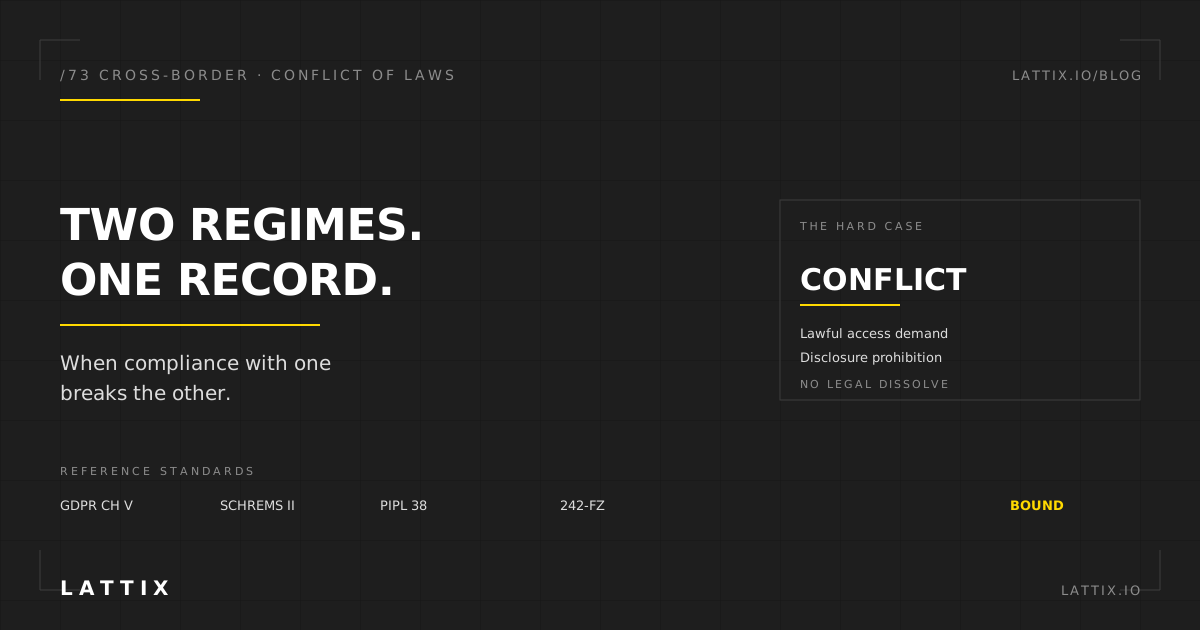
Cross-border data sharing under conflicting legal regimes is the problem of one record falling under two sets of rules that cannot both be satisfied by moving the record. A GDPR transfer restriction, a national localization statute and a foreign lawful access demand can attach to the same object at the same time. Location-based controls fail in that situation because no single storage location satisfies every constraint. A policy bound to the object and evaluated at every request can carry several constraints simultaneously, because the constraint travels with the record instead of with the storage.
GDPR mechanisms for transferring personal data outside the EU
GDPR Chapter V prohibits transfers of personal data to third countries unless a specific mechanism applies. The mechanisms differ in what they require and in where they stop.
| Mechanism | GDPR reference | What it requires | Where it stops |
|---|---|---|---|
| Adequacy decision | Article 45 | A European Commission finding that the third country ensures an essentially equivalent level of protection | Covers listed countries only, and can be challenged or withdrawn |
| Standard contractual clauses | Article 46 | Commission-approved clauses, a transfer impact assessment, and supplementary measures where third-country law undermines the clauses | A contract binds the parties and does not bind the third country's authorities |
| Binding corporate rules | Article 47 | Intra-group rules approved by a supervisory authority, conferring enforceable rights on data subjects | Intra-group transfers only, with a long approval cycle |
| Approved codes of conduct and certification | Article 46 | An approved scheme plus binding and enforceable commitments by the importer | A small ecosystem of approved schemes in practice |
| Derogations for specific situations | Article 49 | Explicit informed consent, contract necessity, important public interest, legal claims, vital interests, or public registers | Interpreted narrowly and generally unsuited to systematic, repetitive transfers |
| Foreign authority orders | Article 48 | A third-country judgment or authority decision requiring transfer is recognizable only if based on an international agreement such as a mutual legal assistance treaty | Provides no route at all for a unilateral foreign demand |
Two dates anchor the current position. On 16 July 2020 the Court of Justice of the European Union invalidated the EU-US Privacy Shield in Schrems II, case C-311/18, while upholding standard contractual clauses subject to case-by-case assessment of third-country law. On 10 July 2023 the Commission adopted an adequacy decision for the EU-US Data Privacy Framework, which is itself subject to challenge.
Data localization laws and what they require
Data localization laws take several different shapes, and a multinational sharing one record can face more than one shape at once.
Hard localization requires storage inside the country. Russian Federal Law 242-FZ, in force since 1 September 2015, requires operators to record, systematize, accumulate, store, amend and retrieve personal data of Russian citizens using databases located in Russia.
Route-based control permits outbound transfer through defined channels. Article 38 of China's Personal Information Protection Law offers three routes for providing personal information outside China: a security assessment by the Cyberspace Administration of China, a filed standard contract, or personal information protection certification.
Permitted-unless-restricted control inverts the default. Section 16 of India's Digital Personal Data Protection Act 2023 permits transfer to any country except those the Central Government notifies as restricted, with sector regulators imposing separate storage requirements.
Category-based control restricts transfers by data type and counterparty rather than by geography alone. The United States rule at 28 CFR Part 202 restricts certain transactions involving bulk sensitive personal data and government-related data with countries of concern, and is examined in The DOJ Bulk Sensitive Data Rule at 28 CFR Part 202.
When one jurisdiction compels disclosure that another forbids
The hard case in cross-border data sharing is not a transfer needing paperwork. It is a lawful demand in one jurisdiction for data a second jurisdiction forbids disclosing.
The United States CLOUD Act, enacted in 2018, allows United States authorities to compel providers subject to United States jurisdiction to produce data in their possession, custody or control regardless of where the data is stored. The demand follows the entity rather than the server.
Article 48 of the GDPR states that a third-country court or administrative decision requiring transfer of personal data is recognizable and enforceable only if based on an international agreement such as a mutual legal assistance treaty. Article 32 of the EU Data Act, Regulation (EU) 2023/2854, imposes a parallel duty for non-personal data held in the Union. Article 41 of China's Personal Information Protection Law is more direct still: a personal information processor shall not provide personal information stored within China to foreign judicial or law enforcement agencies without approval from the competent Chinese authorities. France has operated a blocking statute since Law No. 68-678 of 26 July 1968.
The entity in the middle faces sanction whichever way it moves. Relocating the data does not resolve the conflict, because the demand attaches to the entity that controls the data, and every additional storage region adds another regulator without removing any. The relationship between corporate reach and storage geography is set out in What Is Data Sovereignty: Enforcement, Not Geography.
How object-bound policy carries two constraints at once
An object-bound policy carries several constraints at once because all of them become conditions on the same object, evaluated together at each request rather than resolved once at deployment.
A record subject to both an EU transfer restriction and a partner-nation sharing obligation carries one policy expressing both: release only to subjects holding a specified role, in a listed jurisdiction, on an attested device, for a declared purpose, under a named legal basis. A request that satisfies one condition and fails another returns deny with the failing condition named. There is no location that encodes that rule, because the rule is about the requester and the purpose, not about the building.
The mechanism also changes what a disclosure demand can produce. An entity holding ciphertext, whose keys are wrapped to a key service it does not operate, cannot produce plaintext by complying. It can produce ciphertext and the record of its own requests. Compulsion must then reach the operator of the release function, which can be a different legal entity in another jurisdiction, and key access can be split so several operators must each authorize before a payload key is reconstructed. Coalition sharing uses this property directly, as described in Classified Data Sharing With Coalition Partners.
The evidentiary side matters as much as the enforcement side. Every release produces a decision record carrying the object identifier, the requester's attributes, the policy version hash and the reasons. Regulators in two jurisdictions can be shown the same artifact for the same object, which infrastructure logs recording connections rather than releases cannot produce.
What object-bound policy does not resolve
Object-bound policy does not dissolve the legal conflict. A lawful order remains lawful in its own jurisdiction, and an operator subject to that jurisdiction remains subject to it. What changes is who holds the capability to produce plaintext, how many parties must be compelled, and what record exists afterward.
Object-bound policy does not create a legal basis for transfer. Compliance with GDPR Chapter V is a legal determination that still requires a mechanism under Article 45, 46, 47 or 49. Cryptographic controls are supplementary measures, not a substitute for a transfer mechanism.
Object-bound policy does not satisfy a hard localization statute on its own, because the encrypted bytes still exist wherever they were replicated. The distinction between controlling readability and controlling placement is set out in Policy-Based Data Residency: Turning a Requirement Into a Control.
Object-bound policy does not help if one operator holds both the ciphertext and the authority to release keys. Separating those roles across entities and jurisdictions is a deliberate design decision with real operational cost.
Frequently asked questions
How can data be shared across countries while maintaining policy controls?
Bind the access policy into the data object and evaluate it at every decrypt request. The policy names permitted jurisdictions, roles, purposes and device conditions, and it travels with every copy of the object. A partner in one country and a regulator in another are then governed by the same expression, and each release produces a record naming the object, the requester attributes and the policy version.
What are the GDPR mechanisms for transferring personal data outside the EU?
GDPR Chapter V permits transfers under an adequacy decision (Article 45), appropriate safeguards such as standard contractual clauses, approved codes of conduct or certification (Article 46), binding corporate rules (Article 47), or narrowly interpreted derogations (Article 49). Article 48 adds that a foreign court or authority order requires an international agreement such as a mutual legal assistance treaty to be recognizable.
What happens when one country compels disclosure that another forbids?
The controlling entity faces sanction in both directions. The United States CLOUD Act reaches providers by jurisdiction over the entity, while GDPR Article 48, EU Data Act Article 32 and PIPL Article 41 restrict disclosure to foreign authorities. Moving the data does not resolve the conflict. Separating ciphertext custody from key release authority changes which entity must be compelled and what compliance can produce.
How do multinationals share regulated data across jurisdictions?
Multinationals combine a lawful transfer mechanism with technical controls that survive the transfer. The legal mechanism, typically standard contractual clauses or binding corporate rules for intra-group flows, establishes the basis. Object-level policy binding then enforces which subsidiaries, roles, purposes and jurisdictions can actually open each record, and produces per-object evidence that satisfies auditors in several regimes.
Does encryption solve cross-border transfer compliance?
No. Encryption is treated as a supplementary measure rather than a transfer mechanism, and strong encryption with policy binding does not by itself make a transfer lawful. What encryption with a bound policy does provide is enforcement that survives the transfer, control over which requesters can obtain plaintext, and a decision record per object that supports the assessment a transfer mechanism requires.
How Lattix supports multinational sharing
Lattix binds the constraint to the object and evaluates it at decrypt. The Lattix policy decision point (PDP) evaluates attribute-based access control (ABAC) across subject, device, environment and geography, purpose of use, network posture, risk and data-object attributes, returning a signed, short-lived decision carrying allow or deny, the reasons, the policy version hash and the object identifier. The policy enforcement point (PEP) acts at decrypt time, so a record shared with a partner abroad stays governed by the originator's policy. Defaults are fail-closed and revocation propagates to deny. Merkle-tree lineage makes release history queryable per object, and deployment spans cloud, regional hub, tactical edge and air-gapped environments.