Zero Trust Data Security in 2026: The Standards Map
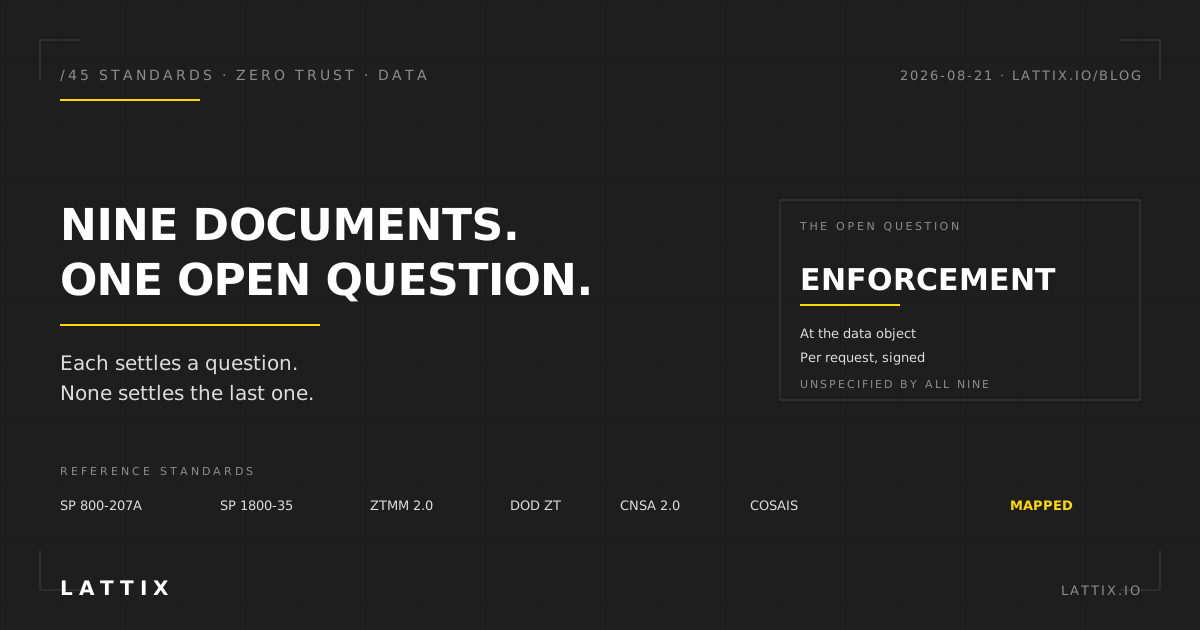
Architecture comes from NIST SP 800-207 and SP 800-207A. Implementation guidance comes from NIST SP 1800-35. Measurement comes from the CISA Zero Trust Maturity Model. Federal sequencing comes from the DoD Zero Trust Overlays and the NSA Zero Trust Implementation Guideline phases. The cryptographic floor comes from CNSA 2.0, the FIPS 203 through 205 post-quantum standards, and FIPS 140-3 validation. AI systems are governed by the NIST AI Risk Management Framework and the SP 800-53 Control Overlays for Securing AI Systems.
Each document settles a different question. None of them specifies how to enforce policy at the data object, which is the reason the data pillar remains the least mature pillar in most assessments.
Architecture: NIST SP 800-207 and SP 800-207A
SP 800-207 defines the reference model. Its contribution is the separation of the policy engine, the policy administrator, and the policy enforcement point, and the principle that access is granted per session against an evaluated policy rather than conferred by network position.
SP 800-207A extends the model to cloud-native applications running across multiple locations, where the perimeter has no coherent definition and identity-based segmentation replaces it.
Read together they settle vocabulary and component roles. They deliberately stop short of specifying products, protocols, or data formats.
Implementation: NIST SP 1800-35
The NCCoE practice guide, finalized in 2025, answers the objection that SP 800-207 is architecture without engineering. It documents reference builds assembled with commercial collaborators across several zero trust approaches, carrying the integration detail that architecture documents omit.
Its value is showing what breaks in integration. Its limit is that the builds reflect the products that participated, and data-layer enforcement is thinly represented among them.
Measurement: CISA Zero Trust Maturity Model
The maturity model version 2.0 organizes zero trust into five pillars, identity, devices, networks, applications and workloads, and data, with cross-cutting capabilities for visibility and analytics, automation and orchestration, and governance. Progress is scored across four stages from traditional to optimal.
This is the document agencies and enterprises report against, which makes its pillar structure consequential. Organizations consistently report advanced or optimal maturity on identity and networks while remaining at traditional or initial on data. The model surfaces the gap. It does not close it, which is the argument made at length in why network zero trust stops at the data boundary.
Federal sequencing: DoD Overlays and the NSA phases
The DoD Zero Trust Overlays map the department's seven-pillar model onto NIST SP 800-53 controls, with activities split between target level and advanced level maturity. The overlays are the mechanism by which zero trust becomes contractually specifiable rather than aspirational, and Strategy 2.0 extended that reach to operational technology and weapon systems.
The NSA Zero Trust Implementation Guideline series began publishing in January 2026 with a Primer and a Discovery Phase on January 8, followed by Phase One and Phase Two later that month. Phase One carries 36 activities and 30 capabilities as the mandatory baseline. Phase Two adds 41 activities and 34 capabilities to be adopted as budget and schedule allow. Two advanced-maturity phases remain unpublished. Earlier analysis of how the guidelines turn target-level maturity into sequence covers the ordering logic.
Both documents assume attribute availability. Access decisions require asserted facts about subject, device, and context, and the guidance presumes something evaluates those facts at request time. Programs treating the data pillar as a later phase are deferring the input the earlier phases depend on.
Cryptographic floor: CNSA 2.0, FIPS 203 to 205, FIPS 140-3
FIPS 203, 204, and 205 standardized ML-KEM, ML-DSA, and SLH-DSA. CNSA 2.0 narrows the field for National Security Systems to the higher parameter sets, ML-KEM-1024 and ML-DSA-87, and becomes binding for new NSS acquisitions on January 1, 2027.
FIPS 140-3 is the validation regime. FIPS 140-2 validated modules move to historical status on September 21, 2026, and the CMVP queue does not clear on demand, which makes module inventory a scheduling problem rather than a paperwork problem.
NIST IR 8547 sets the migration calendar for everyone outside the national security space, deprecating classical algorithms well before the decade closes.
AI systems: AI RMF, AI 600-1, and COSAiS
The NIST AI Risk Management Framework and the AI 600-1 generative AI profile establish the risk vocabulary. They are governance instruments rather than control catalogs.
COSAiS supplies the controls. NIST published the concept paper for SP 800-53 Control Overlays for Securing AI Systems in August 2025, then released an annotated outline for the predictive AI overlay on January 8, 2026, with stakeholder feedback closing February 13, 2026. Five overlays are scoped: generative AI assistants, predictive AI use and fine-tuning, single-agent systems, multi-agent systems, and controls for AI developers.
The two agent overlays are the material development. Scoping single-agent and multi-agent separately recognizes that every agent-to-agent handoff is an authorization boundary, and that existing control families were written on the assumption that a human made the request.
Data formats: TDF, ZTDF, and IC-TDF
Object-level protection needs a wire format, and the format question is largely settled. The Trusted Data Format and its zero trust profile bind policy to the object itself so enforcement is possible wherever the object travels. The NSA has named ZTDF and IC-TDF the interoperability schemas, which moves the format from architectural preference toward procurement requirement, and what the specification actually specifies is the reference for anyone writing it into a solicitation.
This is the layer the architecture documents point at and stop. A format specifies how policy is bound to an object. It does not specify who evaluates that policy, how quickly a revocation takes effect, or what evidence the decision leaves behind.
The question none of these standards answers
Every document above assumes an enforcement point exists that can evaluate policy against current attributes and produce a decision. None of them supplies one.
That is the gap Lattix occupies. The policy decision point evaluates attribute-based access control across subject, device, environment and geography, purpose of use, network posture, risk, and the attributes of the data object. It returns a signed short-lived decision carrying the allow or deny, the reasons, and the hash of the policy version that produced it. The policy enforcement point enforces at decrypt time, so the control holds across cloud, regional hub, tactical edge, and air-gapped deployments without a change in posture. Defaults are fail-closed, and revocation propagates to deny.
Content identifiers and lineage records make the decision history queryable after the fact, which is what turns a compliance narrative into evidence.
How to use this map
Pick the document that matches the decision in front of you. Architecture review reaches for SP 800-207A. A maturity report reaches for the CISA model. A federal solicitation response reaches for the DoD overlays and the NSA phases. A cryptographic inventory reaches for CNSA 2.0 and FIPS 140-3. An AI program reaches for COSAiS.
Then check whether the data pillar in each of those exercises resolves to a control or to an intention. In most organizations it resolves to an intention, and that is the finding worth acting on before the next assessment cycle.