NIST AI 600-1 GenAI Profile Maps Cleanly to Data-Centric Controls
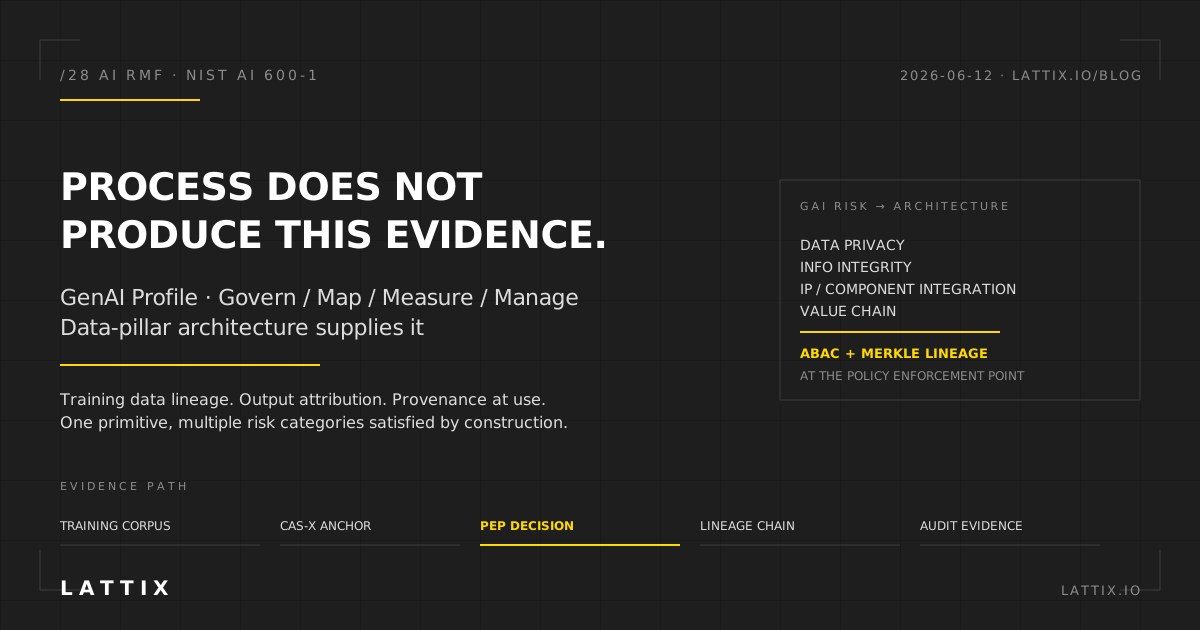
The NIST AI Risk Management Framework Generative AI Profile, published as AI 600-1, names the categories of risk that foundation models introduce beyond the general AI RMF. The list reads as a contemporary catalog of incidents the field has watched play out across the last eighteen months. Confabulation. Data privacy. Information integrity. Information security. Intellectual property. Harmful bias and homogenization. Dangerous, violent, or hateful content. Obscene, degrading, or abusive content. Environmental impacts. Human-AI configuration. Value chain and component integration.
The profile's prescriptions, organized under the Govern, Map, Measure, and Manage functions, name the controls that mitigate each category. Read the prescriptions through an architecture lens, not a process lens, and a pattern emerges. The mitigations that the profile names as evidence-producing controls converge on a small set of architectural primitives. Training data lineage. Output attribution. Access governance over model artifacts and training corpora. Provenance verification at the moment of use. Each of these is a data-pillar evidence category that process attestation cannot produce on demand.
Where the profile asks for evidence that processes do not supply
The Govern function asks for organizational accountability over GAI risks. The Map function asks the team deploying a GAI system to characterize the system, its dependencies, its data sources, and the populations affected. The Measure function asks for measurement of GAI risks against an articulated trustworthy characteristic baseline. The Manage function asks for prioritization, response, and continuous monitoring.
The categories where process attestation does not satisfy the profile's evidence expectations are the data and provenance categories. Training data privacy evidence requires a per-record lineage of where each training datum came from, what consent context it carried, and where derivatives of it live in the deployed system. Information integrity evidence requires a tamper-evident chain of custody over the training corpus and the model artifacts produced from it. Intellectual property evidence requires the same lineage chain to demonstrate that training data licensing was honored and that the model output does not memorize protected material in a recoverable form. Value chain and component integration evidence requires provenance verification at the moment a third-party model, dataset, or fine-tuning artifact enters the deployed system.
Each evidence requirement reduces to a question that a process artifact (a policy document, a checklist completion, a training certificate) cannot answer cryptographically. Which records were touched, by whom, under what attribute claim, in what window. The cryptographic answer is data-pillar architecture. The process answer is a written assertion that an examiner cannot independently verify against the artifact itself.
How the architectural primitives map
The architectural primitives that produce profile-aligned evidence are the same primitives the data-centric zero trust pattern produces for non-AI workloads. Attribute-based access control at the policy enforcement point. Cryptographic binding of policy to the data object. Merkle-tree lineage in tamper-evident audit storage. Content-addressed storage that anchors the lineage chain in cryptographic identifiers rather than database keys.
For training data privacy (Measure, Manage), the policy enforcement point evaluates every read against an attribute set that names the consent context, the derivative chain, and the operation scope. The lineage chain records the read. Subsequent regulatory inquiry against the training corpus reaches the chain. The evidence is produced by construction at the moment of training, not reconstructed after the fact.
For information integrity (Govern, Map, Measure), the training corpus and the model artifacts are content-addressed. A tampered corpus or artifact produces a content address that does not match the lineage chain. The integrity check runs at every read and at every deployment promotion. The integrity evidence is produced at the moment of use, not at a periodic audit.
For intellectual property and value chain integration (Manage), the third-party artifact's provenance is verified at the moment the artifact enters the deployed system. The architecture treats the third-party artifact as a policy-bound data object whose attribute set includes the upstream licensing context. The provenance verification at the moment of use is the architectural answer to the value chain risk category.
The procurement implication
The profile maps to procurement language across federal civilian agencies (Executive Order 14110 successor mandates, OMB M-24-10 implementation review), defense AI acquisition (DoD CDAO Responsible AI guidelines, Joint AI Capability Council artifact requirements), and regulated commercial sectors (HHS OIG audits over AI-assisted clinical decision support, FDA AI/ML SaMD guidance). Each line of authority converges on the same evidence categories the profile names. Process attestation does not satisfy any of them at the level of rigor the relevant enforcement function applies.
The vendors that arrive at the profile's evidence expectations with architecture-derived primitives respond cleanly to the procurement language that is now appearing in FY27 RFIs and RFPs. Lineage chain at the training data layer. Attribute-bound access over model artifacts. Provenance verification at the value chain integration boundary. Each is a configurable capability on a data-pillar foundation, not a custom integration exercise per risk category.
Where the profile and the consensus standards converge
The profile is not isolated. NIST SP 800-207 (Zero Trust Architecture) names the policy enforcement point and the policy decision point as the architectural primitives. CISA Zero Trust Maturity Model 2.0 scores data and credentials as pillars at the Optimal stage. The NSA Zero Trust Implementation Guideline Data Pillar v2 of April 2026 extends the data pillar to model artifacts and training corpora. The Anthropic Zero Trust for AI Agents framework places the same primitives into the agent threat model and names the Optimized tier as the data layer. The four sources are consistent. The GenAI Profile gives security and risk leaders the AI-specific instantiation of the architecture that the consensus standards converge on.
Lattix Technologies binds policy to data objects, including training corpora, model artifacts, and inference inputs, through attribute-based access control at the policy enforcement point, post-quantum key encapsulation under ML-KEM-768 and ML-KEM-1024, and Merkle-tree lineage in tamper-evident audit storage. The architecture implements the data-pillar evidence categories the GenAI Profile names. The implementation is procurable today against AI workloads in healthcare, finance, defense, and federal civilian environments.
The profile names the right risk categories. The risk categories name the right evidence requirements. The evidence requirements name the right architecture. Vendors that ship against the architecture respond to the profile. Vendors that ship against the language of the profile without the architecture beneath it produce evidence the relevant enforcement function does not accept.
References
- NIST AI 600-1, AI RMF Generative AI Profile
- NIST AI Risk Management Framework 1.0
- NIST SP 800-207, Zero Trust Architecture
- CISA Zero Trust Maturity Model 2.0
- NSA Zero Trust Implementation Guideline Data Pillar v2 (April 2026)
- OMB M-24-10, Advancing Governance, Innovation, and Risk Management for Agency Use of AI
- Lattix, Protecting Sensitive AI Training Data with Data-Centric Security
- Lattix, Anthropic's Zero Trust for AI Agents Framework Reaches the Data Layer at the Optimized Tier