The Canvas Breach Is a Data Enforcement Story, Not a Containment Story
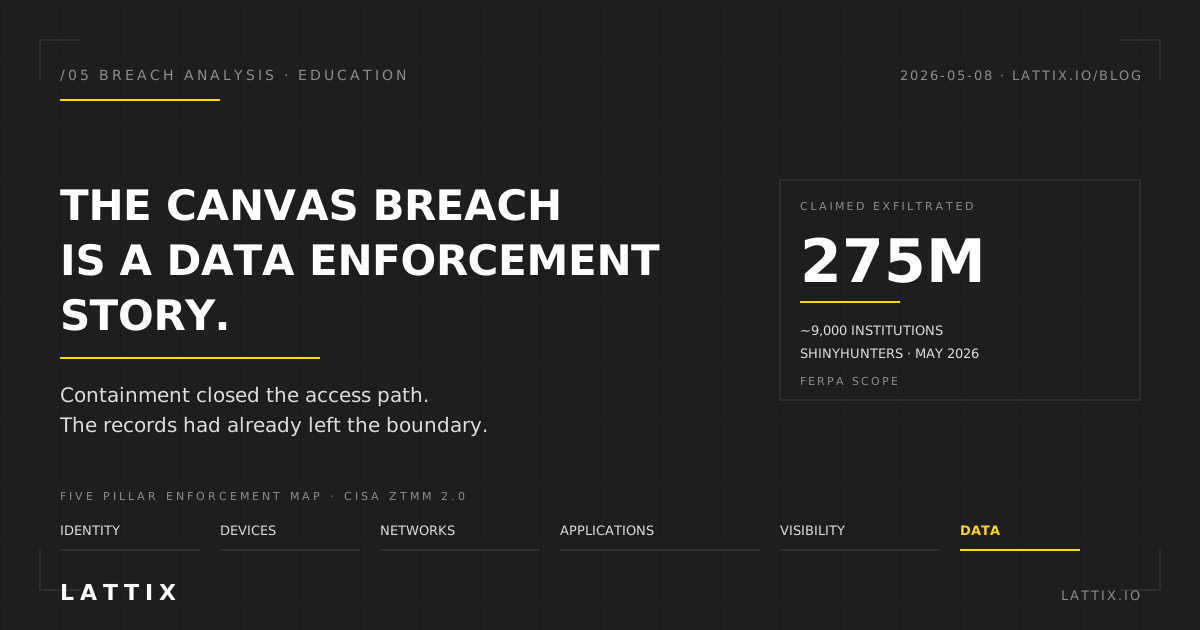
On April 30, 2026, Canvas users began reporting platform disruptions. On May 1, Instructure disclosed a cybersecurity incident perpetrated by a criminal threat actor. On May 3, ShinyHunters publicly claimed 275 million records exfiltrated from Instructure, covering nearly 9,000 institutions across the United States, the United Kingdom, Australia, New Zealand, Sweden, and the Netherlands. On May 7, the group recompromised Instructure systems to demonstrate that the May 2 containment claim did not hold. The "pay or leak" deadline now sits at May 12.
Patch and contain is the standard incident response model. It closes the access path. It does not retroactively reach the data that left the policy boundary before the path closed. The SharePoint CVE-2026-32201 disclosure surface and the Mercor breach analysis document the same pattern in different sectors. The Canvas event documents what happens when an access-path-only enforcement model meets a class of data that schools are legally obligated to protect.
What "contained" actually meant
Instructure's incident communications stated the situation was contained on May 2. Containment, in conventional incident response, means the active access path is closed: revoked credentials, isolated systems, restricted network paths, expired tokens. ShinyHunters' May 7 follow-up demonstrated the cost of the containment frame. Whatever data left the boundary before May 2 remained in the actor's control, available for the public-release threat ShinyHunters delivered on May 7 and for downstream extortion against the institutions whose records were exfiltrated.
Instructure's chief information security officer characterized the exposed data as names, email addresses, student ID numbers, and user-to-user messages. Instructure noted no indication that passwords, dates of birth, government identifiers, or financial data were taken. The narrower claim still describes records that fall inside the FERPA disclosure framework. Names matched with student ID numbers and institutional email addresses are personally identifiable education records, and user messages are educational communications that institutions routinely treat as protected.
The data pillar gap, in commercial form
Federal zero trust documents have a name for the layer the Canvas event exposed. CISA's Zero Trust Maturity Model 2.0 lists Data as one of the five pillars. The April 2026 CISA, NSA, FBI, DoD, and DoE joint guide on operational technology zero trust names the Data pillar in its framework and leaves it to the operator. NIST SP 800-207 places enforcement at the policy enforcement point and treats data protection as a property of the resources being accessed, not a property of the access channel.
Education-sector vendors run an access-channel enforcement model by default. Authentication runs at the edge, authorization runs at the application, encryption runs on the transport. The data object inside the platform carries no enforcement of its own.
Once an attacker reaches the application boundary with a valid principal, the records are readable. Exfiltration becomes a function of network throughput. Containment closes the inbound vector. It cannot revoke a copy that already exists outside the perimeter.
FERPA accountability follows the school, not the vendor
Instructure operates under the FERPA "school official" exception, which permits a vendor to process FERPA-protected data on the institution's behalf. The exception is conditional on the vendor maintaining adequate security and providing accurate, timely information to the school during an incident. The notification obligation under FERPA, including the obligation to assess the breach and respond to affected students and parents, sits with the institution.
That allocation matters operationally. A district or university responding to the Canvas event is now reconstructing what was readable at the moment of exfiltration, mapped to which students, across years of historical course rosters and message threads. The vendor's containment claim does not answer that question.
Logs from the application layer document who authenticated. They do not document which records were materialized into the actor's exfiltration pipeline. The institution is left to assume worst-case exposure across its full Canvas footprint until evidence proves otherwise.
A data-plane enforcement model produces evidence at a different layer. Each record carries policy and a cryptographic identity. Each access decision is a policy event linked to the record's identity. The audit record tells the institution which student records a principal materialized, when, and against which policy attributes. That moves the FERPA notification scope from the full footprint to the records the lineage actually shows were retrieved.
Where data-centric enforcement changes the math
Lattix Technologies binds policy and cryptographic enforcement to the data object itself. Attribute-based access control (ABAC) at the policy enforcement point evaluates the requesting principal's attributes, the record's classification, and the operational context against the policy decision point. Post-quantum key encapsulation through ML-KEM-768 wraps the record's data key.
Content-addressed storage assigns the record a tamper-evident identity. The lineage record anchors every access decision in a Merkle-tree audit ledger. Enforcement is fail-closed at the object, not at the application.
Three operational properties change in a Canvas-class incident under that model. First, exfiltrated bytes without the policy attributes the policy decision point requires do not unwrap. The actor holds ciphertext, not records.
Second, lineage answers the institution's notification question deterministically: the record-level audit shows which records the compromised principals actually retrieved, not which records were theoretically reachable. Third, key revocation at the policy authority severs access to records that have not yet been retrieved, even if the access path returns. Recompromise of the application does not redo a successful exfiltration of unwrapped content because there is no unwrapped content to retrieve.
What this changes for education-sector procurement
The Canvas event will surface in education vendor reviews through Q3 2026. Procurement language for learning management systems, student information systems, and education data warehouses already references FERPA and increasingly references the NIST CSF 2.0 functions. The post-Canvas review will add specific questions that an access-channel enforcement model cannot answer well: what evidence does the vendor produce about which records were retrieved during an incident, what survives a recompromise of the vendor's application boundary, what enforcement remains if a copy of the database is exfiltrated wholesale.
Vendors built on access-channel enforcement will have to write longer answers. Vendors with data-plane enforcement answer the questions in the architecture itself. The next education-sector procurement cycle is the one where the data pillar moves from differentiator to baseline.
The disclosure surface is the architectural question
The Canvas breach is the largest education-sector data event of 2026 to date. The patch was correct. The containment was correct as far as the access path goes. Neither of those answers what 275 million records do once they are outside the institution's policy boundary, and neither prevents the next vendor from facing the same question.
Closing that gap requires enforcement that travels with the record. Lattix Technologies binds policy to the data object through ABAC at the policy enforcement point, ML-KEM-768 key encapsulation, and Merkle-tree lineage in tamper-evident audit storage. The access path is one layer of zero trust. The data pillar is the layer that decides whether a contained breach is also a contained loss.
References
- Instructure, Cybersecurity Incident Communications (May 1, 2026): https://www.instructure.com/
- The Harvard Crimson, Harvard Canvas Site Goes Down After University Listed in Instructure Breach (May 8, 2026): https://www.thecrimson.com/article/2026/5/8/canvas-breach-down/
- The Daily Pennsylvanian, Cybercrime group crashes Penn's Canvas system, demands ransom to prevent data release (May 7, 2026): https://www.thedp.com/article/2026/05/penn-canvas-shinythunters-data-breach-hack-second
- DataBreaches.Net, Developing: ShinyHunters Hacks Instructure Again; Canvas Down (May 7, 2026): https://databreaches.net/2026/05/07/developing-shinyhunters-hacks-instructure-again-canvas-down/
- CBS News, Cyberattack shutters Canvas learning platform for schools across the U.S.: https://www.cbsnews.com/news/cyberattack-shutters-canvas-learning-platform-for-schools-across-us/
- Times Higher Education, Personalised phishing attacks likely after global Canvas hack: https://www.timeshighereducation.com/news/personalised-phishing-attacks-likely-after-global-canvas-hack
- U.S. Department of Education, Family Educational Rights and Privacy Act (FERPA): https://studentprivacy.ed.gov/ferpa
- CISA, Zero Trust Maturity Model v2.0 (April 2023): https://www.cisa.gov/sites/default/files/2023-04/zero_trust_maturity_model_v2_508.pdf
- NIST SP 800-207, Zero Trust Architecture: https://csrc.nist.gov/pubs/sp/800/207/final
- NIST FIPS 203, Module-Lattice-Based Key-Encapsulation Mechanism Standard (ML-KEM): https://csrc.nist.gov/pubs/fips/203/final