SharePoint CVE-2026-32201 Is in KEV. The Disclosure Surface Is the Real Issue.
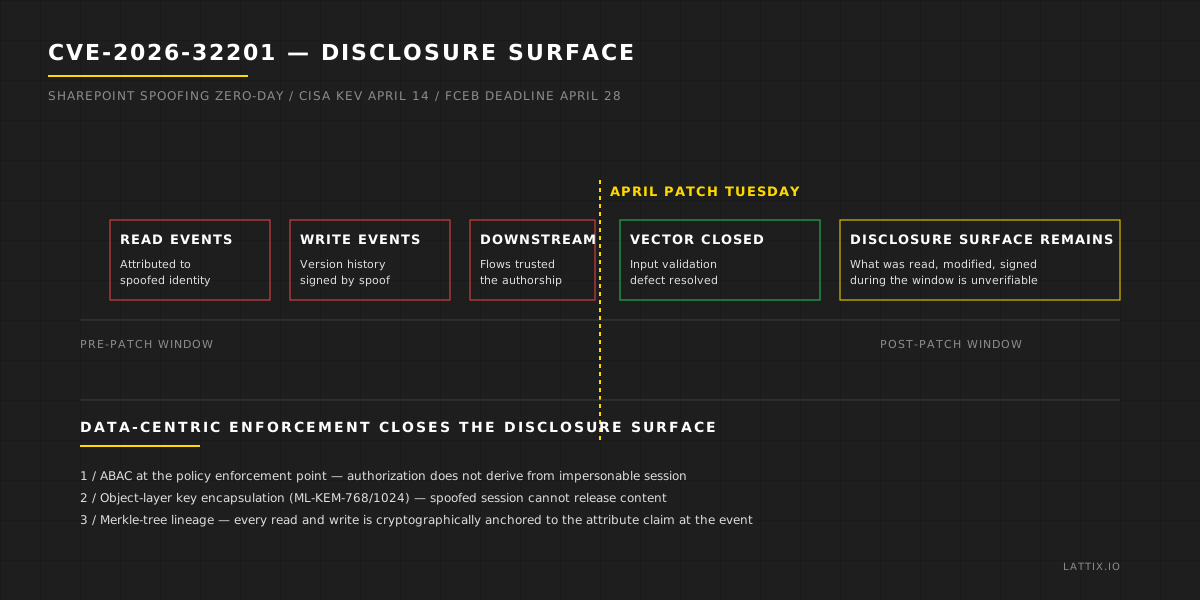
CVE-2026-32201 is a spoofing vulnerability in Microsoft SharePoint that allows an unauthenticated attacker to impersonate another user over the network without any user interaction. Microsoft patched it on April Patch Tuesday. CISA added it to the Known Exploited Vulnerabilities catalog on April 14, 2026, with a Federal Civilian Executive Branch remediation deadline of April 28. Tenable rated the disclosure significant enough to lead their monthly analysis, and SecurityWeek confirmed active exploitation in the wild before the patch shipped.
Every major guidance stream said the same thing: patch now. That is correct advice, and it is also the end of the public conversation. The more difficult question starts on April 29, once the patch is deployed. What did an unauthenticated attacker see, change, or sign while the spoofing primitive was live, and what evidence does the enterprise have to answer that question?
What the patch actually closes, and what it does not
CVE-2026-32201 is an improper input validation issue that lets an attacker present themselves to SharePoint as a trusted principal. That is enough to read documents that should require authorization, modify documents that should have an integrity boundary, and, in many environments, post content into collaboration spaces where other users and automated workflows treat SharePoint authorship as a trust signal. SharePoint's deep integration with Active Directory, Office applications, and automated document workflows means that a spoofed identity inside SharePoint is not an isolated web app abuse. It is an authority grant against the systems that trust SharePoint's word.
The April patch addresses the input validation defect. It does not, and cannot, retroactively answer three operational questions that a security team will face next week.
First, which documents were read by a spoofed principal during the exploitation window. SharePoint's native audit logging records access events by authenticated identity. If the attacker successfully presented as a legitimate user, those events are attributed to the legitimate user, and the pre-patch audit stream does not distinguish authentic access from spoofed access. Second, which documents were modified. SharePoint versioning preserves content snapshots, but the attribution of those snapshots points to the spoofed identity. A policy-bound integrity signal on the document itself is the only way to tell, after the fact, that a change was made by a principal who could not have held the claimed attributes at the time. Third, which downstream systems acted on the spoofed content. Automated Power Automate flows, Teams notifications, and tenant-level Graph API consumers treat SharePoint authorship as a trust anchor. The patch stops the source, but it does not reach into every consumer that already processed the spoofed authorship as valid.
Why this is a data-centric security argument
The modern guidance for this class of incident lives in NIST SP 800-207 and the CISA Zero Trust Maturity Model. Both frameworks make the same point, which SharePoint-style perimeter-authority systems routinely ignore: the network and identity layers are necessary but not sufficient. Authorization decisions bind to attributes carried on the request and enforced at a policy enforcement point that sits in front of the data, not at the web application.
When authorization is enforced at the web application layer, a spoofing primitive inside the web application is game over. The application is the policy enforcement point, and a compromise of its identity parsing is a compromise of the policy itself. When authorization is enforced at the data object layer through attribute-based access control, with cryptographic keys that only release to a principal whose attributes satisfy the policy, a spoofed web session does not unlock the content. The web application sees a request, the policy decision point evaluates the attributes against the object's policy, the key encapsulation fails for any principal whose real attribute claim does not match, and the object remains encrypted.
This is what data-centric zero trust is for. Lattix enforces ABAC at the policy enforcement point, post-quantum key encapsulation using ML-KEM-768 and ML-KEM-1024, and Merkle-tree lineage over every read and write event on the object. A SharePoint spoofing vulnerability is still a vulnerability in that model. It does not, however, translate into exfiltrated content, silently modified documents, or a disclosure surface that the incident response team has no way to measure.
The disclosure surface question, in operational terms
Federal agencies working the April 28 FCEB deadline are running a patch cycle. Enterprises mirroring the KEV guidance are doing the same. The work that comes after is the work that separates organizations with auditable disclosure surfaces from organizations that will spend the next quarter writing reasonable worst-case language into regulator notifications.
The questions that matter: can the security team produce a cryptographically verified list of every document access during the exploitation window, with attribute claims bound to the access event rather than derived from an impersonable session. Can the team produce a cryptographically verified record of every modification during the window, with the policy that was evaluated and the attributes that were presented. Can the team demonstrate that downstream automated consumers only acted on content whose authorship was verifiable against an attribute set at the time of the action.
Under traditional perimeter-authority architectures, the answer to all three is no. Audit logs attribute to the spoofed identity. Version history attributes to the spoofed identity. Downstream consumers trusted the spoofed authorship. The organization is not missing logs. It is missing a verifiable identity anchor on the logs it has.
Under a data-centric zero trust architecture with cryptographic enforcement at the object layer, the answer to all three is yes, because the attribute claim is part of the authorization envelope on every release, and the lineage record is Merkle-anchored and independent of the web application.
What to do after the patch lands
The patch is the first order of business. CISA set the deadline for a reason, and the exploitation activity is real. The second order of business is the architectural question that CVE-2026-32201 surfaces for every organization running collaboration platforms as a trust anchor.
Spoofing vulnerabilities will keep appearing. The defect class is old and it is not going away. The enterprises that handle them well in the next disclosure cycle will be the ones that already moved the authoritative policy evaluation off the impersonable surface and onto the data itself.
Patching SharePoint is a control. Making a SharePoint spoof irrelevant to the content it fronts is an architecture. The first is mandatory. The second is how an organization answers the disclosure surface question without qualifiers.