The Mercor Breach Is a Data-Centric Security Story. Not an Identity One.
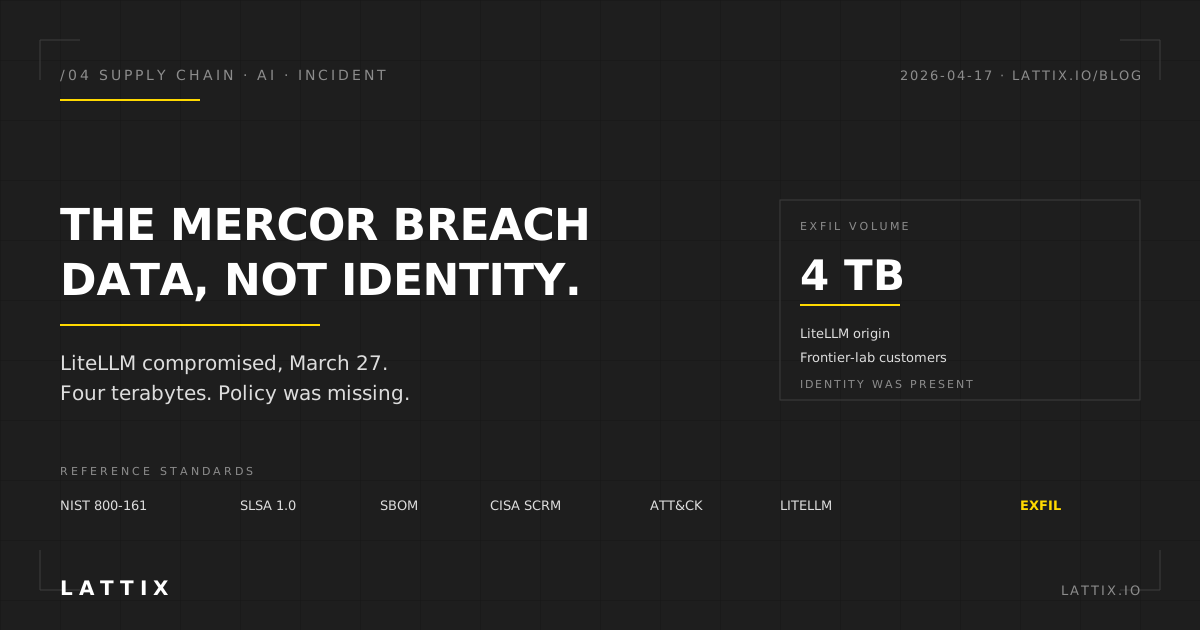
On March 27, 2026, a threat actor published two tainted versions of LiteLLM, an open-source Python library that brokers application traffic to commercial large language model APIs. The malicious packages, 1.82.7 and 1.82.8, were live on PyPI for roughly forty minutes before the maintainers pulled them. That was enough. LiteLLM is installed in an estimated 36 percent of cloud environments and draws approximately 97 million downloads a month. By March 31, Mercor, a $10 billion AI training-data vendor whose customers include Anthropic, OpenAI, and Meta, had confirmed a security incident. Lapsus$ then claimed four terabytes of exfiltrated data including source code, contractor identity records, interview video, and at least portions of customer training corpora.
Every downstream analysis of this event has reached for the usual levers. Identity hygiene. SBOM discipline. Build-system isolation. Credential rotation. These are correct answers to different questions. None of them are the answer to this one.
The failure surface was not identity
Mercor's public posture before the breach was consistent with what a large, well-funded AI vendor is supposed to look like. Mercor had MFA. It had SBOM tooling. It had a managed identity perimeter. Its LiteLLM dependency was pinned, maintained, and inside the declared bill of materials. The package that entered the environment carried a valid signature from the real publisher account, because the real publisher account is what the attacker compromised.
Once that package executed inside a Mercor build or runtime host, the attacker was not a stranger. The process that reached for customer data was an authenticated workload holding cloud credentials Mercor had issued to itself. Every control predicated on "who is calling" returned the answer Mercor wanted. The controls were not bypassed. They were satisfied.
This is the pattern that should be understood as the dominant supply chain failure mode for AI infrastructure. The attacker is not impersonating a user. The attacker is sitting inside a workload that your identity plane trusts by design.
Training data is the highest-value target in the supply chain
A stolen customer list is bad. A stolen authentication token is worse. A stolen corpus of frontier-lab training and evaluation data is a category change. Training data is simultaneously the most expensive asset an AI vendor produces, the most difficult to re-derive once lost, and the most consequential if tampered with before it is fed back to a consuming lab. Poisoning a training set at the scale of a recruiting and annotation vendor is the cheapest way to move a model's behavior in a direction of the attacker's choosing.
The Mercor customer graph is what makes this breach systemic. The data was not only Mercor's. It was the raw material for the next generation of commercial models. The identity-centric defensive model cannot reason about this. It has no concept of the data object having downstream obligations that outlast the workload that touched it.
What a data-centric architecture changes
A data-centric zero trust architecture inverts the question. Instead of trusting the runtime and validating the caller, it distrusts the runtime and validates each access event against the policy cryptographically bound to the data object at the moment it was created.
In a Lattix deployment, three properties of the Mercor event would have behaved differently.
First, the training corpora would have been wrapped as zero trust data format objects at the time they were collected. Each object would carry a post-quantum key encapsulation header, an attribute-based access control policy, and a content-addressed identifier. The malicious LiteLLM process would have inherited the host's identity, reached for the object, and received a policy decision point response conditioned on the declared purpose of the call. A data-exfiltration purpose declared by a telemetry-forwarding workload would have been denied. A data-exfiltration purpose not declared at all would have been denied by default, because ABAC enforcement fails closed.
Second, the access events that did occur, including the exfiltration itself, would have been recorded as immutable entries in a Merkle-tree lineage. The post-incident investigation would not have needed to reconstruct what the attacker might have reached. It would have produced a cryptographic enumeration of exactly which objects were opened, by which workload identity, under which policy justification, and in which order. The four-day clock on materiality determination, the customer notification process, and the downstream lab's decision to quarantine or re-baseline their training set would all proceed from verified facts rather than forensic inference.
Third, the exfiltrated copy of the data, even if taken, would remain sealed. Extraction of an encrypted ZTDF object out of the Mercor environment produces a payload that is useless to Lapsus$ or any secondary buyer without ongoing key release authorized by Mercor's policy decision point. Revocation is a policy update, not a recall notice. The object stays encrypted. The downstream leak site publishes nothing that anyone can read.
None of these three properties depend on the runtime being uncompromised. Each of them assumes the runtime is already compromised and holds against that assumption.
The architectural pattern, concretely
For practitioners thinking about how to apply this to their own AI data pipelines, the pattern decomposes into four elements that have to co-exist.
The first element is object-level cryptographic binding. Every training record, annotation output, evaluation dataset, and contractor identity document is encrypted at the point of creation with a key derived from a post-quantum key encapsulation mechanism. ML-KEM-768 is the baseline under current NIST guidance. The encryption happens inside the workflow that produced the data, not at a storage-layer gateway, so the object is protected across every subsequent hop.
The second element is attribute-based access control bound to the object, not the container. The policy that decides whether a given workload can open an object travels with the object as metadata. The policy decision point evaluates attributes of the caller, the object, the environment, and the declared purpose. When the caller is a compromised LiteLLM workload reaching for training data under a telemetry-forwarding identity, the attribute set does not match and the decision is deny.
The third element is tamper-evident audit storage with Merkle-tree lineage. Every access event is hashed into a tamper-evident log. The log is not an operational convenience; it is the evidentiary backbone of the breach response. It is also the basis for integrity verification of the training set itself, because any downstream lab can recompute the root hash of its received corpus and prove that what it got is what Mercor produced.
The fourth element is fail-closed default. When the policy decision point cannot evaluate, the object stays encrypted. When the attribute source is unreachable, access is denied. When the key release path is ambiguous, the key is not released. In a world where compromised runtimes will hold valid credentials, fail-closed is the only defensible posture.
What the consuming labs should demand
The parties with the most leverage to move the AI data supply chain toward data-centric defaults are the frontier labs themselves. Anthropic, OpenAI, Meta, and the next tier of model developers are the customers whose procurement terms set the ceiling for what vendors must do.
The practical ask is short. Labs should require that incoming training and evaluation data arrives as ZTDF-wrapped objects with Merkle-tree lineage attestation. Labs should require that the attribute-based policy on those objects restricts downstream replication to identified, attested consumer workloads. Labs should require that revocation is a first-class operation that does not depend on the vendor's goodwill or operational state. And labs should require that post-quantum key encapsulation is the default, because the harvest-now-decrypt-later problem applies to training data exactly as much as it applies to classified traffic.
None of these are exotic requirements. All of them are in scope for the NIST SP 800-207 zero trust architecture when it is extended into the data pillar per the NSA's April 2024 CSI on data-pillar maturity. What has been missing is the commercial pressure to make them standard terms.
Closing
The Mercor breach will be read as an identity incident for a while. The identity framing is wrong. The identity controls worked as specified. The failure surface is that the data objects in Mercor's environment had no policy of their own. A compromised runtime with valid credentials walked through controls whose design premise was that runtimes holding valid credentials are the ones that should be allowed.
The architecture that survives this kind of event is not a better identity perimeter. It is data that enforces its own policy, records its own lineage, and stays sealed when the runtime around it is no longer trustworthy. Lattix builds that architecture. The question facing every AI data vendor in the next quarter is whether they will reach for it before their own version of March 27 arrives.