CISA's April 2026 OT Zero Trust Guidance Leaves the Data Plane Unaddressed
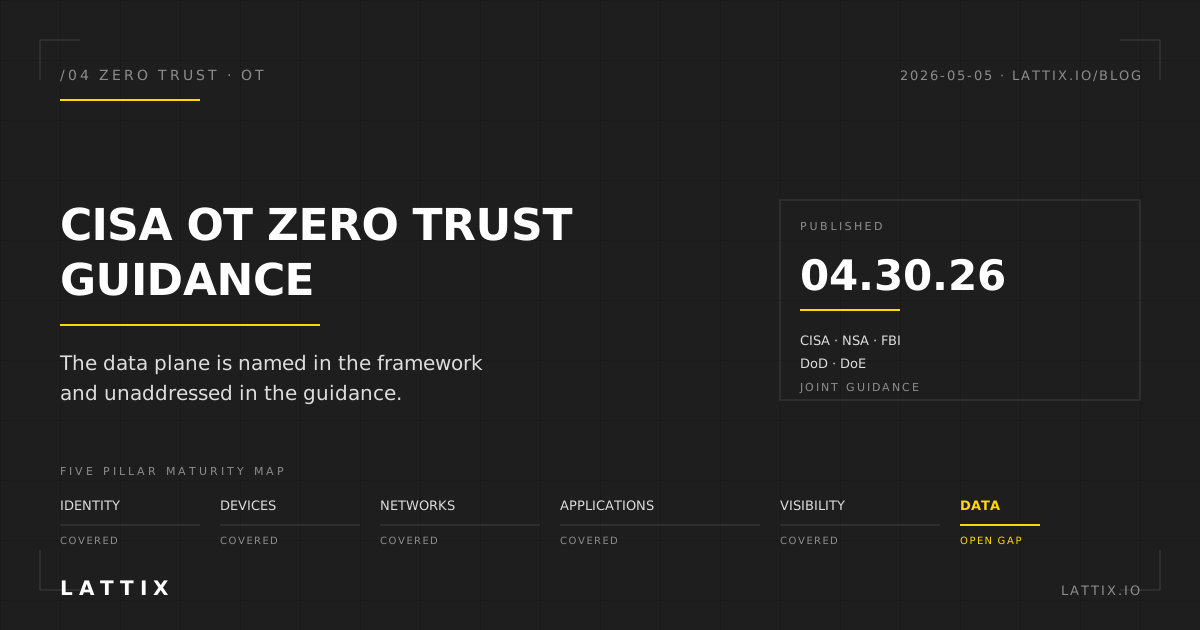
On April 30, 2026, CISA published the joint guide Adapting Zero Trust Principles to Operational Technology, co-authored with the National Security Agency, the Federal Bureau of Investigation, the Department of Defense, and the Department of Energy. The publication consolidates fragmented OT security guidance into a single federal roadmap and aligns OT controls with the NIST Cybersecurity Framework 2.0 functions.
The guide defines maturity targets across identity, devices, networks, applications, and visibility. The data pillar is named in the framework. The data pillar is unaddressed in the operational guidance.
What the joint guidance actually covers
NIST SP 800-207 and the CISA Zero Trust Maturity Model 2.0 both define data as one of five zero trust pillars. In conventional IT environments, the data pillar maps to data classification, attribute-bound access policy, and dynamic encryption. In OT environments, the same pillar covers SCADA values, historian records, configuration files, firmware images, and operational telemetry that often outlive the network or the operator that produced it.
The April joint guide describes how to segment OT networks against IT/OT convergence risk. It describes how to harden OT identity against legacy account sprawl. It describes how to instrument OT visibility for asset inventory and behavioral anomaly detection. It does not describe how to bind cryptographic policy to the OT data object itself.
That gap is the practical question every OT security team faces after reading the guide. Network and identity zero trust enforce only at the moment of access through that layer. The historian record, the firmware image, and the configuration file carry no enforcement once they leave the protected segment.
Why the data plane is harder in OT than in IT
OT data has three operational properties that distinguish it from IT data. First, the lifetime of an OT data object often exceeds the lifetime of the network or perimeter that created it; firmware images and historian records are interrogated decades after production. Second, OT data routinely crosses trust boundaries the operator does not control: vendor maintenance access, regulator submissions, joint-operations data exchange with adjacent agencies. Third, OT environments include legacy endpoints that cannot host modern security agents.
Network-layer or identity-layer policy fails on all three properties. A long-lived data object has no enforcement once it leaves the segment. A trust-boundary crossing transfers the object to a controller that does not see the originating policy. A legacy endpoint cannot participate in a zero trust posture that requires agent-based attestation.
The data pillar exists in the framework because the other four pillars cannot reach the object after first access. Closing the OT data pillar requires enforcement that travels with the data, not enforcement that gates the path the data took.
Where Lattix fits in the OT zero trust stack
Lattix Technologies binds policy directly to the OT data object through cryptographic enforcement. Attribute-based access control (ABAC) at the policy enforcement point (PEP) evaluates the requesting principal's attributes, the object's classification, and the operational context against a policy decision point (PDP). Post-quantum key encapsulation through ML-KEM-768 protects the wrapped data key against current and harvest-now-decrypt-later cryptanalysis. A tamper-evident audit ledger anchors the object's identity in a Merkle-tree lineage record that survives migration, replication, and trust-boundary crossings.
For the joint guidance's identity, network, and visibility maturity targets, Lattix consumes existing OT identity providers and runs at the PEP next to the OT consumer. For the data pillar, Lattix is the enforcement, not a layer in front of it. A spoofed identity, a compromised network segment, or a vendor maintenance laptop reaching a historian record cannot decrypt the object without the policy attributes the PDP requires. The enforcement is fail-closed.
A data-plane enforcement layer changes the OT security team's evidence model. Audit becomes a property of the data object, not of the access stream. Lineage is cryptographic, not log-derived. Algorithm rotation happens at the wrapper layer, not at every endpoint.
The CMMC 2.0 audit-trail requirements and the CISA Zero Trust Maturity Model 2.0 data pillar metrics evaluate against the platform, not against a separate logging pipeline that legacy OT cannot produce. Operators replace ad-hoc audit reconstruction with a deterministic query against the lineage record.
What changes through the rest of 2026
The joint guidance will drive procurement language across DoD, DOE, and CISA-aligned civilian agencies through Q4 2026 and FY27. Acquisition packages will reference the published maturity targets. Vendors will face evaluation against the named pillars, not against generic OT zero trust claims. The data pillar moves from optional to scored as agencies align their internal acquisition with the framework.
The next federal addition to the OT zero trust conversation is the NIST update to SP 800-207A, which extends zero trust to multi-cloud and federated environments common in OT/IT convergence. The data-plane enforcement gap that the April guidance leaves open is the same gap SP 800-207A will surface for federated architectures. Buying network and identity zero trust without data-plane enforcement now produces a procurement liability in the next acquisition cycle.
The data pillar requires data-plane enforcement
Network and identity zero trust without data-plane enforcement leaves the highest-value OT artifacts protected only by the perimeter the rest of the document admits is breached. The April 2026 joint guidance is a strong identity, network, and visibility roadmap. Closing the data pillar requires cryptographic enforcement bound to the OT data object itself.
Lattix Technologies implements that enforcement against the named standards today, in environments that range from civilian SCADA to air-gapped tactical OT. The data plane is not a future maturity target. It is the open pillar in a framework already in federal procurement language.
References
- CISA, NSA, FBI, DoD, DoE Joint Guide, Adapting Zero Trust Principles to Operational Technology (April 30, 2026): https://www.cisa.gov/sites/default/files/2026-04/joint-guide-adapting-zero-trust-principles-to-operational-technology_508c.pdf
- CISA, Zero Trust topic page: https://www.cisa.gov/topics/cybersecurity-best-practices/zero-trust
- CISA, Zero Trust Maturity Model v2.0 (April 2023): https://www.cisa.gov/sites/default/files/2023-04/zero_trust_maturity_model_v2_508.pdf
- NIST SP 800-207, Zero Trust Architecture: https://csrc.nist.gov/pubs/sp/800/207/final
- NIST SP 800-207A, A Zero Trust Architecture Model for Access Control in Cloud-Native Applications: https://csrc.nist.gov/pubs/sp/800/207/a/final
- NIST Cybersecurity Framework 2.0: https://www.nist.gov/cyberframework
- NIST FIPS 203, Module-Lattice-Based Key-Encapsulation Mechanism Standard (ML-KEM): https://csrc.nist.gov/pubs/fips/203/final
- DoD Office of the CIO, CMMC 2.0: https://dodcio.defense.gov/CMMC/