Check Point VPN CVE-2026-50751 Is in KEV. The Concentrator Is Not the Trust Boundary.
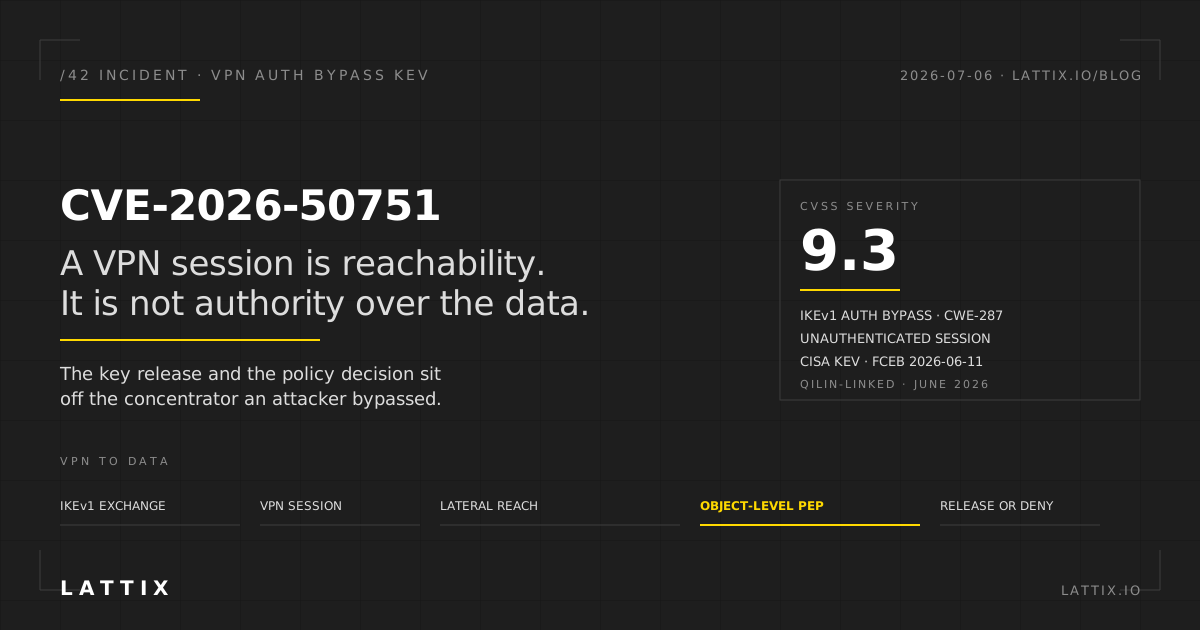
Check Point confirmed in June 2026 that CVE-2026-50751, an authentication bypass in its Remote Access VPN, was under active exploitation. The flaw carries a CVSS score of 9.3 and is classified under CWE-287, improper authentication. It lives in how the Remote Access and Mobile Access components validate certificates during an IKEv1 key exchange. On gateways that still accept the deprecated IKEv1 protocol and do not require a machine certificate, an unauthenticated attacker completes the exchange and establishes a VPN session without valid credentials. The Cybersecurity and Infrastructure Security Agency added the vulnerability to the Known Exploited Vulnerabilities catalog on June 8, 2026 and set a Federal Civilian Executive Branch remediation deadline of June 11, 2026.
Check Point released hotfixes and characterized the campaign as limited in scope, affecting several dozen organizations, with observed activity dating to early May 2026 and at least one incident tied to a Qilin ransomware affiliate. The patch closes the bypass. It does not change what a VPN session grants once an attacker holds one.
A VPN session is reachability, not authority
The remote access VPN answers one question: can this endpoint reach the internal network. An authentication bypass answers that question in the attacker's favor without a credential. What the attacker receives is a routable position inside the network perimeter, the same position a legitimate remote employee receives after logging in. From there, reaching data depends entirely on the controls that sit between the network and the data, and in most architectures those controls assume that anything already inside the VPN is trusted.
That assumption is the failure. Network zero trust reduces the reachable surface, but a valid VPN session is precisely the case network segmentation is built to admit. When the concentrator itself hands out sessions without authentication, the perimeter it anchors stops being a boundary at all. This is the same structural point that network zero trust reaches and then stops at the data boundary.
Moving the decision onto the object
Data-centric zero trust does not route the access decision through the VPN. Lattix Technologies binds policy to the data object through attribute-based access control (ABAC) at the policy enforcement point (PEP), wraps the object under post-quantum key encapsulation with ML-KEM-768 and ML-KEM-1024, and records every release decision as Merkle-tree lineage in content-addressed storage (CAS-X). A request to open a protected object reaches a PEP that evaluates an attribute claim signed by a policy decision point (PDP) running independently of the VPN gateway.
An attacker holding a bypassed VPN session has network reachability to the object and nothing else. The session carries no attribute claim the PDP will honor, so the key release the object requires never happens. The request that cannot satisfy policy fails closed. The concentrator compromise stays in the transport layer, where it began.
The ransomware path is a data path
The Qilin link is the part that turns this from a network incident into a data problem. Ransomware affiliates use a foothold like a bypassed VPN to move laterally, locate high-value data, and either encrypt it in place or exfiltrate it for extortion. Both actions require the attacker to reach data in a usable state.
Object-level cryptographic enforcement removes that state. Data that stays wrapped under a policy the attacker cannot satisfy is not readable for exfiltration, and re-encrypting an already-encrypted object under a foreign key does not deprive the owner of the plaintext the PDP still governs. This is why ransomware does not work the same way on policy-bound data: the leverage ransomware depends on is access to usable data, and the data layer never grants it on the strength of a network session alone.
How the architecture maps to standards
NIST SP 800-207 places the policy decision point outside the systems it governs, which is the property that keeps a VPN compromise out of the data access decision. The CISA Zero Trust Maturity Model 2.0 scores the network pillar and the data pillar separately, and a bypassed concentrator is a network-pillar failure that a strong data pillar contains rather than inherits. For controlled unclassified information under CMMC 2.0 and NIST SP 800-171, the governing control is protection of the data object, not the assurance of the remote access path. CVE-2026-50751 is the operational reminder that a session at the perimeter is not authority at the data.
What teams should do before the deadline
The first action is the hotfix. The June 11 deadline binds federal civilian agencies, active exploitation makes the timeline urgent for everyone else, and gateways still running IKEv1 should retire the deprecated protocol and require machine certificates for remote access. Close the bypass.
The second action is the question the hotfix does not answer. Map what a valid VPN session can reach inside the network, and identify where that reachability becomes access to regulated or sensitive data. Every place a network session alone unlocks data is a place the next concentrator compromise becomes a breach rather than an intrusion. Object-level cryptographic enforcement, with the keys and the policy decision held off the gateway, is the control that keeps a bypassed VPN a transport problem.
References
- CISA Known Exploited Vulnerabilities Catalog
- Check Point, Important Hotfix for Vulnerabilities in the Deprecated IKEv1 VPN Protocol
- Rapid7, Critical Check Point VPN Zero-Day Exploited in the Wild (CVE-2026-50751)
- BleepingComputer, CISA gives feds 3 days to patch Check Point VPN bug exploited as zero-day
- SecurityWeek, Check Point VPN Zero-Day Exploited in Qilin Ransomware Attacks
- NIST SP 800-207, Zero Trust Architecture
- CISA Zero Trust Maturity Model 2.0