SonicWall SMA1000 Zero-Days Chain to Root. The Gateway Is Not the Data Boundary.
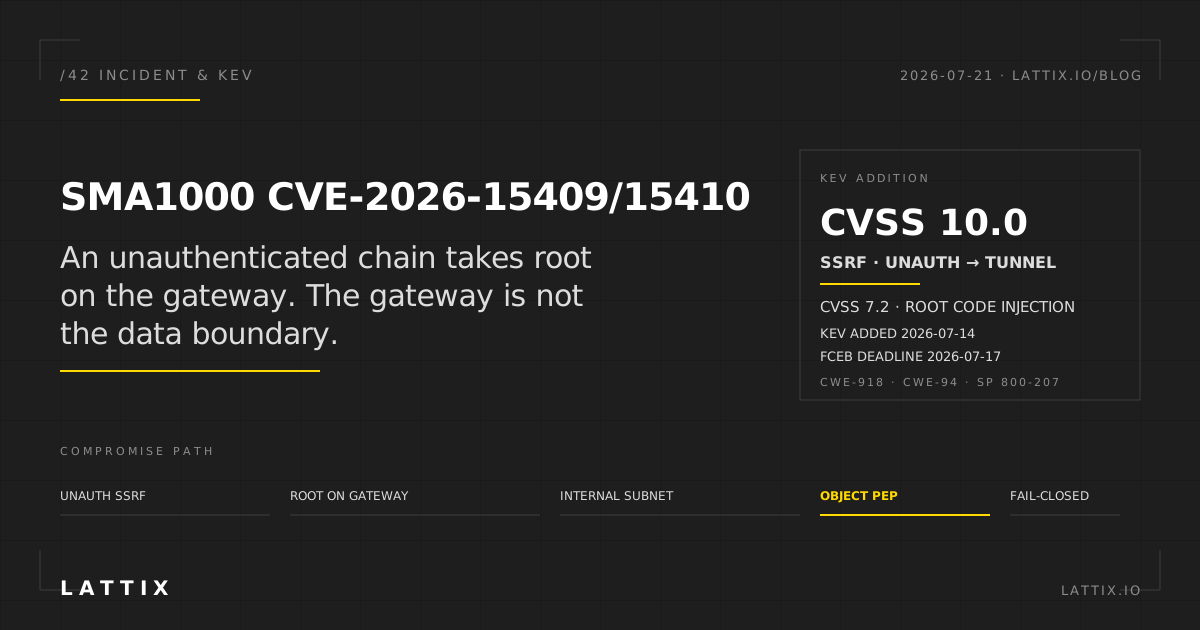
CISA added CVE-2026-15409 and CVE-2026-15410 to the Known Exploited Vulnerabilities catalog on July 14, 2026, the same day SonicWall published its advisory, with a Federal Civilian Executive Branch remediation deadline of July 17, 2026. Both flaws sit in the SonicWall SMA1000, a remote-access appliance that terminates VPN sessions and brokers internal application access for a distributed workforce. Rapid7's managed detection team observed targeted exploitation of internet-facing SMA1000 appliances before SonicWall disclosed the flaws, which makes both of them zero-days, exploited in the wild before a patch existed. Affected models include the 6210, 7210, and 8200v across virtual and physical deployments.
The two CVEs are dangerous in sequence, not isolation. CVE-2026-15409 is a server-side request forgery in the appliance Work Place interface, scored CVSS 10.0, reachable by a remote and unauthenticated attacker. CVE-2026-15410 is a code-injection flaw in the Appliance Management Console, scored CVSS 7.2, which lets an authenticated administrator run arbitrary operating-system commands. Chained, the unauthenticated SSRF opens a websocket tunnel to services listening only on localhost, and the management-console flaw executes commands as root through a path-traversal in the remove_hotfix workflow against an internal service on port 8188. The end state is unauthenticated command execution as root on the device that guards the network.
What the compromise actually grants
Patch the appliance and the exploit chain closes. The architectural question the disclosure raises is what an attacker holds the moment root lands, and whether that reach should be the same the next time a remote-access appliance ships a vulnerable release.
A remote-access gateway is a trusted position by design. It sits at the boundary between the untrusted internet and the internal network, it authenticates users, and it forwards their sessions to the applications, file shares, and data stores behind it. Every packet that clears the gateway is treated as having earned its place inside. That is the function of the appliance. It converts an external identity into an internal network path.
Root on that appliance inverts the function. The attacker no longer needs to authenticate a user, because the attacker now operates the thing that decides which sessions reach the interior. The SSRF alone is instructive: a websocket tunnel to localhost-only services means the appliance can be turned against the very components it was trusted to isolate. With root, the attacker inherits the gateway's entire network reach, its cached credentials, its session tokens, and its routes to internal subnets that were never meant to face the internet. The appliance was the control. Now it is the foothold.
This is the same pivot that made the Cisco SD-WAN isolation gap and the Arista EOS tunnel-decapsulation flaw worth writing about earlier this year. The vendor changes. The appliance class changes. The lesson does not: a device that enforces a network boundary becomes, when compromised, a device that grants network position. SonicWall SMA1000 is that pattern delivered as a pre-authentication chain to root.
The gateway carries reach, not authorization
A remote-access appliance answers one question: can this session enter the network. It does not answer the question that decides whether a specific data object should open. Those are different decisions, and perimeter architectures collapse them into one. Clear the gateway, and the interior treats the session as authorized to everything the network can route to.
That collapse is the exposure. The pattern is consistent across breach reports. An attacker reaches a boundary device, exploits it, and then moves laterally because the internal network extends implicit trust to anything already inside it. The storage tier, the database, the file share, and the object store all treat a routable, authenticated-looking connection as an authorized one. They were never built to re-decide access for each request, because the gateway was supposed to have decided it once at the edge. The mid-year 2026 breach pattern traced this shape repeatedly: the perimeter holds until it does not, and the data layer offers no independent resistance because it delegated its access decision to the network plane.
NIST named this problem before this CVE operationalized it. NIST SP 800-207 defines zero trust around continuous, per-request authorization and rejects the premise that network location confers trust. Its guidance is explicit that a request originating inside the network perimeter is not, for that reason, an authorized request. The SMA1000 chain is a precise illustration of why. An attacker at root on the gateway produces traffic that originates from the most trusted network position in the estate, and any control that reads network position as authorization inherits the compromise.
Network segmentation narrows the blast radius. It does not close it.
The standard response to a compromised gateway is segmentation. Isolate the appliance in a DMZ, restrict the subnets it can reach, and micro-segment the internal network so a foothold cannot traverse the whole estate. This is necessary work, and organizations should do it. Segmentation reduces the blast radius of a boundary compromise by limiting the routes a foothold can take.
It is also enforcement on the network plane, which is the same plane the attacker now controls. Segmentation constrains where packets can go. It does not evaluate whether the payload behind a permitted route should be released to this caller, on this device, for this purpose, right now. A root-level attacker who inherits the gateway's legitimate routes moves within the segment the gateway was allowed to reach, and inside that segment the data stores still answer routable requests. Tightening the network reduces how far a compromise spreads. It does not change what the compromise reaches once it is inside a permitted boundary. That is the gap the CISA Zero Trust Maturity Model marks when it separates network-pillar controls from data-pillar controls and distinguishes transport-level protection from object-level enforcement.
The durable answer sits one layer down, at the data object, where the decision to release plaintext is made independently of whether the caller occupies a trusted network position.
Where a gateway takeover stops
Data-centric zero trust moves the access decision off the network plane and binds it to the object. Lattix Technologies wraps each data object under a cryptographic envelope, and the key that unwraps it is released only after a policy decision, not after a session reaches the interior. A compromised gateway can route a connection to a data store. It does not open the object, because the object requires a separate evaluation that network position cannot satisfy.
The evaluation runs through a policy decision point (PDP) and a policy enforcement point (PEP). Every decrypt request is measured against attribute-based access control (ABAC) rules that consider more than reachability: subject identity, device posture, network origin, geolocation, purpose, and a real-time risk score. Network position is one input among several, and it is the input a gateway takeover controls. The others are not conferred by owning the appliance. The PDP issues a short-lived signed decision, the PEP validates it before any key material is released, and the default is fail-closed. Absent an affirmative, current policy decision, the object stays encrypted.
That model changes what a root-on-the-gateway compromise yields. The attacker still holds the appliance. The attacker still routes traffic to internal subnets and reaches the storage tier. When that traffic requests a Lattix-protected object, the request is evaluated against a policy that expects a known device, a legitimate origin, a declared purpose, and a risk score consistent with authorized access. Traffic laundered through a compromised edge device rarely matches all of them, and the release is denied on the attributes the attacker never held. When the Zero Trust Data Format (ZTDF) carries the policy with the object, the enforcement travels with the data across every hop, so a gateway that admits a session does not silently admit the data that flows out of it.
Post-quantum key encapsulation matters here because the exfiltration path is the point of a boundary compromise. An attacker who cannot decrypt an object in place will try to copy the ciphertext out and defer decryption. Lattix wraps data encryption keys under ML-KEM-768 for standard operations and ML-KEM-1024 for high-sensitivity classifications, so captured ciphertext resists both classical key recovery and the harvest-now-decrypt-later timeline. Copying the bytes off a compromised appliance yields ciphertext bound to a policy the attacker cannot satisfy and wrapped under a key exchange a quantum adversary cannot unwind.
Revocation behaves the same way. When a gateway is known to be compromised, an administrator revokes access to already-reachable objects by invalidating the policy, and the next decrypt attempt fails evaluation. Network trust has no equivalent. Once a connection is inside a permitted segment, the data behind it is reachable until the segment is torn down. Object-level enforcement withdraws access at the next request rather than the next network reconfiguration.
The audit trail closes the loop. Content-addressed storage with Merkle-tree lineage tracking (CAS-X) records every access decision against every object as tamper-evident provenance. During an appliance-compromise incident, that record is the difference between knowing which objects a foothold actually decrypted and assuming every subnet the gateway could reach is exposed. The network logs show a routable session. The object logs show which policies evaluated, which passed, and which failed closed. The SolarWinds Serv-U file-transfer disclosure made the same case for data crossing a trust boundary: the boundary device records that data moved, and only object-level provenance records what was actually released.
What this means for remote-access architecture
CVE-2026-15409 and CVE-2026-15410 are not an argument against remote-access appliances. Distributed workforces need brokered access to internal systems, and SMA-class appliances will stay in production across enterprise and agency estates. The argument is against terminating the trust chain at the gateway. NIST SP 800-207 places continuous, per-request authorization at the center of zero trust, and its data pillar is explicit that access to data should be evaluated at each request rather than granted once at a network boundary. The CISA Zero Trust Maturity Model separates network-level protection from object-level enforcement in its data pillar for the reason this chain exposes: a routable session is not an authorized access.
Organizations patching the SMA1000 chain before the July 17 deadline are doing necessary work. Rotating credentials and session material cached on a compromised appliance is necessary work. Running the forensic review SonicWall recommends for indicators of compromise is necessary work. None of it answers the question the CVE forces: when the device that guards the network is the device the attacker controls, what still refuses the connection it grants. The answer is enforcement that does not read network position as authorization, evaluated at the object, defaulting to closed.
Lattix maps this posture to NIST SP 800-207 and the CISA Zero Trust Maturity Model data pillar, and it enforces it without re-architecting the network fabric. The platform operates as a data protection layer above storage, wrapping objects at ingest and evaluating policy at every decrypt. The gateway keeps brokering sessions. The data stops trusting the network they arrive on.
A compromised remote-access appliance should reach exactly as far as the attributes behind the caller allow, and no further. On July 17, agencies will have closed the exploit chain in the SMA1000. The exposure the chain illustrated will still be waiting the next time a boundary appliance ships a vulnerable release. The layer that answers it is the data layer.