SolarWinds Serv-U CVE-2026-28318 Is in KEV. The File Transfer Appliance Is the Trust Boundary.
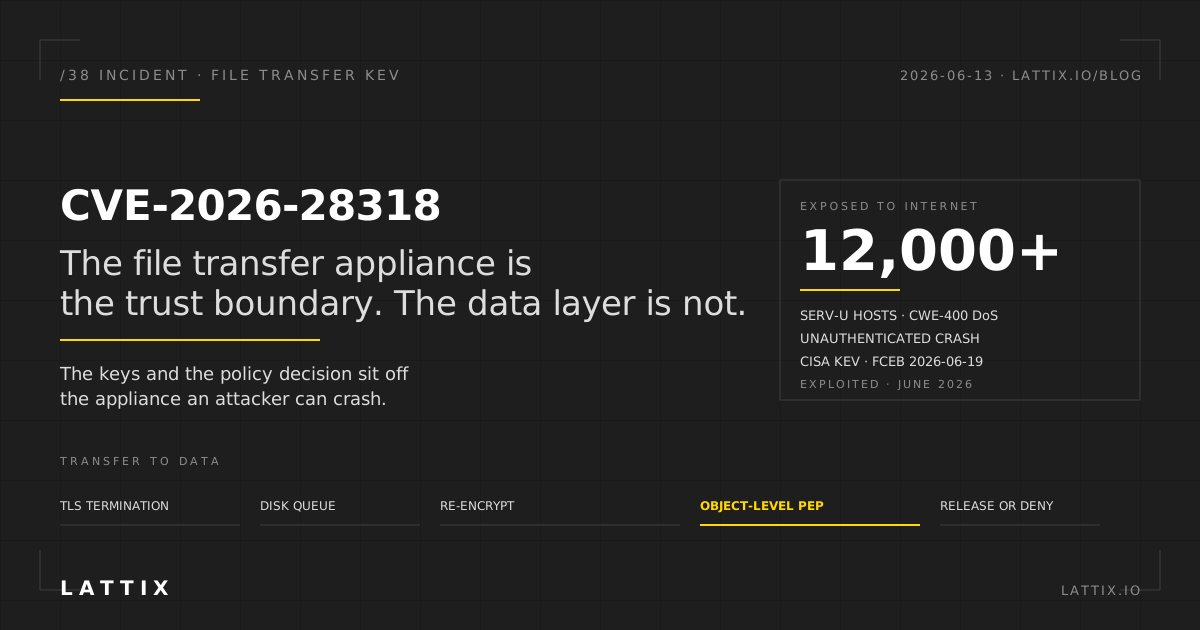
SolarWinds confirmed in June 2026 that CVE-2026-28318, an uncontrolled resource consumption flaw in Serv-U file transfer software, was under active exploitation. The vulnerability lets an unauthenticated attacker crash the Serv-U service with a single crafted request. The attacker sends a POST request carrying a Content-Encoding: deflate header, the service expands the payload without bound, and the process exhausts its resources and fails. The flaw is classified under CWE-400 and requires no credentials. The Cybersecurity and Infrastructure Security Agency added it to the Known Exploited Vulnerabilities catalog on June 5, 2026 and set a Federal Civilian Executive Branch remediation deadline of June 19, 2026.
SolarWinds released a fix in Serv-U version 15.5.4 Hotfix 1, and every prior version is affected. Internet scan data from Shodan tracks more than 12,000 Serv-U instances exposed to the public internet. The patch closes the specific denial-of-service vector. It does not change the structural reason a file transfer appliance keeps appearing in the KEV catalog.
A denial of service is the narrow problem
CVE-2026-28318 takes down a service. It does not read the files moving through it. That distinction matters, because the architectural response to a denial-of-service flaw is not the response to a data exposure, and treating the two as one produces bad decisions. Data-centric enforcement does not keep a service running under a resource-exhaustion attack. Availability of the transfer channel is an operational property of the appliance and the infrastructure around it, and the patch and the deadline are the correct response to it.
The disclosure is worth more than its severity class because of the pattern it continues. Serv-U sits in the lineage of managed file transfer software that has carried high-impact disclosures for years, from Accellion to MOVEit to GoAnywhere. The appliance that moves regulated data between organizations is a standing target because it is the one place the data is decrypted, queued, and handled in the clear.
When the appliance is the trust boundary
Most file transfer deployments make the appliance the trust boundary. The Serv-U server authenticates the peer, terminates the transport encryption, holds the file on disk during transfer, and re-encrypts for the next hop. Confidentiality of the payload depends on the integrity of that appliance for the duration of the transfer. A compromise of the appliance, whether it crashes the service or reaches the data, is a compromise of everything that transited it.
Data-centric zero trust moves the trust boundary off the appliance and onto the data object. Lattix Technologies binds policy to the object through attribute-based access control (ABAC) at the policy enforcement point (PEP), wraps the object under post-quantum key encapsulation with ML-KEM-768 and ML-KEM-1024, and records every release decision as Merkle-tree lineage in content-addressed storage (CAS-X). The file transfer appliance becomes a transport for an object that is already encrypted and already carries its own policy. The appliance never holds the cleartext and never holds the keys.
What changes when the transfer layer fails
Two failure modes separate cleanly under this architecture. A denial-of-service flaw like CVE-2026-28318 still interrupts the channel. The transfer does not complete until the appliance is patched and back in service, and a data-centric posture does not claim otherwise. What the posture removes is the second failure mode. A remote code execution flaw in the same class of appliance, of which the managed file transfer category has produced many, reaches an attacker into the place the data sits in the clear. Under object-level cryptographic enforcement there is no cleartext at the appliance to reach.
The request to open a Lattix-protected object travels to a PEP that evaluates an attribute claim signed by a policy decision point (PDP) running independently of the transfer appliance. The keys are released by that decision, not by the appliance. An attacker who owns the Serv-U host owns a transport node, not a policy decision and not a key. The request that cannot satisfy policy fails closed.
The evidence question for regulated transfers
File transfer between organizations is where regulated data crosses a boundary, which is exactly where breach-notification obligations attach. After an appliance compromise, the question a response team has to answer is which files were exposed and to whom. Logs on a compromised appliance are evidence of uncertain integrity.
Merkle-tree lineage answers the question from outside the appliance. The chain records every release decision the PEP made, anchored in content-addressed storage the appliance cannot rewrite. A response team queries the chain for releases during the incident window. Objects that were released surface as entries. Objects the attacker did not obtain a release for surface as the absence of an entry. The materiality determination and the notification scope rest on that record rather than on logs the attacker could reach.
How the architecture maps to standards
NIST SP 800-207 places the policy decision point outside the systems it governs, which is the property that keeps a transfer-appliance compromise out of the policy decision. The CISA Zero Trust Maturity Model 2.0 scores the data pillar separately from the network pillar, and a hardened network around a file transfer appliance does not raise the data-pillar score. For controlled unclassified information moving under CMMC 2.0 and NIST SP 800-171, and for cardholder data under PCI DSS 4.0.1, the governing control is protection of the data object across the transfer, not the hardening of the appliance alone. CVE-2026-28318 is the operational reminder that the appliance is a transport and the data layer is the boundary.
What teams should do before the deadline
The first action is the patch. Serv-U 15.5.4 Hotfix 1 closes CVE-2026-28318, the June 19 deadline is binding on federal civilian agencies, and the more than 12,000 exposed instances make the timeline urgent for everyone else. Patch, then remove the management interface from the public internet where the deployment allows it.
The second action is the architecture question the patch does not answer. Inventory the regulated data that crosses organizational boundaries through a file transfer appliance, and identify where that data exists in the clear during transit. Every point where the appliance holds plaintext is a point where a future appliance compromise becomes a data exposure rather than an outage. Object-level cryptographic enforcement, with the keys and the policy decision held off the appliance, is the control that converts the next managed file transfer disclosure into a transport problem.
References
- CISA Known Exploited Vulnerabilities Catalog
- Help Net Security, CISA: Patch actively exploited SolarWinds Serv-U DoS vulnerability (CVE-2026-28318)
- BleepingComputer, CISA: Hackers now exploit SolarWinds Serv-U flaw to crash servers
- Security Affairs, U.S. CISA adds SolarWinds Serv-U flaw to its Known Exploited Vulnerabilities catalog
- NIST SP 800-207, Zero Trust Architecture
- CISA Zero Trust Maturity Model 2.0
- NIST SP 800-171 Rev. 3, Protecting Controlled Unclassified Information