PTC Windchill CVE-2026-12569 Is in KEV. The PLM Repository Is the Trust Boundary.
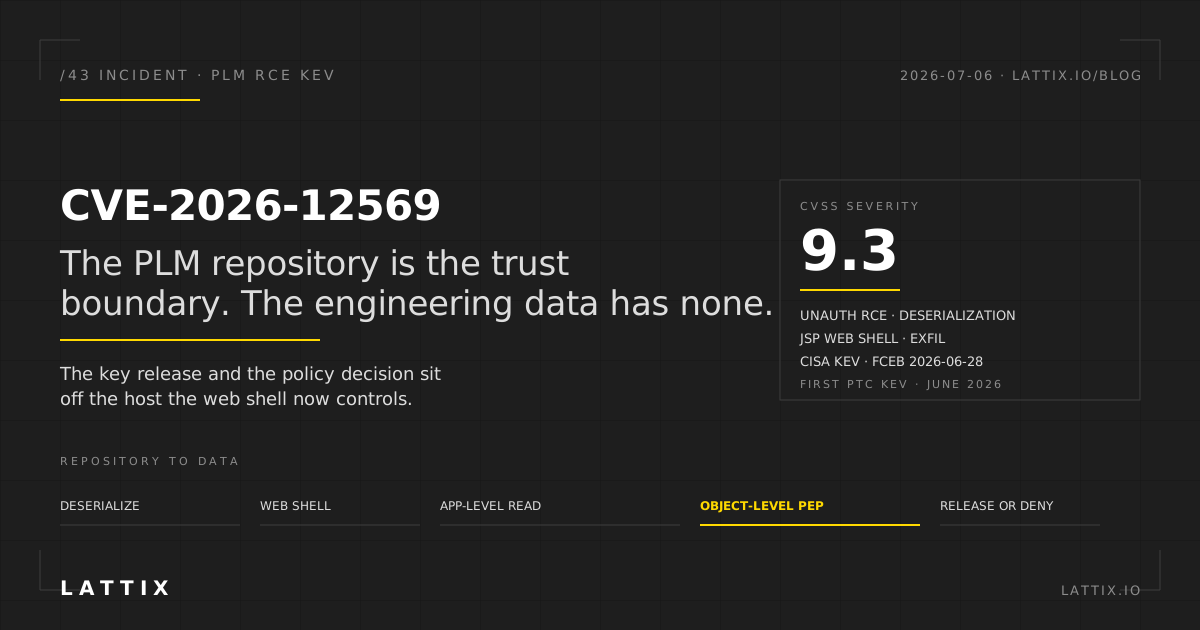
CISA added CVE-2026-12569, an unauthenticated remote code execution flaw in PTC Windchill PDMLink and FlexPLM, to the Known Exploited Vulnerabilities catalog on June 25, 2026, with a Federal Civilian Executive Branch remediation deadline of June 28, 2026. The vulnerability carries a CVSS score of 9.3 and stems from insecure deserialization of untrusted data. The application accepts a serialized object from the network and rebuilds it into a live object without validating its safety, and a crafted object triggers code execution during that reconstruction. It is the first PTC product to appear in the catalog.
Attackers are exploiting the flaw to deploy persistent JSP web shells, establishing footholds that enable remote command execution and data exfiltration. PTC published indicators of compromise alongside its fix. The systems in the blast radius are not peripheral. Windchill PDMLink is a product data management system and FlexPLM is a product lifecycle management suite, and together they hold the most sensitive material a manufacturer owns: CAD models, bills of materials, engineering specifications, supplier data, and in many defense programs, ITAR-controlled designs.
The repository holds the crown jewels in the clear
A PLM system is built to be the single authoritative store of engineering data, which is exactly why it becomes a concentrated target. The data sits on the repository in a form the application can read, index, and serve. Access control is enforced by the application, encryption at rest is keyed to the host, and confidentiality of the design data depends on the integrity of the Windchill server. An unauthenticated RCE against that server collapses all three at once.
Once the attacker holds code execution on the repository, the exfiltration path is short. The data is already assembled and readable on the box the attacker now controls. This is the recurring shape of repository compromise: the system designed to be the source of truth is the system where the truth sits unprotected against a compromise of the system itself.
Moving the boundary onto the object
Data-centric zero trust does not make the repository the trust boundary. Lattix Technologies binds policy to each data object through attribute-based access control (ABAC) at the policy enforcement point (PEP), wraps the object under post-quantum key encapsulation with ML-KEM-768 and ML-KEM-1024, and records every release decision as Merkle-tree lineage in content-addressed storage (CAS-X). The engineering object carries its own policy and its own encryption, independent of the application that stores it.
Under that model, a web shell on the Windchill host reaches objects it cannot open. The key release each object requires comes from a policy decision point (PDP) that evaluates a signed attribute claim and runs independently of the compromised repository. Code executing as the application holds neither a valid claim nor the key, so the request fails closed. The RCE stays a compromise of the host, not a compromise of the CAD, the BOMs, or the ITAR-controlled designs.
The evidence question for regulated designs
Manufacturing and defense data carry disclosure and reporting obligations, and the question after a PLM compromise is precise: which engineering objects were exposed and to whom. Logs on a repository an attacker reached with SYSTEM-equivalent web shell access are evidence of uncertain integrity, because the attacker could alter them.
Merkle-tree lineage answers the question from outside the repository. The chain records every release decision the PEP made, anchored in content-addressed storage the compromised host cannot rewrite. A response team queries the chain for releases inside the incident window. Objects that were released appear as entries; objects the attacker never obtained a release for appear as the absence of an entry. The scope determination rests on that record rather than on logs the web shell could reach. This is the same provenance discipline that turns signed software supply chain artifacts into verifiable evidence.
How the architecture maps to standards
NIST SP 800-207 places the policy decision point outside the systems it governs, which keeps a repository compromise out of the data access decision. The CISA Zero Trust Maturity Model 2.0 scores the data pillar separately from application and network hardening, so a locked-down Windchill deployment does not raise the data-pillar score on its own. For controlled unclassified information and covered defense information under CMMC 2.0 and NIST SP 800-171, and for ITAR-controlled technical data, the governing control is protection of the data object across a repository compromise, not the assurance of the application alone.
What teams should do before the deadline
The first action is the patch and the hunt. Apply PTC's fix, then use the published indicators of compromise to hunt for JSP web shells already present, because a June 28 deadline on an actively exploited unauthenticated RCE means intrusions may predate the remediation. Remove the exposure and confirm the host is clean.
The second action is the architecture question the patch does not close. Inventory the engineering and design data concentrated in PLM and PDM systems, and identify where a compromise of the repository becomes direct access to that data in usable form. Every object the application can read in the clear is an object a repository RCE can exfiltrate. Object-level cryptographic enforcement, with the keys and the policy decision held off the repository, is the control that converts the next PLM disclosure into a host problem rather than the loss of a manufacturer's core intellectual property.
References
- CISA Known Exploited Vulnerabilities Catalog
- PTC, Remote Code Execution Vulnerability in Windchill and FlexPLM Solutions
- The Hacker News, CISA Adds Exploited PTC Windchill RCE Flaw to KEV as Web Shell Attacks Continue
- SecurityWeek, First-Ever Exploitation of PTC Windchill Vulnerability Discovered in the Wild
- NVD, CVE-2026-12569
- NIST SP 800-207, Zero Trust Architecture
- CISA Zero Trust Maturity Model 2.0