The Linux Copy Fail CVE-2026-31431 Reaches Root. Object-Level Enforcement Reaches the Data.
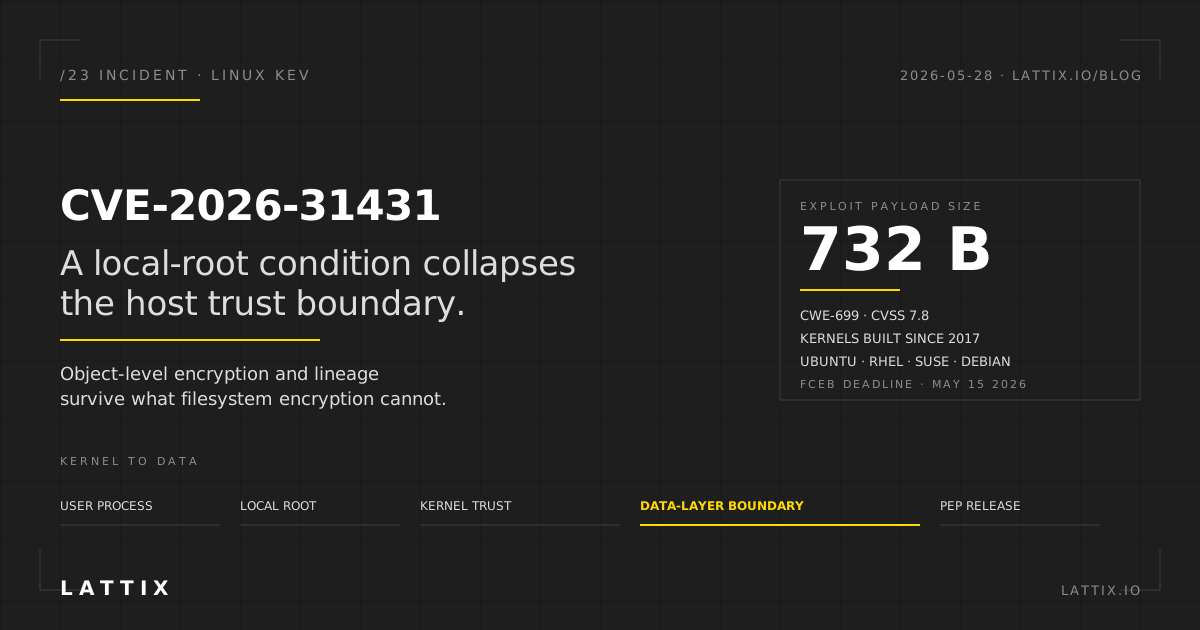
CVE-2026-31431, dubbed Copy Fail, is a local privilege escalation against Linux kernels built since 2017. The flaw carries a CVSS score of 7.8 and is classified under CWE-699 (Incorrect Resource Transfer Between Spheres). The Cybersecurity and Infrastructure Security Agency added the vulnerability to the Known Exploited Vulnerabilities catalog on May 1, 2026, with a mandatory remediation deadline of May 15 for federal civilian executive branch agencies. The exploit reliably escalates an unprivileged local user to root through a 732-byte Python script.
The vulnerability affects every major Linux distribution running kernels built since 2017. Ubuntu 24.04 LTS, Amazon Linux 2023, Red Hat Enterprise Linux 10.1, SUSE 16, Debian, Fedora, and Arch Linux all ship affected kernels. Patches landed quickly. The patch story is the operationally simple part of the incident. The architectural question that follows is the question this post addresses.
What a local-root vulnerability changes
A local-root condition collapses the boundary between an application-layer compromise and a host-layer compromise. Any process that reaches user-level execution on the host can reach root within the lifetime of a Python interpreter call. Every host-layer security control that depends on the integrity of the operating system kernel becomes contingent on the integrity of that kernel.
The list of host-layer controls is long. Mandatory access control under SELinux or AppArmor. File system permissions. Linux capabilities. Auditd subsystem integrity. Endpoint detection and response agents that hook syscall paths. Filesystem-level encryption that derives keys from local secrets. Kernel-mode integrity measurement. Each of these controls sits inside the trust boundary that a local-root exploit breaches.
The relevant question for security architects is not whether the patch lands. The patch lands. The relevant question is what survives the next variant.
Where filesystem encryption breaks
The dominant data protection model in cloud and on-premises Linux deployments is filesystem-level encryption. LUKS protects block devices. Per-file encryption services derive keys from the kernel keyring or from cloud KMS APIs invoked by host-level agents. The encryption is invisible to applications. The encryption is also invisible to a root process on the host.
A root process reads cleartext from the filesystem because the kernel decrypts the bytes on the read path. A root process reads the kernel keyring. A root process invokes the cloud KMS client with the host's instance identity. The threat model assumes that the host is trusted. A local-root vulnerability invalidates the assumption.
The patching cadence does not change this structure. The next local-root vulnerability arrives. The kernel surface remains broad. The host-layer trust boundary remains the boundary that filesystem encryption depends on.
What object-level cryptographic enforcement actually moves
The architecture that does not depend on host integrity is one in which the data object carries its own encryption, the policy that gates decryption is evaluated outside the host, and the lineage of release decisions is recorded outside the host.
Object-level encryption binds a unique data encryption key to the object at creation time. The key is wrapped under a key encryption key held at a policy decision point. The decision point evaluates an attribute claim presented by the requesting principal. The claim is a signed assertion about who the principal is, where the principal is operating, and what scope the principal is authorized for. A compromised host can present claims it possesses. It cannot fabricate claims signed by an authority outside the host.
Lattix Technologies binds attribute-based access control (ABAC) at the policy enforcement point (PEP) to ML-KEM-768 and ML-KEM-1024 key encapsulation. A read operation against a Lattix-protected object reaches the PEP, presents an attribute claim, and either receives the wrapped key for unwrap on the requesting host or receives a denial. The kernel of the requesting host is in the read path only as a transport. The decision and the audit record are not on the host.
The lineage answer to "what did the root process read"
Incident response after a local-root event spends most of its time reconstructing what the root process read. Application logs were tampered with after the privilege escalation. Auditd records were truncated or replayed. Filesystem timestamps were altered.
Merkle-tree lineage in tamper-evident storage answers the question cryptographically. Every key release decision writes a record to content-addressed storage anchored in a Merkle tree managed at the policy decision point, not on the host. A compromised root process can read the data it is authorized to decrypt. It cannot decrypt data it is not authorized for. It cannot remove the audit record that the read occurred.
The response team queries the lineage chain for releases during the incident window, filtered by host attribute, by principal claim, or by data classification. The chain produces a defensible answer in minutes. The materiality determination for the Securities and Exchange Commission disclosure window, the breach scope notification for state attorneys general, and the technical lineage for federal incident reporting all rest on this answer.
What teams should be doing in the next 30 days
Three operational priorities matter against the next Copy Fail-class disclosure.
The first is a data classification pass against the high-impact data on Linux hosts. The classification deliverable identifies which data objects rely on filesystem-level encryption and would be exposed under a local-root condition. The deliverable bounds the scope of the architectural change.
The second is the policy decision point architecture. Where is the PEP. Where is the policy evaluation logic. What attribute authorities sign the claims. The decision moves keys and policy off the protected host and into infrastructure that the local-root condition does not reach.
The third is the audit log architecture. Audit records written to the same host whose root the attacker holds are records the attacker can rewrite. Records anchored cryptographically into off-host storage are records that survive.
How the architecture maps to existing standards
NIST SP 800-207 Zero Trust Architecture names the policy enforcement point and policy decision point as the architectural primitives. The CISA Zero Trust Maturity Model 2.0 scores the data pillar separately from the host pillar precisely because the data pillar reaches conditions in which the host is no longer trusted. The NSA Zero Trust Implementation Guideline Data Pillar v2 published April 2026 is explicit that the data pillar applies under local-root conditions.
The architecture described in this post is the prescribed direction. Copy Fail is one disclosure in a continuing series of local-root conditions against the Linux kernel. The defensive answer scales because it does not depend on the kernel staying clean.
References
- CISA Known Exploited Vulnerabilities Catalog
- CISA Alert, Adding CVE-2026-31431 to the KEV Catalog (May 1, 2026)
- NIST National Vulnerability Database, CVE-2026-31431
- NIST SP 800-207, Zero Trust Architecture
- CISA Zero Trust Maturity Model 2.0
- NSA Zero Trust Implementation Guideline Data Pillar v2
- NIST FIPS 203, Module-Lattice-Based Key-Encapsulation Mechanism Standard