HHS HC3 Q2 2026 Threat Brief: Healthcare Data Is the Target. The Response Is Architectural.
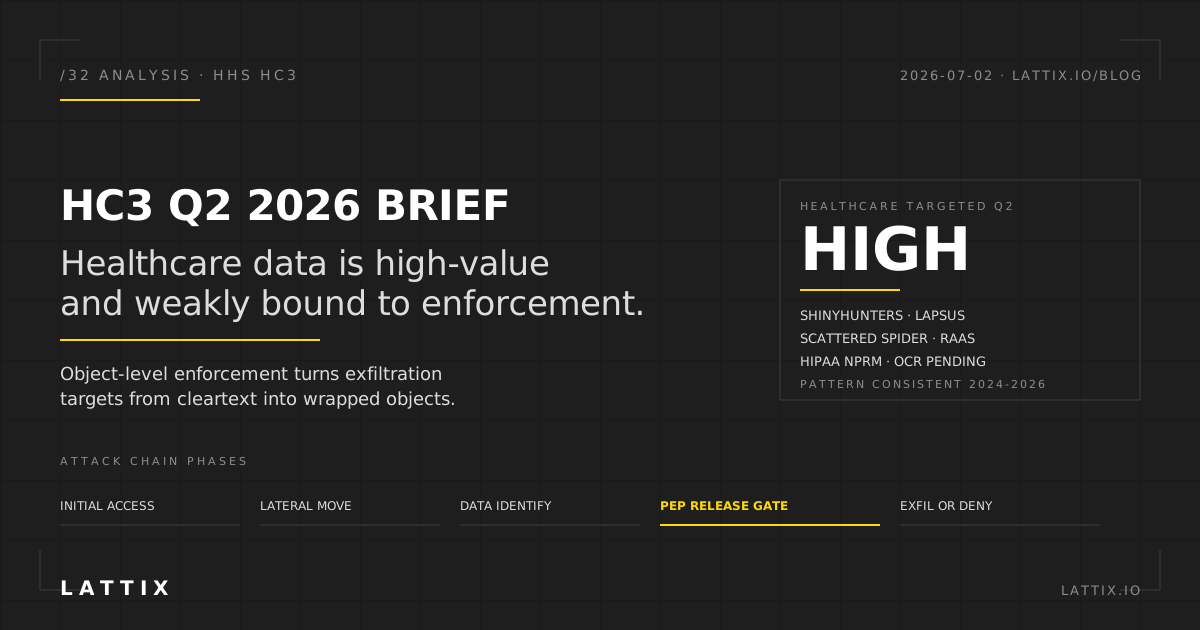
The Department of Health and Human Services Health Sector Cybersecurity Coordination Center publishes quarterly threat briefs covering the threat actor groups, tactics, and observed targeting against healthcare data. The Q2 2026 brief catalogs the continuation of patterns established through 2024 and 2025. ShinyHunters, Lapsus, Scattered Spider, and a continuing roster of ransomware operators continue to identify healthcare entities as high-value targets. The Medtronic intrusion attributed to ShinyHunters in April 2026, the long tail of operational impact from the Change Healthcare ransomware event in 2024, and the Q2 2026 attempted intrusions against major payer and provider organizations all share architectural characteristics that the brief does not explicitly name but that the underlying technical details surface consistently.
The pattern is that healthcare data is among the most valuable categories in the breach economy and among the most weakly bound to architectural enforcement. The combination produces a threat surface that does not shrink with patching cadence, with identity hardening, or with network segmentation alone. The architectural response that does shrink the surface is data-centric enforcement.
What the threat briefs actually describe
HC3 briefs name the threat actor groups and the tactics they employ. The tactics across Q2 2026 are consistent with the prior year. Initial access through phishing or stolen credentials. Lateral movement through identity infrastructure compromise. Data identification through application enumeration. Exfiltration through cloud storage to attacker-controlled infrastructure. Extortion through ransomware deployment, data leak threats, or both.
Each phase of the pattern reaches a defensive control category. Phishing reaches the identity perimeter. Lateral movement reaches the network segmentation and identity controls. Data identification reaches the application boundary. Exfiltration reaches the network egress controls. Extortion reaches the resilience and continuity controls. The defensive investments that healthcare entities have made over the past five years are concentrated at these layers.
The pattern persists because the data itself remains weakly bound to enforcement. An attacker that completes lateral movement to a host with database access reads patient records. An attacker that reaches a backup repository reads patient records. An attacker that compromises a third-party application with patient data access reads patient records. The data does not carry policy that fails closed for the unauthorized principal. The enforcement is at the systems around the data, not at the data.
Where data-centric architecture changes the threat pattern
A data-centric architecture binds policy to the patient record at the object level. The record carries its own encryption key wrapped under attribute-based release policy. The policy specifies the attribute set that authorizes release: clinical role, treatment relationship, authorized purpose, time window, originating context. The release decision runs through a policy enforcement point at every read. The release event writes a Merkle-tree lineage record.
An attacker that completes lateral movement to a host with database access encounters ciphertext. An attacker that reaches a backup repository encounters ciphertext. An attacker that compromises a third-party application encounters denials at the PEP for every record the application is not authorized to read. The exfiltration target shifts from cleartext patient data to wrapped data objects that produce no value at any unauthorized runtime.
Lattix Technologies implements this pattern through attribute-based access control (ABAC) at the policy enforcement point, FIPS 140-3 validated cryptographic modules using ML-KEM-768 and ML-KEM-1024, and Merkle-tree lineage in tamper-evident audit storage. The architecture produces direct evidence against HIPAA Security Rule technical safeguards, the proposed cryptographic safeguards under the December 2024 NPRM, and the operational threat patterns the HC3 briefs catalog.
The breach scope answer
A healthcare incident's breach scope determines the notification population, the regulatory reporting obligations, the litigation exposure, and the recovery cost. The breach scope question in current architectures is reconstructed from heterogeneous logs across systems that the attacker reached. The reconstruction takes weeks for clean incidents and months for messy ones.
Merkle-tree lineage over policy decision events answers the breach scope question cryptographically. The chain records every release decision. After detection, the response team queries the chain for releases during the incident window, filtered by the attacker's likely attribute claims, by the compromised host's identity, or by the affected data classification. The chain produces a defensible breach scope statement in hours.
The materiality determination under the SEC cyber disclosure rule rests on this evidence. The breach notification scope under HIPAA Breach Notification Rule rests on this evidence. The state attorney general reporting under state breach notification laws rests on this evidence. The architecture changes the breach scope analysis from a reconstruction to a query.
Where the proposed HIPAA NPRM applies the pattern
The HHS Office for Civil Rights Notice of Proposed Rulemaking published December 27, 2024 in the Federal Register proposes the first major update to the HIPAA Security Rule since 2003. The NPRM removes the "addressable" designation that has produced two decades of risk analyses concluding encryption is not reasonable and appropriate. The NPRM mandates encryption of ePHI at rest and in transit. The NPRM requires multi-factor authentication, technical asset inventory, network segmentation, and tamper-evident audit logs.
The final rule timing remains uncertain. The OCR regulatory agenda targets May 2026 publication, though OCR Director Stannard at HIMSS 2026 noted that 4,700 public comments remain under review. The substantive direction is clear regardless of the final rule date. The architectural posture the rule converges on is data-centric, with cryptographic enforcement and tamper-evident audit logging.
A healthcare entity that approaches the final rule with data-centric architecture in place faces a compliance posture that the architecture produces by construction. A healthcare entity that approaches the final rule with a contract-and-process posture faces a 180-day proposed compliance window that is shorter than the architectural change requires.
What healthcare entities should be doing in the next 90 days
Three operational priorities matter for healthcare entities holding ePHI.
The first is the ePHI inventory against the threat pattern. Where is ePHI stored. Where is ePHI accessed. Which third-party applications and Business Associate relationships touch ePHI. The inventory bounds the architectural scope and is the input to every other compliance and security activity.
The second is the architectural posture decision. Healthcare entities operating with cryptography distributed across application infrastructure face threat exposure proportional to the application footprint. Healthcare entities operating with data-centric protection at the object level face threat exposure proportional to the PEP infrastructure. The decision in 2026 determines the threat outcome for the next several years.
The third is the lineage and audit instrumentation. Logs scattered across electronic health records, claims systems, and downstream analytics platforms do not meet the proposed HIPAA Security Rule audit log expectations under tamper-evident scrutiny. A consolidated, cryptographically anchored lineage chain does.
How the architecture aligns with healthcare-specific direction
The HHS HC3 threat briefs, the HHS OCR proposed Security Rule update, the CISA Healthcare and Public Health Sector guidance, and the broader cybersecurity direction across federal healthcare regulators converge on the same architectural pattern. Data-centric enforcement produces evidence against the controls those frameworks share. Identity and network enforcement alone produces a threat surface that the HC3 briefs continue to document.
The investment in data-centric architecture for healthcare data compounds across the HIPAA, state breach notification, SEC disclosure, and broader regulatory portfolio. The architectural decision in 2026 is one decision against multiple regulatory regimes and the operational threat patterns that have remained consistent across the past several quarters.