Federal Cloud Migration ATO Acceleration Lives at the Data Layer
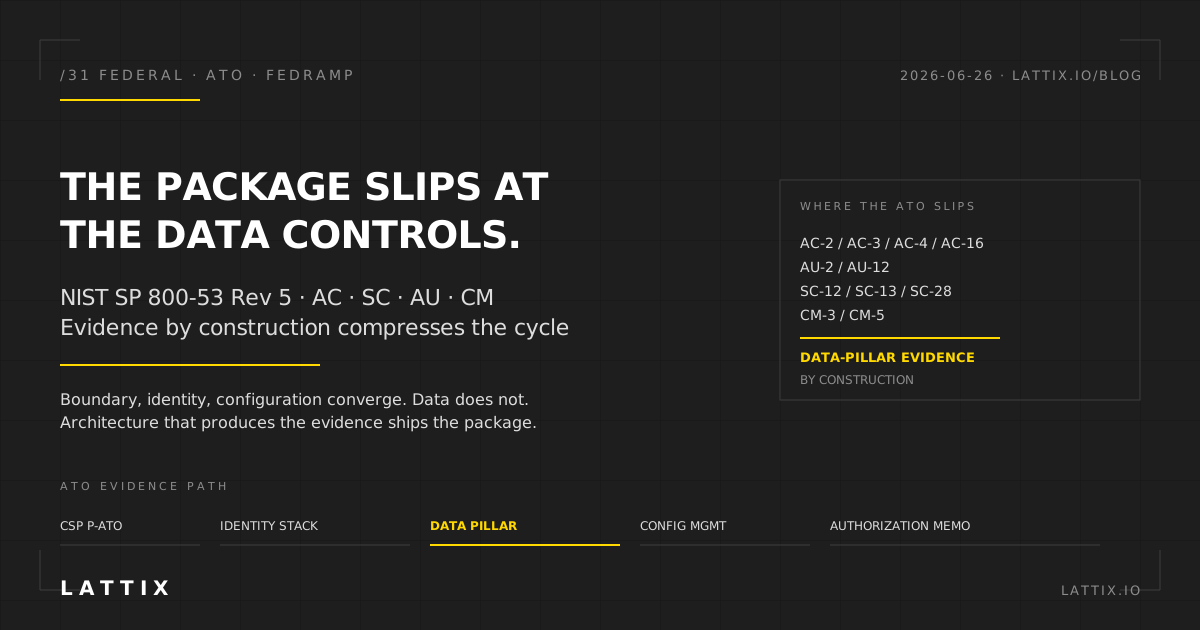
Federal cloud migration programs share a recurring pattern. The technical implementation reaches a workable state on schedule. The Authority to Operate package, which has to land before the workload can serve mission, does not. The slip is rarely the boundary, the identity, or the configuration. The slip is consistently the data control families, and the conversation that the assessor wants to have is the conversation about evidence the program office cannot produce on demand.
NIST SP 800-53 Rev 5 catalogs the control families the assessor evaluates. The Access Control (AC), System and Communications Protection (SC), Audit and Accountability (AU), and Configuration Management (CM) families are the ones that consistently slow ATO packages from a defensible draft to a signed Authorization Memorandum. Inside those families, the specific controls that slip are the ones that ask for cryptographic protection of regulated data, attribute-bound access decisions over the data, and tamper-evident lineage records over reads and writes. AC-2, AC-3, AC-4, AC-16, AU-2, AU-12, SC-12, SC-13, SC-28, CM-3, CM-5. Each is a control whose evidence the boundary and identity layers do not produce by themselves.
The architecture that produces the evidence by construction is the architecture that compresses the cycle. Data-centric zero trust at the policy enforcement point, with cryptographic binding of policy to the object and Merkle-tree lineage in tamper-evident storage, is not a marketing claim against ATO. It is the configuration that produces the evidence the assessor has to see, in the format the package has to carry, at the moment the program needs to submit.
Why boundary, identity, and configuration converge fast
The boundary layer converges fast because the federal cloud providers (Azure Government, AWS GovCloud, Google Cloud for Government, Oracle Government Cloud) inherit FedRAMP-authorized boundary controls. The program office documents the boundary the cloud service provider has authorized and references the existing P-ATO. The boundary control families (AC-4, SC-7, SC-8, CM-2) compose from the CSP's baseline.
The identity layer converges fast because the identity stack (Azure Entra ID Government, AWS IAM Identity Center, Google Cloud Identity, agency PIV/CAC federations) inherits established FedRAMP boundaries and CISA Zero Trust Maturity Model patterns. The program office documents the identity flows and references the existing identity-pillar evidence the agency has already developed across prior systems.
The configuration management layer converges fast because the Infrastructure as Code pattern (Terraform, Bicep, Cloud Formation, Pulumi) produces the configuration evidence the assessor needs. The drift detection runs at the moment of deployment. The change control loop is auditable in the source repository. The configuration management control family (CM-2, CM-3, CM-5, CM-6) composes from the deployment toolchain.
The control families that produce evidence about the data itself do not compose from the same patterns.
Why the data control families slip
The data control families ask for evidence the program office has to produce against the workload's data plane. The assessor wants to see, for AC-2 and AC-3, that access decisions over the regulated data evaluate the requesting principal's attribute set against an articulated policy. The program office that has not bound the policy to the data plane produces a policy document that describes the intention. The assessor wants to see the enforcement.
For AC-4 (information flow enforcement) and AC-16 (security and privacy attributes), the assessor wants to see that the data carries the attribute that downstream policy decisions evaluate. The program office that has not bound the attribute to the data object produces an attribute that lives in a separate system the data references. The assessor wants to see the binding.
For AU-2 (event logging) and AU-12 (audit record generation), the assessor wants to see the per-event audit record that the program produces over reads and writes against the regulated data. The program office that has not built lineage into the data plane produces an audit record over the database connections rather than the data accesses. The assessor wants the data-level lineage.
For SC-12 (cryptographic key establishment), SC-13 (cryptographic protection), and SC-28 (protection of information at rest), the assessor wants to see the cryptographic protection at the object granularity the regulation requires. The program office that has not bound the cryptography to the data plane produces volume encryption and database transparent data encryption, which protect the medium and not the object. The assessor wants the object protection.
Each conversation reaches the same architectural answer. The evidence the assessor wants is the evidence the data-pillar architecture produces. The evidence the boundary and identity layers produce, in the absence of the data pillar, is not the evidence the control family was written against.
How the data-pillar architecture compresses the cycle
A data-pillar architecture binds the policy to the data object cryptographically. The policy names the attribute set the requesting principal must satisfy. The policy enforcement point evaluates the attribute set at the moment of access. The lineage record produces per-read in tamper-evident audit storage. The cryptographic protection holds at the object granularity. The configuration management governs the policy attribute schema and the enforcement point deployment.
For AC-2 and AC-3, the evidence the assessor needs is the policy attribute schema, the enforcement point configuration, and the access logs from the policy enforcement point. The evidence is configuration data and operational telemetry, not narrative.
For AC-4 and AC-16, the evidence is the object's policy and attribute set, available by inspection of the object format. The binding is the wire-level data, not a separate system that holds the binding.
For AU-2 and AU-12, the evidence is the per-read lineage record in tamper-evident storage. The records have cryptographic identifiers. The chain root verifies. The audit is the architecture.
For SC-12, SC-13, and SC-28, the evidence is the object format, the key access service configuration, the post-quantum parameter set (ML-KEM-768 or ML-KEM-1024 under CNSA 2.0 for National Security Systems), and the FIPS 140-3 validation status of the cryptographic module. Each evidence item is a configuration value or a vendor certification.
The package the program office submits carries the evidence in the format the assessor evaluates. The cycle compresses because the assessor's question and the program's evidence converge at the architecture level, not at the narrative level.
What this means for FedRAMP 20x and the FY27 procurement window
The FedRAMP 20x program announced in 2024 reshaped the authorization pathway around automated assessment and continuous monitoring. The continuous monitoring requirement compounds the data-control pressure. Evidence the program office has to produce monthly is evidence the architecture has to produce by construction. A data-pillar architecture produces the evidence continuously. A boundary-and-identity architecture without the data pillar produces the evidence by ad-hoc assertion, which the continuous monitoring program is structurally designed against.
FY27 procurement language is reaching the data-pillar specification with frequency. Solicitations name attribute-based access control at the policy enforcement point, post-quantum key encapsulation parameter sets, Zero Trust Data Format and IC-TDF wire formats, and lineage chain evidence. The language is the configuration of the architecture. Vendors that ship against the architecture respond to the language. Programs that procure against the language acquire the evidence base their ATO and continuous monitoring functions require.
Lattix Technologies binds policy to data objects through attribute-based access control at the policy enforcement point, post-quantum key encapsulation under ML-KEM-768 and ML-KEM-1024, and Merkle-tree lineage in tamper-evident audit storage. The architecture produces evidence that maps to AC-2, AC-3, AC-4, AC-16, AU-2, AU-12, SC-12, SC-13, and SC-28 by construction. The implementation is procurable today against federal cloud migration programs in Azure Government, AWS GovCloud, and the broader federal civilian and defense cloud estate.
The ATO cycle is not slow because the assessor moves slowly. It is slow because the architecture produces the evidence in the format the package needs, or it does not, and the conversation about the gap happens late. The architecture that produces the evidence by construction is the architecture that lets the gap conversation never happen.
References
- NIST SP 800-53 Rev 5, Security and Privacy Controls
- NIST SP 800-207, Zero Trust Architecture
- FedRAMP 20x program overview
- CISA Zero Trust Maturity Model 2.0
- NSA CNSA 2.0, Commercial National Security Algorithm Suite
- NIST FIPS 140-3, Security Requirements for Cryptographic Modules
- Lattix, Federal Zero Trust Deadlines Are Binding. Data Layer Enforcement Is Not.
- Lattix, FedRAMP High Cloud-Native Government Workloads