Cisco SD-WAN CVE-2026-20182 Bypasses the Network Controller. The Data Layer Holds.
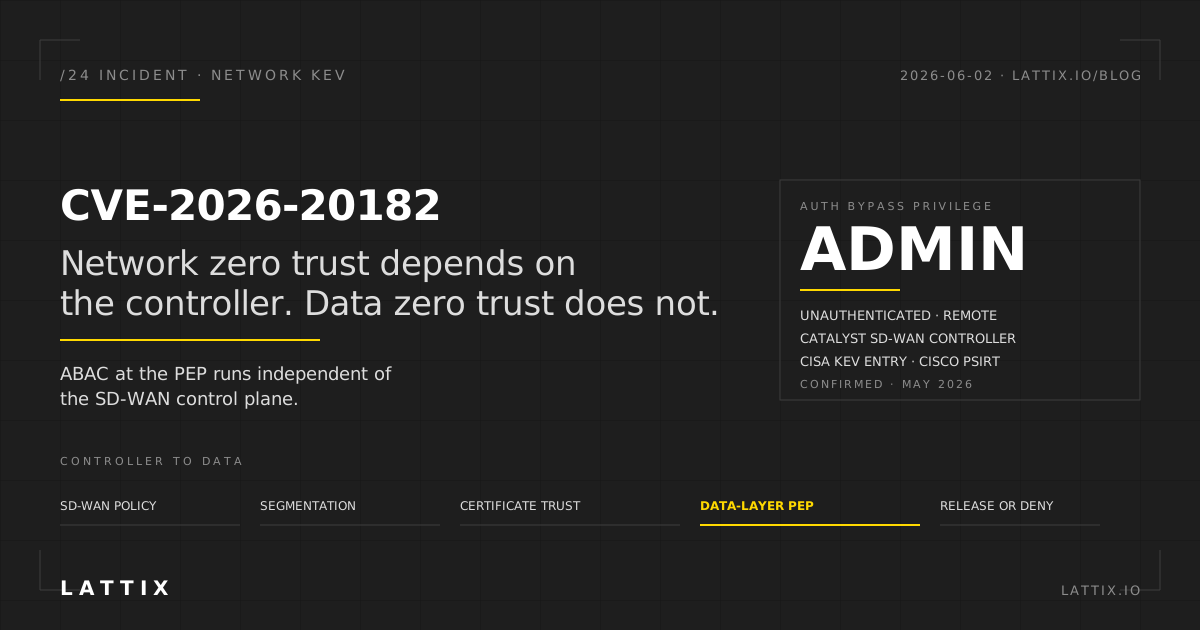
Cisco confirmed in May 2026 that CVE-2026-20182, a vulnerability in Catalyst SD-WAN Controller, had been exploited as a zero-day in the wild. The flaw allows an unauthenticated remote attacker to bypass authentication and gain administrative privileges on an affected controller. The Cybersecurity and Infrastructure Security Agency added the vulnerability to the Known Exploited Vulnerabilities catalog. The patches available from Cisco close the technical vector. The architectural question that follows the disclosure is the question this post addresses.
The SD-WAN controller is the orchestration plane for the data plane of a software-defined network. The controller distributes policy to the SD-WAN edge devices, programs the segmentation rules that gate East-West traffic, and serves as the management trust root for the deployment. An attacker who gains administrative privileges on the controller does not need to break further into the network. The network is, by definition, what the controller controls.
What the bypass actually accesses
A compromised SD-WAN controller produces three immediate capabilities for an attacker. The attacker can modify the segmentation policy distributed to edge devices, opening traffic flows that the network design closed. The attacker can introduce new routes and tunnels that exfiltrate traffic to attacker-controlled endpoints. The attacker can issue revocation actions against legitimate certificates and replace them with attacker-issued material that downstream systems will trust.
Each capability defeats a category of zero trust control that depends on network-layer enforcement. Segmentation enforced at the SD-WAN fabric falls when the segmentation policy can be rewritten by the attacker. Identity-bound mutual TLS between services falls when the certificate authority is reachable from the compromised controller. Microsegmentation policies that assume the controller is the source of truth fall when the controller is no longer the source of truth.
The patch lands. The architectural question is what zero trust posture survives the next disclosure against a network control plane.
Where network zero trust stops
NIST SP 800-207 lists seven tenets of zero trust architecture. Several depend on the integrity of the policy enforcement point that gates network access. CISA Zero Trust Maturity Model 2.0 scores network as a separate pillar from data because the maturity of the two pillars is independent. An organization can achieve a high network maturity score and a low data maturity score simultaneously, and the inverse is also true.
A network zero trust architecture in which segmentation, identity, and policy distribution all flow through one controller has its trust boundary at that controller. When the controller is compromised, every control that depends on the controller is compromised in parallel. The attacker does not have to break each control individually.
Data-level enforcement breaks the parallelism. A data object that carries its own encryption and policy does not become readable when the SD-WAN controller is compromised. The policy decision point that gates decryption is not the SD-WAN controller. The keys that wrap the object are not stored on the SD-WAN controller. The audit log of release decisions is not written to the SD-WAN controller. A compromised network control plane does not produce data access.
What object-level enforcement actually moves
The architecture that survives a compromised SD-WAN controller is one in which the access decision is independent of network position. Lattix Technologies implements this pattern through attribute-based access control (ABAC) at the policy enforcement point (PEP), post-quantum key encapsulation under ML-KEM-768 and ML-KEM-1024, and Merkle-tree lineage in tamper-evident audit storage.
Under the Lattix architecture, a read request against a protected data object travels from the requesting process to the PEP. The PEP evaluates an attribute claim signed by an authority outside the SD-WAN fabric. The claim asserts who the requester is, where the requester is operating, and what scope is authorized. A compromised SD-WAN controller can route the request anywhere on the network. It cannot fabricate a claim signed by an authority it does not control. The request fails closed at the PEP, and the failure is recorded in the lineage chain.
The architecture changes the failure mode of a network control plane compromise. In the network-zero-trust posture, controller compromise produces data access. In the data-centric posture, controller compromise produces failed PEP requests and audit records that detection teams can act on.
The audit chain answer to "what did the attacker reach"
Incident response after a network control plane compromise spends days reconstructing what traffic the attacker rerouted, what segmentation rules were modified, and what certificates were replaced. The reconstruction depends on logs from the compromised systems. The logs are exactly the artifacts a sophisticated attacker tampers with first.
Merkle-tree lineage over policy decision events answers a more useful question. The chain records every key release decision made by the PEP. The chain is anchored in content-addressed storage that the SD-WAN controller cannot write to. After a compromise is detected, the response team queries the chain for releases during the incident window. Releases that match the attacker's traffic pattern surface immediately. Releases that did not occur surface as the data the attacker did not reach.
The materiality determination for disclosure rests on this evidence. The breach notification scope rests on this evidence. The remediation prioritization rests on this evidence. The chain produces defensible answers in minutes, not the days that a log-stitching reconstruction takes.
What teams should be doing in the next 30 days
Three operational priorities matter against the next disclosure against a network control plane.
The first is an inventory of trust dependencies on the SD-WAN controller. Which security controls assume the controller is the source of truth. Which certificates are issued under the controller's trust. Which segmentation enforcement relies on the controller's policy distribution. The inventory bounds the scope of the architectural change.
The second is the architecture decision about where access policy lives. A PEP architecture independent of the network control plane is the change that limits the next compromise. The Lattix pattern of ABAC over object-level cryptographic enforcement is one implementation of this independence. Other implementations exist. The principle is consistent.
The third is the audit log architecture. Logs from the SD-WAN controller go to log aggregation infrastructure that the attacker also reaches. Lineage records anchored cryptographically in storage that the controller cannot write to are records that survive.
How the architecture maps to standards
The CISA April 2026 joint guide on Adapting Zero Trust Principles to Operational Technology, the DoD Zero Trust Strategy 2.0, and the NSA Zero Trust Implementation Guideline Data Pillar v2 all converge on the same architectural pattern. Network controls are necessary but not sufficient. Data controls bind enforcement to the object rather than to the path the object traverses. The CVE-2026-20182 disclosure is the operational case for accelerating the data pillar build.
References
- Cisco Security Advisory, Catalyst SD-WAN Controller Authentication Bypass (CVE-2026-20182)
- CISA Known Exploited Vulnerabilities Catalog
- NIST SP 800-207, Zero Trust Architecture
- CISA Zero Trust Maturity Model 2.0
- NSA Zero Trust Implementation Guideline Data Pillar v2
- CISA, Adapting Zero Trust Principles to Operational Technology (April 2026)