AI Agents Form Credential Delegation Chains. Static Tokens Cannot Hold.
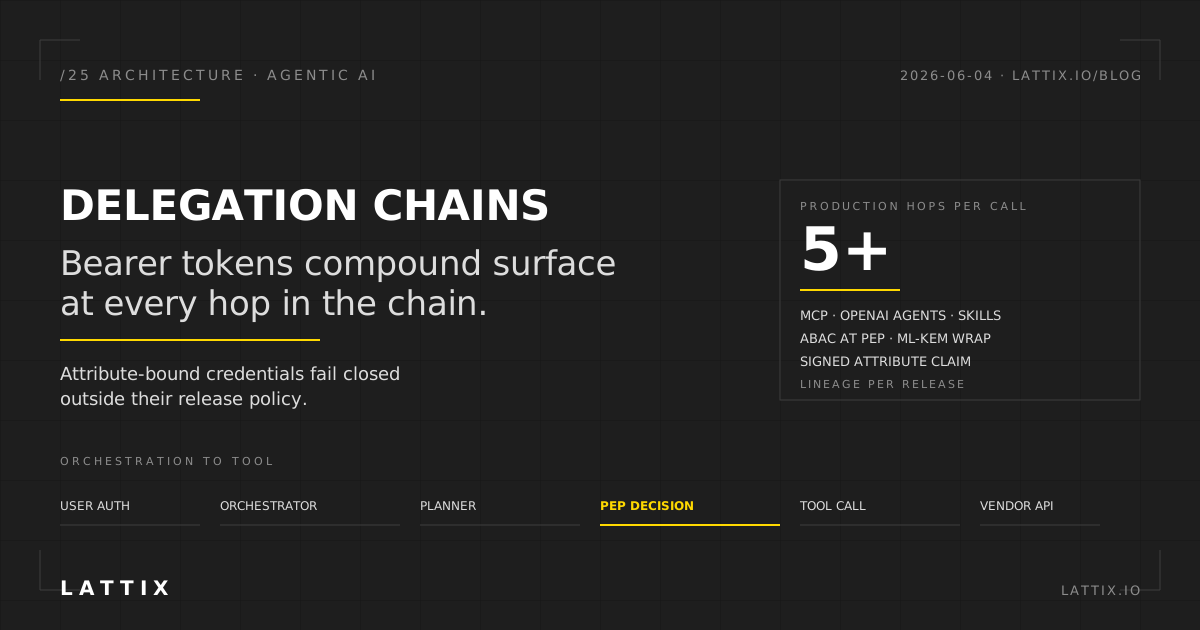
Autonomous agent workflows have moved from single-vendor demonstrations to production multi-hop systems within eighteen months. A representative production chain in mid-2026 looks like this. A user invokes an orchestration agent. The orchestration agent delegates to a planning agent. The planning agent invokes a tool-use agent that calls vendor APIs. The tool-use agent invokes a code execution agent. The code execution agent reads data from cloud storage, writes intermediate artifacts to a vector store, and calls back to the planning agent with results.
Every hop in this chain authenticates to the next hop. Every hop holds credentials. Every hop passes credentials or surrogates of credentials forward. The static bearer token is the dominant credential pattern across the chain. The structural risk this introduces is the same structural risk the Nx Console supply chain attack exposed for developer workstations, scaled to the throughput of agent execution.
Where the failure mode actually is
A bearer token works at any host that holds it. The token carries no attribute about the principal, the host, the calling chain, or the operational scope. The receiving system accepts the token because the token was issued, not because the token is being used in a context consistent with the policy that authorized its issuance.
In a single-hop human-to-system call, the token model produces a known attack surface: credential theft from user devices. In a multi-hop agent chain, the token model produces a compounded surface. Each hop adds a host that holds the token, a memory space the token transits, and a logging destination the token is recorded in. A compromise at any hop produces credential material that works at every downstream system.
The pattern is structural, not accidental. The Model Context Protocol (MCP) specification, the OpenAI agents documentation, and the Anthropic skills implementation all assume bearer credentials at the boundary. Each spec is correct under its assumptions. The combined system requires more than each spec individually addresses.
What attribute-bound credentials change
A credential bound to an attribute claim does not work at a different host. It does not work at a different operational scope. It does not work outside its release policy. The receiving system that evaluates the claim at a policy enforcement point fails the request closed when the attributes do not match.
The attribute set that an agent chain needs to evaluate includes the calling principal, the operational scope of the call, the chain ancestry of upstream agents, the host or runtime the agent is executing in, and the time window of the original user authorization. Each of these is an assertion that an authority outside the agent can sign. The agent presents the signed assertion at the PEP. The PEP evaluates it.
Lattix Technologies binds policy to data objects through attribute-based access control (ABAC) at the policy enforcement point. Treating each delegated credential as a data object brings the same enforcement to the credential. The token is wrapped under a key encryption key held at the PEP. The unwrap decision is the PEP's decision. The unwrap event writes a Merkle-tree lineage record.
The lineage answer to chain forensics
Forensic analysis of an agent chain failure today is a log-stitching exercise. Application logs from each hop, identity provider logs from each authentication event, cloud audit logs from each API call, and vector store logs from each read or write. The reconstruction takes days. The output is a probability statement about what each agent in the chain did and which downstream calls produced material side effects.
Merkle-tree lineage over credential release decisions compresses the reconstruction. Every release writes a record. The chain answers operationally useful questions. Which credentials were released to which agent at which hop. Under which attribute claim. Within which scope. Against which time window. The chain is cryptographically anchored, so an attacker that compromises a hop cannot rewrite history at that hop.
The chain also answers the inverse question, which is the question incident response teams underrate. Which credentials were not released. The negative answer is what bounds the breach scope. In a token-only architecture, the negative answer is unanswerable. The team can prove which credentials were used. It cannot prove which credentials were not used.
What the next 90 days look like
Three operational priorities matter for organizations running agent workflows in production.
The first is a credential inventory across the agent chain. Which tokens does each hop hold. Which secrets are accessible to the runtime each agent executes in. Which downstream systems trust which tokens. The inventory is the surface the next compromise will harvest, and it is invariably larger than the architecture diagram suggests.
The second is the policy decision point architecture. A single PEP per agent host scales for development environments. A PEP architecture that issues attribute-bound credentials for each hop, evaluates claims at the receiving boundary, and records lineage centrally scales for production. The decision is to choose the PEP architecture before the agent population grows past the inventory bandwidth.
The third is audit instrumentation. Lineage records anchored cryptographically outside the agent runtime are records that survive a runtime compromise. Logs written to the same systems whose credentials were just stolen are logs the next attacker also reaches.
How this maps to existing direction
The NIST SP 800-207 Zero Trust Architecture model has named the policy enforcement point as the architectural primitive since 2020. NIST SP 800-63 Digital Identity Guidelines (revision 4 draft) addresses delegated authentication and credential lifecycle. The NIST Cybersecurity Framework 2.0 GOVERN function scores credential governance as a separate maturity dimension. The CISA Secure by Design AI pledge identifies provenance and lineage as evidence categories for AI vendor commitments.
The architecture described in this post is the prescribed direction across these frameworks. Static bearer credentials between agents are the bridge architecture. Attribute-bound credentials wrapped as policy-bound data objects are the target architecture. The agent workflows already in production make the target architecture the prerequisite for the next eighteen months of operational scale.