What is Zero Trust Data Format (ZTDF) and Why Does It Matter?
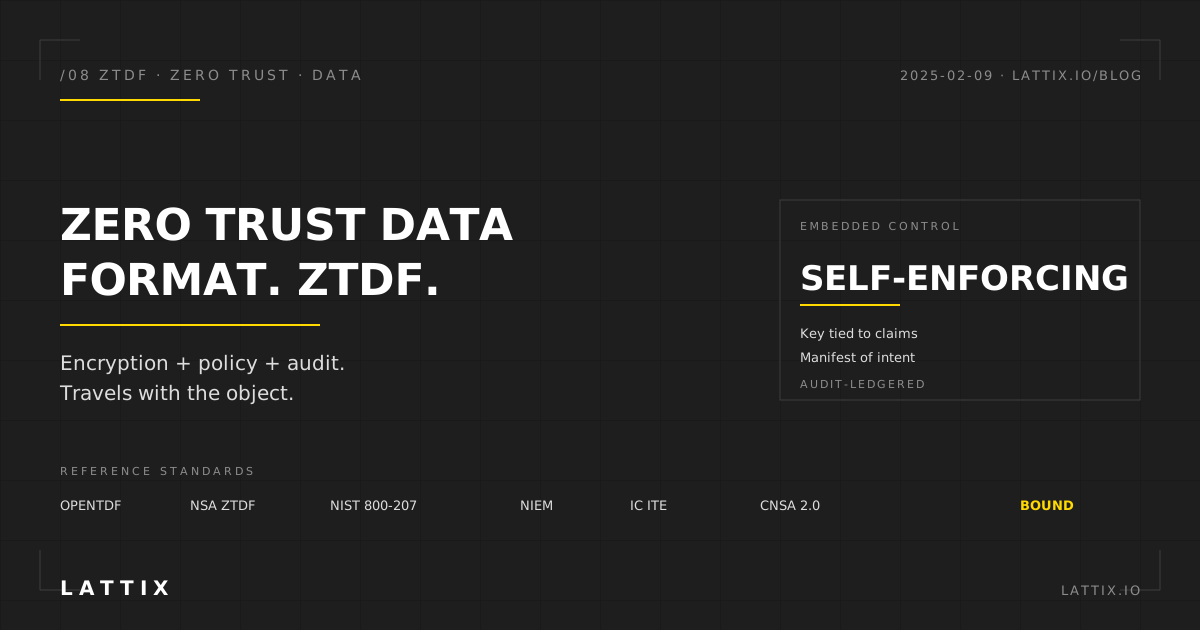
Zero Trust Data Format, or ZTDF, represents a fundamental shift in how security is applied to data. Rather than relying on external systems to enforce access controls and encryption, ZTDF embeds these capabilities directly into the data object itself. Every file, record, or data element wrapped in ZTDF carries its own encryption, its own access policies, and its own audit mechanisms. The result is a self-enforcing security boundary that persists regardless of where the data travels, who handles it, or what infrastructure it passes through. The data does not depend on its environment for protection; it protects itself.
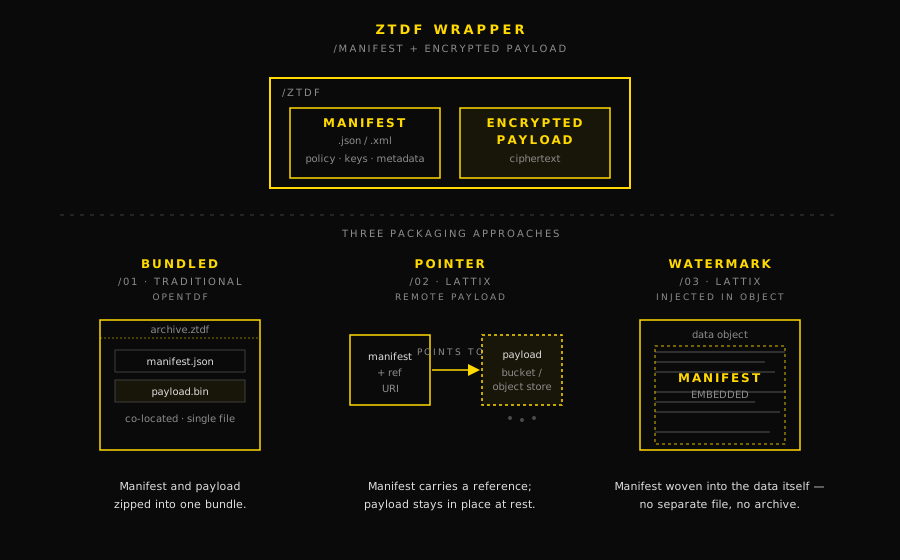
The Envelope Encryption Model
At the technical level, ZTDF combines envelope encryption with attribute-based access control policies expressed in a standardized, machine-readable format. When data is wrapped in ZTDF, it is encrypted with a unique data encryption key, which is itself encrypted under a key encryption key managed by a policy authority. The access policy, embedded alongside the encrypted payload, specifies the exact conditions under which decryption is authorized: user attributes, device posture, time constraints, geographic restrictions, and any other contextual factor the data owner deems relevant. A requesting entity must satisfy every policy condition before the key encryption key is released and decryption can proceed.
Blockchain-Anchored Audit
Blockchain integration amplifies the security guarantees that ZTDF provides. Every access decision, every policy evaluation, and every decryption event can be recorded on an immutable distributed ledger. This creates a verifiable chain of custody for every data object throughout its lifecycle. If a regulatory auditor needs to verify who accessed a specific record, when, under what authority, and whether the access was policy-compliant, the blockchain record provides cryptographic proof.
Enterprise Applications
Enterprise applications for ZTDF span every sector that handles sensitive data. In defense and intelligence, ZTDF enables secure data sharing across coalition partners and classification boundaries without requiring every participant to maintain identical infrastructure. In healthcare, patient records wrapped in ZTDF enforce HIPAA access requirements automatically, even when shared with external specialists or research institutions. Financial services organizations use ZTDF to maintain regulatory compliance as transaction data moves between internal systems, cloud analytics platforms, and regulatory reporting pipelines. In each case, the data carries its compliance requirements with it.
Regulatory Convergence
The compliance implications of ZTDF are particularly significant as regulatory frameworks converge on data-level accountability. GDPR requires demonstrable control over personal data throughout its lifecycle. HIPAA demands access controls and audit trails for protected health information. CCPA gives consumers rights over their data that organizations must honor regardless of where that data resides. CMMC requires defense contractors to protect controlled unclassified information according to specific practices.
ZTDF provides a single architectural mechanism that addresses all of these requirements simultaneously because the controls are inherent to the data format itself, not dependent on the compliance posture of surrounding infrastructure.