The Nx Console Supply Chain Attack Is a Credentials-as-Data Story
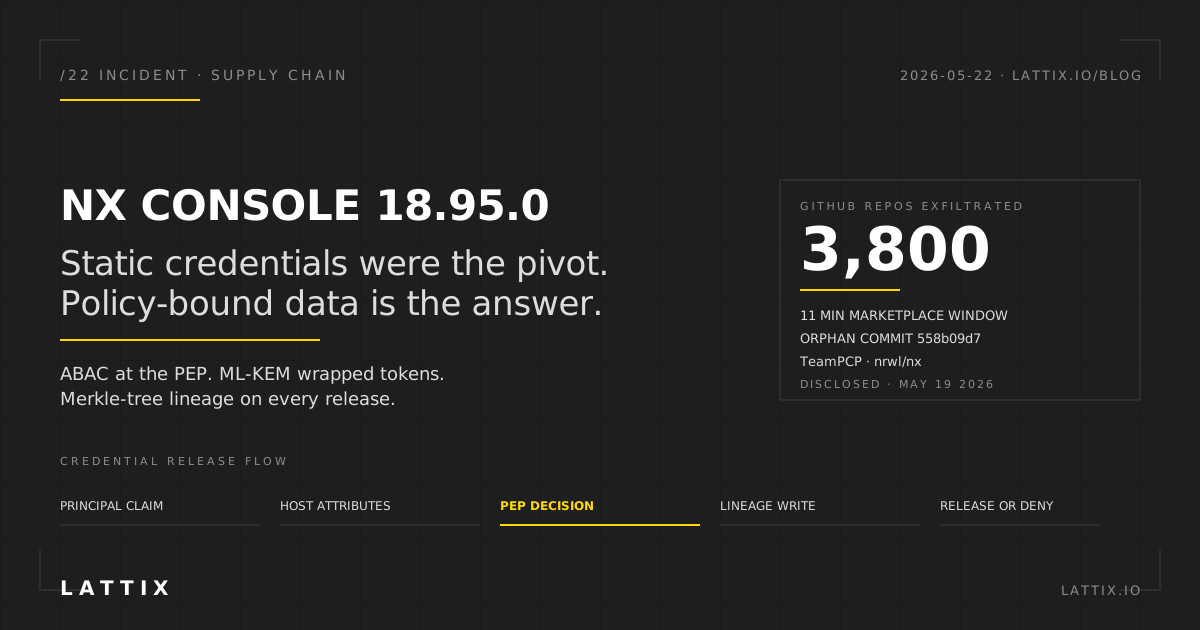
On May 18, 2026, a malicious version of the Nx Console Visual Studio Code extension was published to the Visual Studio Code Marketplace under the package identifier nrwl.angular-console version 18.95.0. The extension counts more than 2.2 million installations across the developer ecosystem. The malicious build remained live for approximately 11 minutes before the Nx maintainers pulled it. By 03:18 UTC, the attacker had pushed orphan commit 558b09d7 to the official nrwl/nx GitHub repository to host a 498 KB obfuscated credential stealer that the extension fetched the moment a developer opened any workspace. On May 19, GitHub disclosed publicly that approximately 3,800 internal repositories had been exfiltrated as a result. The threat group TeamPCP claimed responsibility.
The forensic detail published by StepSecurity, Aikido, The Hacker News, and Infosecurity Magazine is unusually clean for a supply chain event. The infection vector is settled. The pivot mechanism is settled. The architectural question that the incident raises has not been settled, and it is a data-centric question rather than a network or identity question.
What the attacker actually used
The stealer harvested tokens and secrets from GitHub, npm, AWS, HashiCorp Vault, Kubernetes, and 1Password. It exfiltrated them over HTTPS, the GitHub API, and DNS tunneling channels. On macOS hosts it installed a persistent Python backdoor that used the GitHub Search API as a dead drop for command-and-control messages signed with a 4096-bit RSA key.
The harvested tokens were the pivot. The 3,800 GitHub internal repositories that GitHub disclosed on May 19 were not read by the compromised extension. They were read by an attacker who took GitHub personal access tokens from developer workstations and replayed those tokens against the GitHub API from an attacker-controlled runtime. The same pattern applied to the npm, AWS, Vault, Kubernetes, and 1Password material. Static bearer credentials worked at the new origin because nothing in the credential bound it to the original origin.
The structural problem
A bearer credential is a string that grants access to whoever holds it. The credential carries no attribute about the principal who is presenting it, no attribute about the host that is presenting it, no policy that the receiving system evaluates against the request context, and no lineage record that survives the credential's reuse. The receiving system accepts the credential because it was issued, not because it is being used in a context consistent with the policy that authorized its issuance.
This is the same architectural gap that data-centric zero trust addresses for documents and database rows. Documents that carry only ambient access control fail at the moment the perimeter is compromised. Credentials that carry only ambient validity fail at the moment the workstation is compromised. The Nx Console incident is a clean demonstration that the secret material itself is data, the same as a healthcare record or a contract document, and that the same enforcement architecture applies.
Treating credentials as policy-bound data
The architecture that closes the pivot is one in which every credential is bound to attribute-based policy, every release decision runs through a policy enforcement point, and every release event is recorded in a tamper-evident lineage chain.
In that architecture, a GitHub personal access token is not a bearer string. It is a data object wrapped under attribute-based access control (ABAC) at the policy enforcement point (PEP). The token's release policy specifies the principal attribute set, the host attribute set, the time window, and the operation scope under which the wrapped key can be unwrapped. An attacker who exfiltrates the wrapped credential from a developer workstation obtains ciphertext. Presenting that ciphertext from an unsanctioned host, at an unsanctioned time, against an unsanctioned scope produces a fail-closed result at the PEP and a release-denied event in the lineage chain.
The same model applies to npm publish tokens, AWS access keys, Vault tokens, and Kubernetes service account tokens. Each becomes a wrapped data object with a release policy. Each fails closed when used outside the policy. Each generates an audit event at the moment the policy decision is made, not minutes or hours later when log aggregation completes.
What the lineage chain answers
The incident response work that follows a credential-pivot event is dominated by reconstruction. The team rebuilds, from heterogeneous logs across CI/CD, IAM, source control, secrets management, and endpoint detection, an account of which tokens were valid, which tokens were used, against which systems, from which origins, and on which timeline. The reconstruction takes days for a clean incident. It takes weeks for a messy one. The output is a probability statement that supports a customer notification, a regulator filing, and a board update.
Merkle-tree lineage over policy-decision events compresses the reconstruction. Every credential release writes a record to content-addressed storage anchored in a Merkle tree. The chain answers the operative questions cryptographically. Which credentials were released during the incident window. Against which scopes. From which originating attribute claims. The answer comes from one query rather than from log stitching. The answer is defensible against tampering because the chain is cryptographic, not a permission set on a file.
What this changes about the calculus for developer tools
The Nx Console incident did not require a novel attack technique. The orphan commit pattern is documented. The malicious-marketplace-extension pattern is documented. The credential stealer pattern is documented. What the incident demonstrates is the throughput available to an attacker who can land any of these techniques against a developer workstation that holds static bearer credentials for production systems. Eleven minutes of marketplace presence produced 3,800 internal-repository exfiltrations at GitHub alone.
The defensive answer that scales to that throughput is not faster marketplace moderation or stricter extension review. Both are useful and both will lag the next variant. The defensive answer is to remove the value of the credentials at the workstation. A credential that fails closed outside its policy is not worth the cost of exfiltrating. A pivot that does not work is a pivot that does not occur.
What teams should be doing in the next 90 days
Three operational priorities matter.
The first is an inventory of static bearer credentials held on developer workstations. The inventory should cover GitHub PATs, npm tokens, cloud provider keys, secrets manager tokens, and CI/CD service account credentials. The inventory deliverable establishes the surface that the next variant of this attack will harvest.
The second is the architecture decision about where these credentials should live. Options that move credentials off the workstation, such as short-lived workload identity federation, cryptographic agent forwarding, and hardware-bound credential issuance, reduce the harvested surface. Options that leave credentials on the workstation but bind them to attribute-based release policy at a centralized enforcement point reduce the value of the surface. Both directions are improvements over static bearer tokens in plain files.
The third is the audit instrumentation. The output of a policy enforcement decision needs to land in tamper-evident storage at the moment of the decision. Logs written to the same systems whose credentials were just stolen are logs that the next attacker also reaches. A cryptographically anchored lineage chain in storage that the workstation cannot write to directly is the integrity boundary that incident response actually needs.
How the architecture maps to existing standards
The NIST SP 800-207 Zero Trust Architecture model already names the policy enforcement point and the policy decision point as the architectural primitives. The CISA Zero Trust Maturity Model 2.0 names data and credentials as separately scored pillars. The NSA Zero Trust Implementation Guideline Data Pillar v2 (April 8, 2026) is explicit that the data pillar reaches credentials, secrets, and tokens, not only documents and database rows. The architecture described in this post is the prescribed direction in each of these frameworks. The Nx Console incident is the operational case for accelerating the build.
Lattix Technologies binds policy to data objects, including credential objects, through attribute-based access control at the policy enforcement point, post-quantum key encapsulation under ML-KEM-768 and ML-KEM-1024, and Merkle-tree lineage in tamper-evident audit storage. The architecture is procurable today against the surface the Nx Console attack exposed, not as a roadmap item against the next supply chain breach.
The Nx Console maintainers responded quickly. The Visual Studio Code Marketplace, GitHub, and the affected ecosystem partners published clear remediation guidance. The architectural lesson is for the systems the next variant will reach, not for the package that already shipped the fix. Credentials are data. Treating them as data is the work.
References
- Aikido Security, GitHub Breached via VS Code Extension: Developer Supply Chain Attack 2026
- StepSecurity, Nx Console VS Code Extension Compromised
- The Hacker News, Compromised Nx Console 18.95.0 Targeted VS Code Developers with Credential Stealer
- Infosecurity Magazine, GitHub Breach Traced to Malicious Nx Console VS Code Extension
- Rescana, GitHub Internal Repositories Breached via Compromised Nx Console VS Code Extension
- NIST SP 800-207, Zero Trust Architecture
- CISA Zero Trust Maturity Model 2.0
- NSA Zero Trust Implementation Guideline Data Pillar v2, April 2026