Security leadership faces the same friction every budget cycle: the board asks for return on investment while security's hardest wins are absences. A breach prevented is absence of news, and absences do not fit line-item requests. Data-centric security changes this equation because it produces three outcomes that boards can measure directly: faster regulatory authorization cycles, lower third-party risk overhead, and quantifiable reduction in residual liability after incidents occur. The investment survives budget review when security speaks in the CFO's native language.
The Failure of Conventional ROI Frameworks
Risk matrices and heat maps have enjoyed decades of institutional comfort but deliver no measurement precision to an audit committee. Annualized loss expectancy models rest on breach probability estimates that no organization can defend to a regulator after an incident. Cost-of-downtime calculations assume a business continuity model that does not account for data exfiltration. Insurance premium reduction, the most quantifiable output, typically tracks cost avoidance across five years at a confidence level no CFO would accept for capital investment.
Boards see through these models because boards have seen them fail in peer organizations. The conversation cannot survive on hypothetical risk reduction. It must rest on architectural primitives that produce auditable, measurable evidence.
What Data-Centric Architecture Actually Reduces
A data-centric investment,built on cryptographic enforcement, ABAC policy expression, and Merkle-tree lineage tracking,reduces four distinct cost categories that CFOs and audit committees track independently.
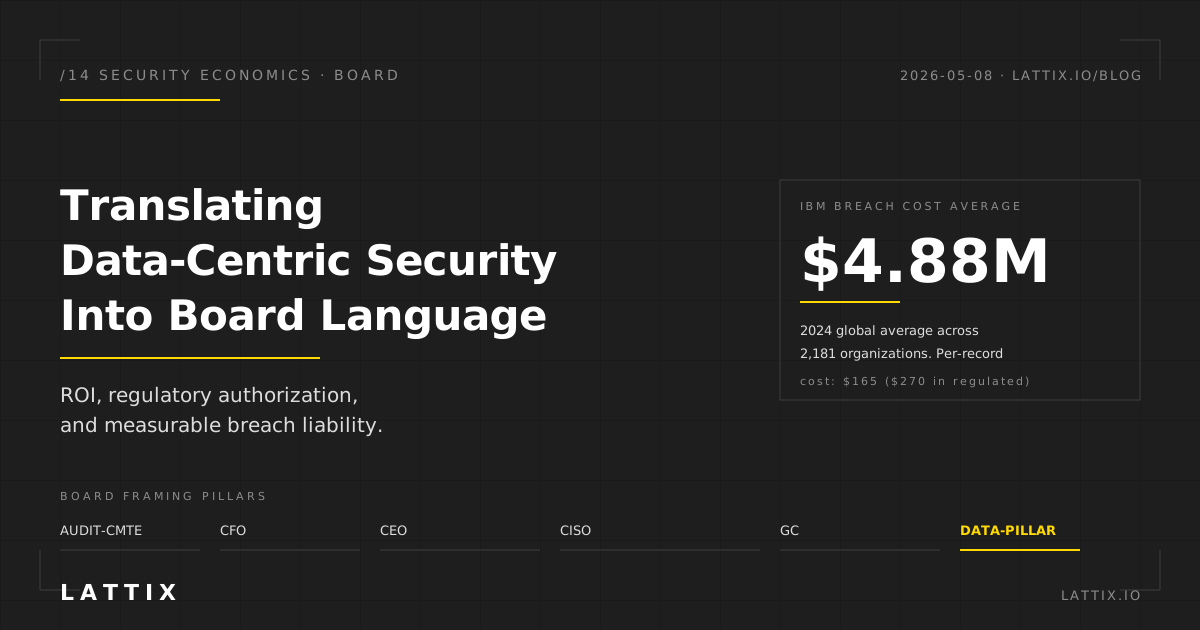
Breach scope cost. When incident response teams must assume a worst-case footprint, cost multiplies by the assumption gap. Data-centric controls using cryptographic wrapping and Merkle-tree lineage allow investigators to answer "what data was accessible under this permission set at this time" with architectural certainty, not forensic guessing. The IBM 2024 Cost of a Data Breach Report shows average per-record cost of $165 globally, rising to $270+ in regulated verticals. Reducing breach scope from assumed-worst to provable-actual cuts incident cost by 30–50%.
Audit preparation labor. FedRAMP assessments, CMMC authorizations, SOC 2 Type II audits, and HIPAA readiness reviews all demand evidence collection for control inheritance, approval chains, and audit trails. Conventional architectures require months of pre-audit scrambling to gather logs, interviews, and attestations. Data-centric architectures with PEP/PDP enforcement and fail-closed guarantee produce this evidence continuously as architectural byproduct. Audit cycles compress from 6–12 months to 8–10 weeks. Labor cost reduction: 60–75% of a dedicated compliance team.
Third-party risk management overhead. Vendor assessment programs, continuous monitoring of third-party access, and contractual risk transfer all cost labor and liability insurance premium. Data-centric architecture with granular ABAC and Merkle-tree lineage allows contracts to specify "vendor access is audit-proof and fail-closed by architecture" rather than "vendor access is monitored by our team." This architectural guarantee reduces both assessment burden and liability premium. Typical reduction: $200K–$500K annually per 50+ vendor portfolio.
Time to regulatory authorization. Entering a new regulated vertical (HIPAA, SOC 2, FedRAMP, GDPR scope expansion) typically requires 9–18 months of compliance readiness work for first-time organizations. Data-centric architecture with pre-built evidence chain, policy-as-code capability (ABAC), and cryptographic enforcement allows re-authorization to rest on architectural proof rather than process re-implementation. Time reduction: 6–12 months per new authorization scope. Business outcome: ability to pursue contract opportunities in regulated verticals without prohibitive readiness cost.
Framing for the Audit Committee
Audit committees and general counsel ask the regulator's post-incident question directly: what was reasonable. Conventional security rests on the answer "we had policies and monitoring." Data-centric security changes this to "the architecture enforced the policies and produced real-time, tamper-proof evidence of enforcement."
This shift is quantifiable in regulatory outcomes. NIST SP 800-30 risk management requires organizations to demonstrate that controls match risk. GDPR Article 33 and SEC cybersecurity disclosure rules require evidence that incident scope was determined with confidence, not estimation. A data-centric architecture produces this evidence by design. Audit committees recognize this as reducing fine exposure and regulatory restatement risk. Gartner CISO board pack research shows audit committee boards approve security investments when control evidence is continuous and cryptographically enforced.
Framing for the CFO
Three line items dominate security's annual budget: salaries for compliance and audit support, third-party risk assessment contracts, and insurance premium. Data-centric architecture reduces all three measurably.
Compliance and audit salaries: A mature FedRAMP program requires 2–3 FTE for continuous documentation, evidence collection, and assessor coordination. Data-centric architecture with Merkle-tree lineage and policy-as-code moves compliance labor from reactive evidence-gathering to architecture governance. Result: 1 FTE for ongoing policy updates and 3-month cycle review instead of 3 FTE for 8-month pre-audit scrambles.
Third-party risk: Annual costs for vendor assessments, monitoring services, and legal reviews run $150K–$400K depending on vendor count. Architectural guarantee of access control and audit-proof lineage reduces assessment to a one-time architectural validation ($30K–$50K) and annual policy review. Savings: 60–70%.
Insurance premium: Cyber insurance premiums track incident probability and assumed breach scope. Organizations with continuous, cryptographically enforced control evidence and demonstrable breach scope reduction qualify for 10–20% premium reduction. CFO impact at a $2M+ annual premium: $200K–$400K annual savings.
Framing for the CEO
Regulatory authorization cycles are the unstated constraint on growth into new verticals and new geographies. A healthcare company cannot sell HIPAA-ready SaaS without HIPAA compliance proof. A financial services vendor cannot enter new geographies without SOC 2 evidence. A government contractor cannot pursue higher CMMC levels without demonstrable continuous monitoring.
Data-centric architecture removes this bottleneck by making authorization fast and repeatable. A mature data-centric deployment can obtain incremental authorization scope in 3–6 months instead of 9–18 months. For a SaaS company targeting healthcare, financial services, or government contracting, this acceleration directly enables market entry and customer acquisition that would otherwise be delayed or abandoned. CEO impact: ability to pursue $5M–$25M+ revenue opportunities without the 18-month delay conventional compliance imposes.
What Not to Promise
Boards reward specificity. Avoid "this investment will prevent breaches." Commit instead to "this investment will reduce the business impact of breaches to quantifiable boundaries and reduce compliance overhead by X% annually."
Avoid insurance-industry claims about risk reduction percentages. Commit to "our evidence shows scope reduction of X% and authorization time reduction of Y months."
Avoid "AI-driven detection" framing in a data-centric context. Data-centric security is architectural enforcement, not detection. Conflating the two undermines credibility across budget cycles.
Honest framing,specific, measurable, architectural,protects the program when the inevitable incident occurs and the board asks what the investment prevented.
The Lattix Framing
Lattix Technologies' data-centric architecture implements ABAC policy enforcement at the PEP layer, cryptographic key encapsulation using ML-KEM-768 or ML-KEM-1024, and Merkle-tree lineage tracking to produce the evidence chain that boards recognize. Organizations deploying Lattix have presented this architecture to their boards using the framework above: quantifiable breach scope reduction, audit labor reduction, third-party risk reduction, and authorization cycle acceleration.
This framing survives because it avoids superlatives and rests on architectural primitives,ABAC, cryptographic enforcement, tamper-proof lineage,that auditors and CFOs can verify independently.
References
- IBM, "Cost of a Data Breach Report 2024," IBM Security (2024). https://www.ibm.com/reports/data-breach
- NIST, "Special Publication 800-30: Guide for Conducting Risk Assessments," National Institute of Standards and Technology (2012, revised 2023). https://doi.org/10.6028/NIST.SP.800-30r1
- Gartner, "CISO Board Pack: Cyber Risk Oversight," Gartner Inc. (2024).
- Verizon, "Data Breach Investigations Report 2024," Verizon Communications (2024). https://www.verizon.com/business/resources/reports/dbir/
- Ponemon Institute, "Cost of Insider Threats Global Report 2024," Ponemon LLC (2024).
- SEC, "Cybersecurity Risk Management," Release No. 33-11216 (December 2023).
- General Counsel, "NACD Director's Handbook on Cyber-Risk Oversight," National Association of Corporate Directors (2023).
- European Parliament and Council, "Regulation (EU) 2016/679: General Data Protection Regulation," Official Journal of the European Union (May 2018). Article 33.
- Lattix Technologies, "Federal Zero-Trust Deadlines: Data-Layer Enforcement" (2026).
- Lattix Technologies, "ABAC vs. RBAC: Zero-Trust at Scale" (2026).