ABAC vs RBAC: Why Attribute-Based Access Control Is the Zero Trust Default
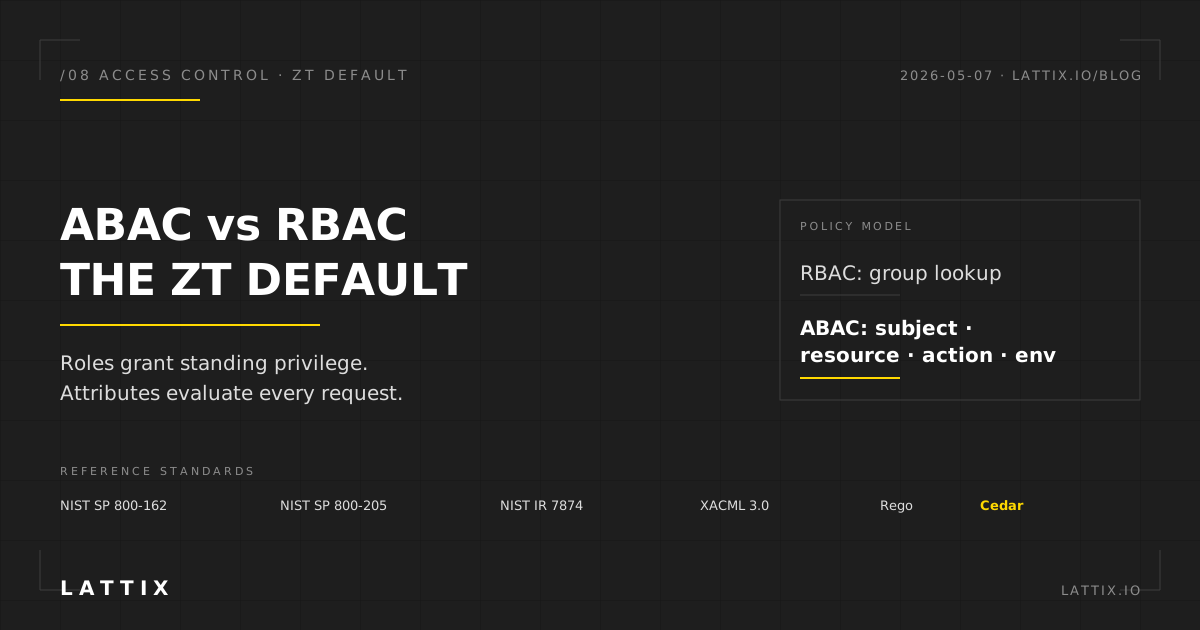
Most enterprise access control started as role-based by accident. Someone needed a permission, an admin created a role, and twenty years later that role still exists, still carries those permissions, and is now granted to three hundred users who inherited it because their job title matched. Zero trust treats every access request as a policy decision evaluated in real time against current context. Role-based access control cannot express "current context"; it can only express which group the requester is in. The two models are not on a spectrum; they are architecturally different.
What RBAC was designed for
RBAC was formalized by Ferraiolo and Kuhn at NIST in 1992 and ratified as ANSI INCITS 359 in 2004. It assumed an enterprise where the org chart was the access control plan. A user inherited their role's permissions on hire, kept them through tenure, and lost them on termination. The model worked when applications were monolithic, deployments were on-premises, and users sat in named roles such as "AP Clerk" or "Sales Engineer."
Three properties of that environment made RBAC tractable. Role definitions changed slowly. Resource taxonomies were stable. The set of contexts in which a request might happen was small enough to enumerate. None of those properties holds in a modern enterprise.
The model also assumed that the security boundary was the network perimeter and that authenticated users were trustworthy by default. Zero trust inverts that assumption: every request is treated as potentially adversarial, regardless of the requester's location or session state. RBAC has no language for "potentially adversarial." It has language for "in the right group" and nothing else.
Where RBAC breaks down
Role explosion is the well-documented failure mode. NIST IR 7874 (2009) flagged this as a structural property of RBAC at scale, not a deployment mistake. Studies of large enterprises consistently find role counts in the tens of thousands, often exceeding the number of users, because every exception generates a new role rather than a refinement of an existing one.
Permission accretion compounds the problem. A user changes jobs internally and inherits a new role; the old role is rarely removed because removal might break something. Over a five-year tenure, the user's effective permission set grows monotonically. By year three, the principle of least privilege exists only on paper. NIST SP 800-205 documented this pattern as a dominant cause of insider-threat exposure in large RBAC deployments.
The hardest break is in cloud-native and AI environments. Service accounts, ephemeral pods, autonomous agents, and OAuth integrations all need access. Each one is a "role" in the RBAC model, but the role's lifetime is minutes, not years. Provisioning a role for a 90-second job is operational overhead that no team executes consistently. The result is permanent service accounts with broad standing access, which is exactly what RBAC was meant to prevent.
What ABAC actually evaluates
NIST SP 800-162 defines ABAC as policy evaluation over four attribute classes: subject (who), resource (what), action (the intended operation), and environment (context). Every request gets evaluated against a policy that names attributes from those classes and returns permit or deny. The user's group memberships are a subset of subject attributes, but they are not the whole story.
A representative ABAC policy: a request to read a document succeeds if (a) the subject's clearance level is at or above the document's classification, (b) the subject's nationality is on the document's release list, (c) the request originated from a managed device with current attestation, (d) the time of day is within working hours for the document's owning office, and (e) the document's policy authority has not revoked access in the last 60 seconds. RBAC cannot express any of those clauses. ABAC encodes them as one expression.
This is the architectural difference. RBAC asks whether the user is in the right group. ABAC asks whether the policy on this object accepts this request, given everything we know right now.
The four attribute classes, modeled concretely
Each of the four classes carries a different operational meaning, and each comes from a different source system. The architecture is only as strong as the worst-modeled class.
Subject attributes describe the principal making the request. The well-known ones (employment status, role, group memberships, clearance level) come from the identity provider. The less-obvious ones (training completion, project assignment, current oncall status, citizenship, security incident flag) come from HR systems, training platforms, project management tools, and SIEM. NIST SP 800-205 names "subject attribute provenance" as a frequent failure mode: the IdP knows the role, but the policy needs the training completion, and the link between the two is missing.
Resource attributes describe the data object being accessed. Classification level, owning agency, project, dataset name, retention policy, regulatory regime, and origin lineage are the operational ones. Resource attributes are the class most often produced by semantic tagging at write time, because the producing system knows the most about the object. Classification at creation is the architectural pattern that produces high-quality resource attributes, and it is the prerequisite for every other ABAC dimension to be useful.
Action attributes describe what the principal is trying to do. Read, write, forward, derive, delete, copy-to-clipboard, print, and screenshot are all distinct action types in a well-modeled policy. The most expressive ABAC deployments include "purpose of use" as an action attribute, because HIPAA and GDPR both require purpose limitation in ways that simple read/write distinctions cannot express. NIST IR 8112 describes purpose-of-use as a first-class attribute that the calling application must declare on every request, not infer at the storage layer.
Environment attributes describe the context in which the request is happening. Time of day, geographic location, network position, device posture, threat-intelligence indicators for the requesting IP, and active emergency declarations are all environment attributes. The policy can require that a read succeed only when the environment matches expected conditions: managed device, expected geography, no active high-severity incident on the user's account, current device attestation, normal working hours. Environment attributes are the most volatile class, because they change second-to-second, and they are the class that distinguishes ABAC from RBAC most clearly. RBAC has no way to express "this request is fine right now but would not be fine in five minutes if the threat indicator changes."
Modeling ABAC dimensions through semantic tagging
The four classes are only useful if the attributes they reference are reliable, current, and tied to the systems of record. The architectural pattern that produces reliable attributes is semantic tagging: every attribute is named, typed, sourced, and version-controlled, the same way schema fields are.
Subject attributes get tagged at the identity layer. The IdP issues SAML or OIDC tokens that carry not just the user's group membership but a structured set of named attributes (clearance, training, project assignment, citizenship, employment status). The policy references these attributes by name, and the IdP integration provides the values at request time. Federated environments require attribute provenance: the policy says "the clearance attribute must come from a trusted IdP," and the trust list is itself version-controlled. Attribute issuance becomes a first-class operation alongside authentication.
Resource attributes get tagged at the storage layer or the producing application. The classification, owning project, retention policy, and regulatory regime all attach to the object as metadata. The policy reads the metadata as part of the request evaluation. A well-tagged resource has its policy attributes embedded in the object itself, not in a sidecar database that can drift. Lattix Technologies implements this through cryptographic enforcement: the resource attributes are bound to the object's wrapping key release, so an unattributed read returns ciphertext. The semantic tagging pipeline (pattern matching, ML content analysis, metadata inference) feeds into the policy authority, which signs the attributes and binds them to the object.
Action attributes get tagged at the calling application. The application declares the intent of every request: not just "read this file" but "read this file for HIPAA-compliant treatment purposes." The policy can reject reads that lack a declared purpose, or accept only specific purposes for specific resource classifications. The architectural pattern requires explicit support in the SDK or API; pattern-matching the calling code is not sufficient. The Lattix SDK takes the action attribute as a required parameter on read, write, and forward, which means the policy can express purpose-bound rules that the application is structurally unable to bypass.
Environment attributes get tagged at the policy enforcement point (PEP) at evaluation time. The PEP queries the device-posture system, the threat-intelligence feed, the time service, and the network identification service, and constructs the environment block for the policy decision. The freshness of environment attributes is the key property: the PEP must source these at the moment of decision, not from cached values that could be hours stale. A well-modeled environment block is the difference between a policy that reflects current risk and a policy that reflects yesterday's risk.
Writing policies that humans can audit
The standing critique of ABAC is that policies become unreadable. NIST IR 8112 (2018) addressed the criticism directly by recommending that policies be written in structured policy languages with explicit versioning and unit tests, not free-form expressions. Three languages have emerged as production-grade options: XACML 3.0 (OASIS standard, mature but verbose), Rego (used by Open Policy Agent, expressive and CNCF-graduated), and Cedar (AWS, 2023, designed for formal verification).
Each language separates the policy from the runtime. Policies are stored in version control, reviewed like code, tested against fixture inputs, and deployed through CI/CD. The auditor reads the policy, not a permission tree. The policy decision point (PDP) compiles the policy and evaluates requests against it at scale.
The cultural shift is that access control becomes a software engineering practice. The compliance team writes the requirement; the security team writes the policy; the platform team operates the PDP. Each role has a deliverable, and the policy itself is the audit artifact rather than a screenshot of group memberships.
The migration path
Nobody rips out RBAC overnight. A realistic migration runs RBAC and ABAC in parallel: RBAC handles the coarse filter (is this user in the company at all), and ABAC handles the fine-grained decisions on classified resources (does this specific request meet the policy for this specific object). This is the pattern NSA's Zero Trust Implementation Guidelines describe as the Phase Two integration point.
Lattix Technologies implements ABAC at the policy enforcement point (PEP) bound to each data object's classification. The policy decision point (PDP) evaluates ABAC requests against the requesting principal's attributes, the object's classification, and the operational context. Existing RBAC infrastructure remains in place as the first-pass authentication layer; ABAC takes over once the request reaches the data plane. The enforcement is fail-closed.
The migration cost is bounded by the number of objects that need policy bound to them, not by the number of users or roles. That economic property is why data-centric architectures roll out ABAC incrementally where wholesale RBAC replacement would be prohibitive. Programs that begin the parallel deployment now hit the FY27 zero trust target-level outcomes on the calendar the federal acquisition language already references.