The EU AI Act High-Risk Deadline Slipped to December 2027. The Architecture Window Did Not.
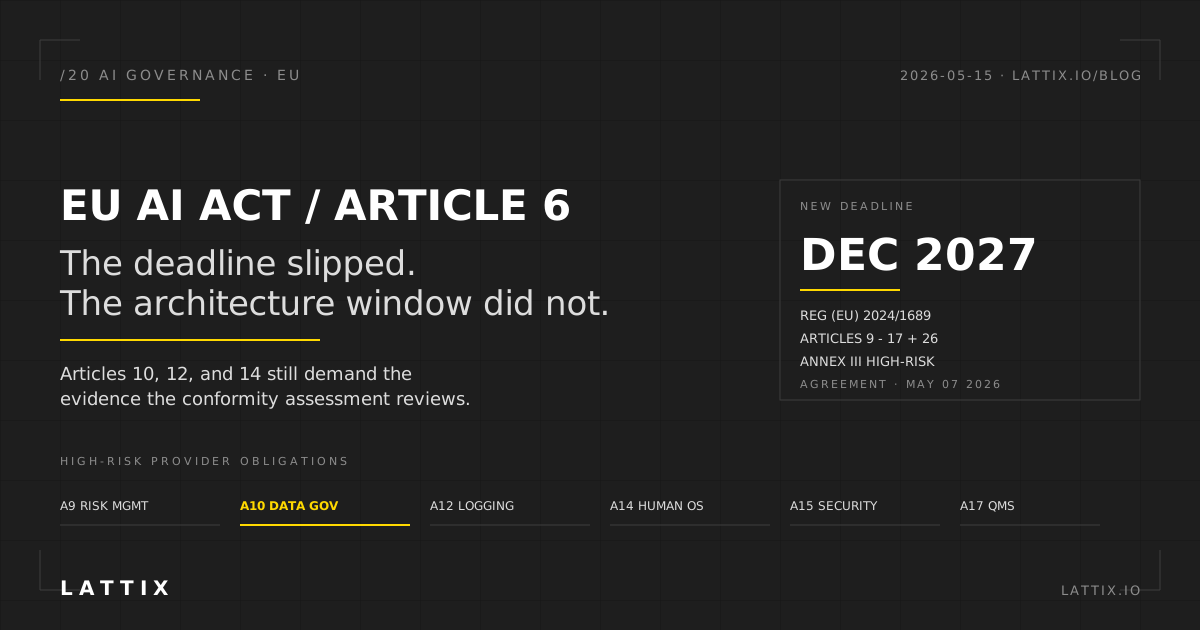
The European Union reached a political agreement on May 7, 2026 to push the binding compliance deadline for high-risk AI systems under Article 6 of the EU AI Act from August 2, 2026 to December 2027. The shift gives providers and deployers additional time to complete conformity assessments, register systems in the EU AI database, affix CE marking, and stand up post-market monitoring. The shift also gives the conformity assessment ecosystem additional time to mature: more notified bodies, harmonized standards work under CEN-CENELEC JTC 21, and clearer guidance from the European AI Office. The deadline moved. The substantive obligations did not move. Organizations that treat the delay as relief will face the same architectural gap in December 2027 that they would have faced in August 2026, with sixteen fewer months to close it.
The deadline shift affects Articles 9 through 17, which govern provider obligations for high-risk AI systems, and Article 26, which governs deployer obligations. The substance of these articles is unchanged in the political agreement. Article 9 still requires a risk management system. Article 10 still requires data governance practices for training, validation, and testing datasets. Article 12 still requires automatic logging of events relevant to system operation. Article 14 still requires human oversight. Article 15 still requires accuracy, robustness, and cybersecurity by design. Article 17 still requires a quality management system. Each obligation is technical in nature. Each obligation requires evidence at the conformity assessment.
What changed and what did not
The agreement reached at the May 7, 2026 Council and Parliament negotiation responds to industry concerns about the maturity of harmonized standards, the readiness of notified bodies, and the operational burden on SMEs. The European Commission's accompanying statement acknowledges that fewer than half of the expected harmonized standards under CEN-CENELEC JTC 21 had reached final form by Q1 2026, and that notified body capacity for AI conformity assessments remained limited. The delay gives the standards ecosystem time to deliver the assessment criteria and the notified body ecosystem time to scale.
The agreement does not narrow Article 6's definition of high-risk AI systems. The Annex III list remains intact, covering biometric categorization, critical infrastructure operation, education and vocational training scoring, employment and worker management, access to essential services, law enforcement, migration and border control, and administration of justice and democratic processes. The agreement does not narrow Article 10's data governance requirements, which include relevance and representativeness of training data, examination for biases, data preparation processing, and assumption-checking for the dataset against the intended purpose. The agreement does not narrow Article 12's logging requirements, which include logs sufficient to identify risks and serious incidents, and logs that are retained for an appropriate period.
The substantive obligations are technical. The deadline shift gives organizations time to build. It does not change what needs to be built.
Why the delay is build time, not relief
The architecture that produces evidence for Article 10 data governance is a training data lineage architecture. The lineage has to record the origin of each data element, the transformations applied, the access decisions made during training, and the validation against representativeness criteria. The architecture has to survive an audit by a notified body twelve to twenty-four months after a model is placed on the market, and the audit may extend backward to data sourced before the model was trained.
Organizations that have run conformity assessment pilots through 2025 report a consistent finding. The training data corpus is the artifact that the notified body examines most closely. The questions the assessor asks are not about the model. They are about the data. Where did this data come from. How was it labeled. Who had access to it. What attribute filters were applied during selection. What was excluded and why. How can the organization prove that the corpus does not contain prohibited categories under Article 10(3). Each question has an evidentiary answer or it has a finding.
Training a high-risk AI system without these answers in place at the start produces a model that cannot pass conformity assessment retroactively. The lineage has to exist at training time, not at audit time. Reconstructing lineage after the fact from heterogeneous logs and ETL pipelines produces a probability statement, which is not the evidence Article 10 demands.
Sixteen months between today and December 2027 is the build window for the lineage architecture. Twelve months is the lower-bound estimate from organizations that have completed pilots. Six months is below feasibility. The agreement that moved the deadline to December 2027 did not extend the build window relative to the work. It restored the build window to a feasible duration.
What Article 10 evidence actually looks like
Article 10(2) requires that training, validation, and testing datasets be subject to data governance and management practices that address the relevant design choices, data collection processes, data preparation processing operations, the formulation of assumptions, prior assessment of the availability and quantity and quality of the datasets, examination for biases, and identification of relevant data gaps.
Each item in the list resolves to an evidence question that a notified body will ask.
The design choices evidence asks why the training data composition was selected the way it was. The answer is a recorded design decision that traces back to specific data subsets in the corpus. The data collection processes evidence asks where the data came from and whether the sources were lawful and representative. The answer is a sourcing record per data element. The data preparation operations evidence asks what transformations were applied and whether the transformations preserved relevance. The answer is a transformation lineage per data element. The bias examination evidence asks what test was applied, what results were produced, and what mitigations followed. The answer is a test record bound to the corpus version that was examined.
The architectural primitive that produces all of these answers is content-addressed storage with policy-bound metadata and a Merkle-tree lineage chain. Each data element is addressed by its cryptographic content hash. Metadata travels with the element through every transformation. Every access and every transformation event is recorded in a tamper-evident chain that the notified body can replay.
How Lattix supports the conformity assessment
Lattix Technologies binds policy to training data objects through attribute-based access control (ABAC) at the policy enforcement point, post-quantum key encapsulation through ML-KEM-768 and ML-KEM-1024, and Merkle-tree lineage in tamper-evident audit storage. The architecture produces the evidence Article 10 demands at training time, as a side effect of the training process, rather than as a documentation exercise before the assessment.
The Lattix Key Access Service evaluates each read of training data against the principal requesting access and the policy attached to the data object. Each release is recorded in the lineage chain. A notified body conducting the conformity assessment can query the lineage for the sourcing record of any data element, the access history of any subset, and the transformation chain leading from raw data to the training corpus version that produced the deployed model. The assessment is a query against the audit chain, not a reconstruction from logs.
Article 12 logging requirements are satisfied at the same layer. The logs the article requires are automatically generated during system operation by the policy enforcement point. The logs are retained in tamper-evident storage. The logs are queryable by the deployer for post-market monitoring under Article 72 and the post-market monitoring system under Article 61.
Article 15 cybersecurity-by-design requirements are satisfied by the cryptographic enforcement model itself. The system meets the article's requirement that AI systems have appropriate cybersecurity measures throughout their lifecycle, including measures to prevent and respond to attacks aimed at altering the use, behavior, or performance of the system. Object-level cryptographic enforcement bound to ABAC satisfies the article's expectation that protections persist through the data lifecycle.
What organizations should do between now and December 2027
The build window is the calendar between today and the first conformity assessment for the organization's highest-priority high-risk system. The first assessment will not happen on December 31, 2027. Most providers will target Q2 or Q3 2027 to leave audit buffer before the December deadline. The build window for those providers is eighteen months.
Three priorities matter inside the window.
The first is the corpus inventory. The organization needs to identify every training dataset, validation dataset, and test dataset associated with every high-risk system in the portfolio. The inventory has to be at the data-element granularity that Article 10 demands. An inventory at the dataset granularity will fail an assessment that asks element-level questions.
The second is the lineage architecture. The organization needs to determine whether the current training pipeline produces element-level lineage as a side effect of the pipeline, or whether lineage is reconstructed after the fact. Pipelines that reconstruct lineage will not produce defensible Article 10 evidence. Pipelines that produce lineage at training time will. The architectural decision is upstream of every dataset that enters the corpus.
The third is the conformity assessment dry run. By Q4 2026 or Q1 2027, the organization should run an internal dry-run assessment against the harmonized standards work that has finalized to date. The dry run identifies the evidence gaps that the actual notified body will identify. Closing the gaps takes months. Identifying them in 2026 leaves the months. Identifying them in 2027 does not.
The December 2027 deadline is not relief. It is the precise duration of the build the substantive obligations actually require. Organizations that read the agreement as relief will discover the build duration in 2027 with no build window left.
References
- Regulation (EU) 2024/1689, the EU AI Act (consolidated text)
- Annex III of Regulation (EU) 2024/1689, High-Risk AI Systems List
- European AI Office, Navigating the AI Act
- CEN-CENELEC JTC 21, Standardization Request M/593 for AI
- European Commission, AI Act Implementation Timeline
- NIST AI Risk Management Framework (AI RMF 1.0)
- NIST SP 800-207, Zero Trust Architecture