Data-Centric Security Closes the Third-Party Risk Assurance Gap
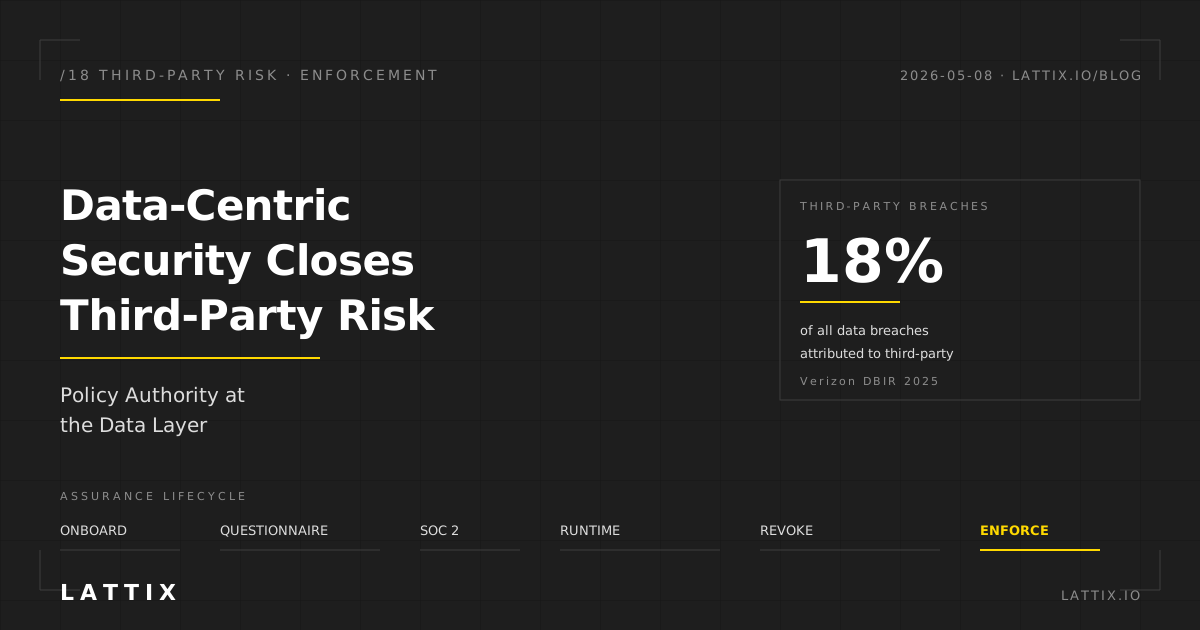
Every enterprise with procurement authority confronts the same structural problem: the company remains liable for data once it reaches a vendor, but possesses no continuous visibility into the vendor's environment. Questionnaires snapshot a moment. SOC 2 Type II reports describe the past. Annual reassessments miss the intervening 364 days. When a material vendor is breached,and statistics from the latest Verizon Data Breach Investigation Report place third-party compromise at 18 percent of breaches,the regulator's opening question is not whether a checkbox existed in the vendor management program. It is how the data was protected in an environment the company does not control.
A data-centric approach inverts the problem. Instead of auditing the vendor's infrastructure continuously (an impossibility at scale), the data itself enforces policy at the point of access, regardless of where the data resides or who holds the keys to the network. The data carries policy with it. The vendor evaluates policy at the PEP (Policy Enforcement Point) against attributes the data carries. The data owner retains the policy authority,the PDP (Policy Decision Point),on their own infrastructure. Access is granted or denied by reference to the data owner's policy, not the vendor's trust boundary.
The Questionnaire Ceiling
The Shared Assessments Consortium's Common Assessment Initiative Questionnaire (CAIQ) contains 197 control questions. Organizations routinely add custom questionnaires on top. Vendors respond. Assessors review. The result is a static snapshot of vendor posture at a single moment, surrounded by contractual language that says "representations made as of the date hereof."
The gap appears immediately. By the time responses are validated, integrated into a risk score, and approved by the procurement committee, the vendor's environment has changed. Security patches are deployed. Team members rotate. Infrastructure is added or retired. The questionnaire provides zero visibility into any of it. Questionnaire fatigue,documented extensively in Shared Assessments research,compounds the problem: vendors struggle to differentiate between substantive controls and checkbox exercises, reducing response quality across the board.
SOC 2 Type II audits, intended as point-in-time evidence of control maturity over a measurement period, suffer the same temporal liability. A 12-month audit report signed in April describes controls that existed in January and provides no assurance about current posture. Continuous monitoring dashboards and SIEM outputs see network and infrastructure signals but not data flows. None of these mechanisms answer the core question: Is this specific data currently protected in this vendor's current environment.
Regulatory Expectations Demand Continuous Demonstration
SEC Cybersecurity Disclosure Rule Item 1.05 (8-K filing) and the OCC's Heightened Standards both require material breach notification within four days of discovery and clear disclosure of third-party involvement in any incident affecting customer data. NIST SP 800-161 Rev 1 (Cybersecurity Supply Chain Risk Management) mandates continuous assessment of supplier risks and documented evidence of data handling controls. DORA (Digital Operational Resilience Act, binding across EU Member States from 2025 forward) requires operational resilience plans that include third-party risk with specific incident escalation and response timelines. NYDFS Part 500 requires annual security audits and vendor risk reviews for financial services firms. GDPR Article 28 requires that Data Processors demonstrate compliance through contractual terms and technical safeguards; "demonstrate" implies continuous, not annual or event-driven.
The language is consistent: regulators expect demonstrable, continuous control. Demonstrable means auditable by a third party,the vendor's auditor, the data owner's auditor, a regulator. Continuous means not frozen to a quarterly or annual cycle. The gap between what enterprises can practically achieve through procurement and what regulators expect defines the third-party risk assurance problem.
Policy That Travels: Zero-Trust Data Framework at the Vendor
Data-centric zero trust (ZTDF) applies access control not at the perimeter but at the data layer. In third-party contexts, this means the data object arrives at the vendor already encrypted and bound to attribute-based access control (ABAC) policy. The vendor does not hold the keys that unlock the data. The vendor does hold a policy evaluation engine,a PEP capable of reading the policy attached to the data and enforcing it.
When a developer at the vendor's company attempts to access the data in question, the vendor's PEP intercepts the request. It evaluates the policy against real-time attributes: the requestor's role, the timestamp, the requestor's session context, geographic origin, multi-factor authentication status, and custom attributes defined by the data owner. The data owner retains the PDP,the authority to define, update, and revoke policy,on their infrastructure. If the access request matches the policy, the cryptographic key release authority issues a key release token (typically using post-quantum key encapsulation mechanisms like ML-KEM-768/1024 for forward security). If the request does not match, access is denied. The vendor cannot override the decision.
Revocation is instantaneous. If the data owner observes anomalous access patterns, discovers a compromise, or simply wants to sever a vendor relationship, revoking the policy and rotating the key release token cuts all future access. Existing access tokens expire. The vendor cannot request a new token unilaterally. The data owner controls the flow of cryptographic material from the point of issuance forward.
Revocation as Incident Response
The practical impact appears most clearly in a breach scenario. When a vendor announces a compromise on a Friday afternoon,the Mercor ransomware incident, the Instructure Canvas breach, the Anodot unauthorized data access,enterprises face a narrow set of choices: request the vendor delete the data (unverifiable), assume the data is exfiltrated and plan disclosure, or freeze the vendor account pending investigation. Each option carries exposure.
A data-centric architecture inverts the dynamic. The exfiltrated data is already wrapped in ZTDF. The cryptographic keys required to access it remain under the data owner's authority. Revoking the key release policy in 30 seconds severs unwrapped access everywhere the data has been copied. Data extracted before revocation remains encrypted and policy-bound. The vendor cannot unwrap it without requesting a new key release token from the data owner's PDP,a request that will be denied.
Revocation is an incident response primitive comparable to disabling a user account or revoking a certificate. It works without requiring vendor cooperation, without requiring forensic access to the vendor's environment, and without requiring notification of every customer affected. The data owner controls the boundary, not the vendor's incident response team.
Cryptographic Evidence for Every Audience
Under ZTDF, every access decision is logged and anchored to a cryptographic commitment (typically via Merkle-tree lineage) that links the access event to the data object, the policy that governed access, the attributes that satisfied the policy, and the key release event. The vendor holds the same audit evidence the data owner does.
This matters for three parties. The data owner's auditor can verify that vendor access was governed by the data owner's policy, not the vendor's infrastructure controls. The vendor's auditor can show that access was refused when policy did not permit it, reducing vendor liability exposure. The regulator reviewing a breach disclosure can examine the lineage and determine whether the data in question was actually compromised or remained policy-protected throughout.
The cryptographic chain is continuous. There is no temporal gap between the audit report and the current state. Evidence is generated at the moment of access decision, not reconstructed retrospectively. Evidence is usable by multiple parties without requiring shared infrastructure, VPNs, or privileged access to the data owner's environment.
Procurement Conversations Shift
The due diligence conversation with a third-party shifts from "How do you protect our data?" to "Can your platform accept data wrapped in ZTDF policy, and can your access infrastructure evaluate policy at the PEP?" The vendor's answer is either yes or no. Yes means the vendor's platform can accommodate data that protects itself. No means the data owner must maintain a separate, encrypted repository outside the vendor's primary data store,or decline to use the vendor.
Contractual language follows. Instead of general language about "appropriate safeguards," the contract names the policy authority, the audit rights, the revocation procedure, and the technical architecture that determines whether a vendor breach implies a data exposure. The distinction collapses if the vendor can unwrap the data unilaterally. The distinction holds if unwrapping requires a key release token that remains under the data owner's control.
SLAs change too. Rather than "99.99 percent availability of your data," they become "99.99 percent availability with mandatory access denial if your policy has been revoked." The vendor assumes the obligation to enforce policy, not merely to store and serve data.
From Assurance to Enforcement
The third-party risk assurance gap persists because assurance,questionnaires, audits, assessments,is inherently historical. Enforcement is continuous. Data-centric security moves the boundary from what the vendor's infrastructure must do to what the data itself enforces. The vendor remains a critical operator: access decisions are evaluated there, keys are held temporarily, and incident response procedures are coordinated. But the policy authority, and the ability to revoke access instantly, remains with the data owner.
Regulatory expectations align with this approach. NIST SP 800-161 Rev 1 calls for demonstrable controls. DORA requires operational resilience plans. The SEC and OCC require clear timelines for breach notification and disclosure. All of these are easier to satisfy when the policy is embedded in the data, when every access decision is cryptographically logged, and when revocation does not depend on vendor cooperation.
The assurance gap closes not by auditing vendors more frequently, but by making the audit trail continuous and auditable by every party who needs to see it. The data travels the policy. The vendor enforces it. The data owner retains authority. When a vendor is breached, the exfiltrated data remains bound to policy the vendor cannot unilaterally revoke.
References
- NIST SP 800-161 Rev 1: Cybersecurity Supply Chain Risk Management
- SEC Cybersecurity Disclosure Rule (Item 1.05, 8-K filing rules)
- DORA: Digital Operational Resilience Act (EU 2025)
- OCC Heightened Standards for Cybersecurity Risk
- NYDFS Part 500: Cybersecurity Requirements for Financial Services Companies
- GDPR Article 28: Data Processor Obligations
- Verizon 2025 Data Breach Investigation Report (third-party breach statistics)
- Shared Assessments CAIQ and Questionnaire Fatigue Research
- FFIEC Third-Party Risk Management Guidance
- ISO/IEC 27036: Supplier Relationship Information Security