Most Zero Trust architectures were designed with human principals in mind. A user authenticates once per session. The system evaluates their attributes,role, department, risk profile, location, device state. Policy decides whether to grant access. That model worked for human-paced interaction. Autonomous AI agents shatter those assumptions.
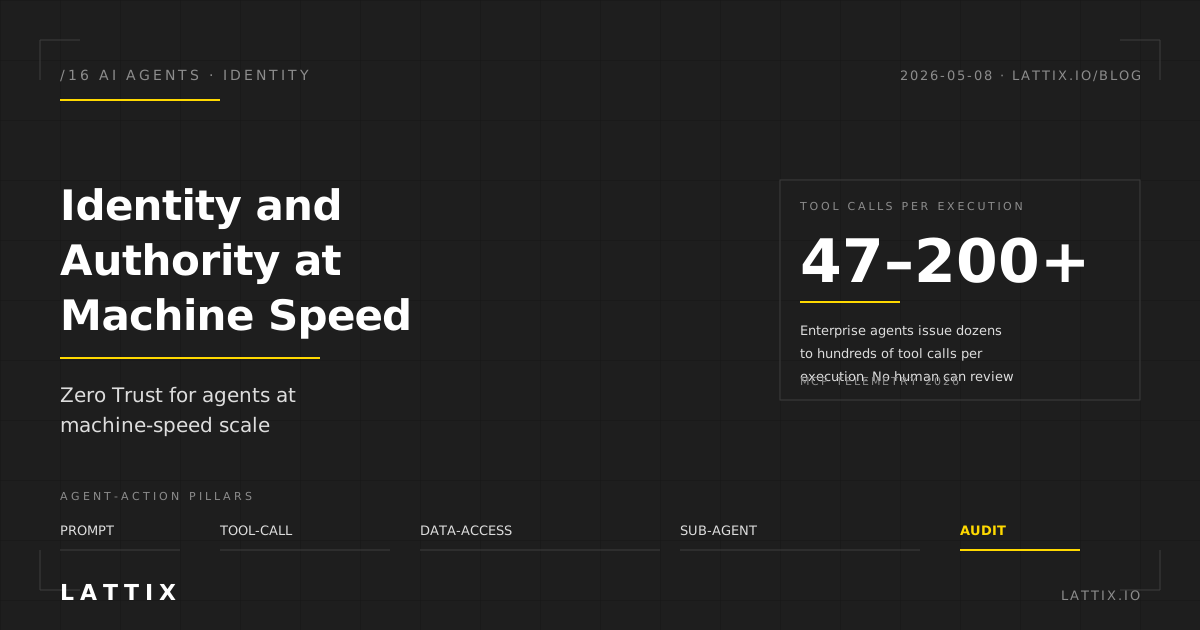
An agent is not a user. It has no human session boundary. It can be invoked by another agent, escalating the delegation chain. It accumulates tool calls in a single execution context,each call represents an access request, but the call chain itself becomes the audit surface. Most critically, an agent operates at machine speed. Where a human reviews a few dozen decisions per day, an agent can issue thousands per minute. The identity model built for humans cannot handle this.
Lattix calls this the machine-speed identity problem. It affects every autonomous agent framework in production today: Anthropic Model Context Protocol agents, LangChain agents, OpenAI Assistants API, AutoGen, CrewAI, AWS Bedrock Agents, Azure AI Studio agents. The frameworks themselves provide no unified way to bind authority across agent invocations or to anchor decisions in a cryptographically verifiable audit trail.
Agent Identity Is Contextual, Not Static
A human user's identity is relatively stable within a session. An agent's identity shifts with every tool it loads, every sub-agent it invokes, and every permission it assumes on behalf of a human principal. The attributes that matter for policy are not "which department manages this agent" but "which model is executing right now, under whose authority, with what tools loaded, against which principal's data, for what declared purpose."
This is why role-based access control fails for agents. RBAC says "data analysts can read reports." But an agent can read reports, write to a data lake, invoke a sub-agent for enrichment, and call a third-party API,all in one execution. Its role is insufficient to express the decision context.
Attribute-based access control with data-centric zero trust is the necessary foundation. Attributes like agent-model, agent-purpose, tool-identity, principal-authority, and execution-context become the policy input. The Policy Decision Point evaluates all of them together, every single time a tool is called.
The Delegation Chain Problem
When a human grants an agent permission to act on their behalf, they are delegating a subset of their authority. Expressing that subset precisely is where most agent frameworks fail. The human might say: "Use this agent to process expense reports, but only approve amounts under five hundred dollars, and only for the engineering department." The agent must carry that constraint across every tool call.
Current implementations typically hand the agent an OAuth token and hope the scopes are right. On-behalf-of (OBO) flows,where the agent passes tokens to sub-agents,create ambiguity: which principal's authority is actually being invoked? The audit record often cannot answer that question. Revocation is messy. If the human's permissions change, the agent's cached authority does not automatically contract.
Workload Identity Federation, SPIFFE/SPIRE, and bound-secret flows help, but they still require the agent framework to cooperate. Lattix's data-centric zero trust approach binds every agent invocation as a complete attribute set: the principal's current authority, the agent's declared purpose, the requested tool, and the data being accessed all flow to the PDP together. Evaluation is cryptographically anchored in a Merkle-tree lineage so every decision, even at machine speed, has a deterministic audit record.
Tool Calls Are Policy Events
An autonomous agent's tool invocation is an access request. Today, each tool typically implements its own authentication,some check OAuth scopes, some use API keys, some rely on the host's identity. The result is a fragmented, inconsistent permission model. An agent can pass authentication for one tool but not the next, and the failure modes are not standardized.
A unified policy layer treats every agent tool call as a discrete policy decision. The PEP intercepts the call at the framework level or at the tool boundary. The PDP evaluates the agent's current attributes against a common policy: Does this agent, with these attributes, against this principal's authority, have permission to invoke this tool with these parameters, against this data. The answer is yes or no. Fail-closed. No fallback to the tool's native auth.
This requires policy as code that understands agent context. NIST AI RMF and NIST SP 800-218A provide structural guidance, but the evaluation itself must happen at runtime, not in planning. The PEP must be agent-aware.
Anomaly Detection in Lineage, Not in Logs
An agent can make tens of thousands of decisions per minute. Human audit review cannot operate at that scale. Traditional SIEM systems that flag anomalies in the log stream after the fact are insufficient. The agent has already moved the data, called the sub-agent, committed the transaction.
Lattix's approach binds every machine-speed decision into a Merkle-tree lineage,a cryptographic chain where each decision node contains the full context and a hash of the prior decision. The lineage itself becomes summarizable. Anomaly detection runs on the structure of the tree, not on raw events. A sustained pattern of unusual tool calls, or a sudden shift in which principals' authority is being exercised, surfaces at the lineage level. The audit record proves not just what happened but what policy was evaluated and why the decision was made.
This scales. A thousand-decision-per-minute agent produces a lineage that can be reviewed, traced, and audited without needing a human to watch the execution in real time.
Risks Unique to Agent Authority
Prompt injection that escalates privilege is the most obvious vector. A user's injected instruction redirects the agent to invoke tools outside its intended purpose. The agent's policy context should catch this,if the declared purpose is "generate a report" but the injected instruction tries to invoke deletion tools, policy fails-closed.
But the bind is not always tight. An agent in a long-running inference loop may drift from its original purpose. Sub-agent composition can obscure the principal's original authority. An agent invoked by another agent creates a delegation chain whose effective permissions are the intersection of all constraints, but if any link in the chain is weak, the whole chain weakens.
Tool-name confusion is a deeper attack surface. An agent framework loads tools by name. If an attacker can register a tool with a name that collides with an expected tool, or if the name resolution is not anchored to the tool's actual implementation, the agent invokes the wrong code. Cryptographic tool binding,where the tool's identity is a hash of its interface and behavior, not just a string,prevents this.
Data exfiltration via prompt-leaked context windows is increasingly common. An agent may load sensitive context into its inference window. A jailbreak prompt extracts that context. The agent then writes it to an attacker-controlled output. The tool invocation itself looks legitimate,it matches policy,but the data moving through it should not have been accessible to that principal in that context. This requires understanding data classification as part of the policy decision, not as a separate compliance layer.
Lattix Direction: Cryptographic Enforcement at the PEP
Every autonomous agent invocation must carry a complete attribute set: agent-model, execution-purpose, principal-authority, tools-bound, data-classification. This set is evaluated by the Policy Decision Point against data-centric zero trust policy. The decision is cryptographically signed and anchored in a Merkle-tree lineage. The PEP enforces the decision fail-closed.
This is what Lattix is building into ZTDF and CAS-X. Post-quantum key encapsulation with ML-KEM-768/1024 ensures the lineage survives cryptographic transitions. The audit record is not a log to be read later,it is the source of truth for what authority was granted at what moment to what agent for what purpose.
As agentic AI becomes operational in enterprises, this architecture will separate the systems that can be audited and governed from the ones that cannot. The cost of adopting it now is the cost of rearchitecting identity for machine speed. The cost of not adopting it is the cost of a breach or regulatory finding that nobody can explain.
References
- Anthropic. Model Context Protocol (MCP). https://modelcontextprotocol.io
- NIST. AI Risk Management Framework. https://airc.nist.gov/docs/NIST.AI.RMF.1.0.pdf
- NIST SP 800-218A. Secure Software Development Framework (SSDF). https://csrc.nist.gov/pubs/detail/sp/800/218/a
- OAuth 2.1 Framework. https://datatracker.ietf.org/doc/html/draft-ietf-oauth-v2-1
- SPIFFE/SPIRE: Secure Production Identity Framework for Everyone. https://spiffe.io
- Merkle, R. C. "A Certified Digital Signature." In Advances in Cryptology,CRYPTO '89. Springer, 1989.