The Medtronic Breach Is the Canvas Playbook Run Against a Medical Device Maker
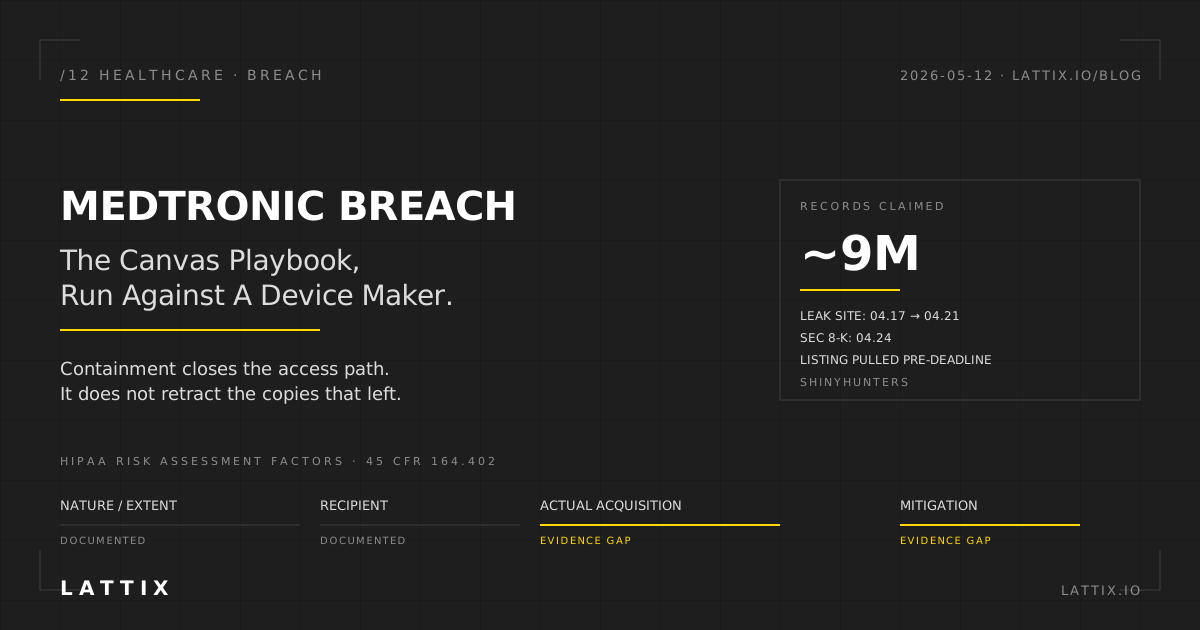
Medtronic disclosed an unauthorized intrusion into specific corporate IT environments in a Form 8-K filed with the U.S. Securities and Exchange Commission on April 24, 2026. The disclosure followed ShinyHunters adding Medtronic to its Tor-hosted leak site on April 17 and 18 and demanding negotiations by an April 21 deadline. ShinyHunters claimed approximately nine million records and several terabytes of internal corporate data. The leak-site listing disappeared before the deadline, a pattern associated with ongoing negotiation or payment.
This is the second healthcare-adjacent disclosure in two weeks where the architectural failure is the same one. Instructure's Canvas LMS incident put roughly 275 million education records at risk under FERPA. The Medtronic incident moves the same pattern into a HIPAA-governed environment with a regulator that operates a different notification clock and a different penalty schedule.
What the disclosure does and does not answer
Medtronic's public statements scope the intrusion to corporate IT systems and stress that customer-managed hospital networks were not exposed through this incident. That framing answers the first operational question, the radius of the compromise inside the operator's environment. It does not answer the second question, the radius of the data already moved out of the environment before containment.
ShinyHunters' nine-million-record claim is unverified by Medtronic. Verification is not actually the central question. The central question is whether Medtronic's data layer can produce a cryptographically anchored answer to which records were retrieved by the compromised principal, when, and against which policy decision. SEC Item 1.05 disclosure language asks for material impact characterization. HIPAA Section 164.404 attaches notification timing to discovery of a breach affecting protected health information. Both regimes assume that the entity holding the records can describe what walked out.
The Canvas incident demonstrated what happens when the audit stream attributes access to the compromised principal rather than to a verifiable attribute claim on the access event. Schools with access-channel logs alone are running reasonable worst-case notification across years of Canvas footprint. Schools with record-level lineage are running scoped notification against actually-retrieved records. The same fork is now in front of Medtronic and any covered entity downstream of its data flows.
Why corporate IT scoping does not close the disclosure surface
Medical device manufacturers carry several classes of data that survive a corporate-IT scoping caveat. Adverse event reports submitted under FDA 21 CFR Part 803. Cybersecurity event communications with the Healthcare Sector Coordinating Council and CISA under the Joint Cyber Defense Collaborative. Patient-bound design history files. Service contracts and field engineer access logs. None of these live exclusively on the hospital networks the disclosure exempts. All of them sit on corporate IT systems by design.
The legacy architectural model places the policy enforcement point at the perimeter and at the application. A successful authentication into the corporate environment produces a session that the application trusts to read attached records. The audit log records the session, not the attribute claim that should have authorized each read. When the session itself is the compromise vector, the audit log becomes a list of activities by a name the attacker controlled, not a list of attribute-bound decisions an investigator can replay.
Object-level cryptographic enforcement reverses this. Each record is wrapped under a policy that releases the wrapping key only against an attribute set that satisfies the policy at the moment of access. A compromised session presenting an attribute claim that does not match the policy unwraps nothing. A compromised session presenting a claim that does match the policy is logged with the satisfied attributes attached, not the impersonated identity alone.
The HIPAA reporting math after a data-centric architecture
The Office for Civil Rights treats unauthorized acquisition of PHI as a presumed breach unless a documented risk assessment under 45 CFR 164.402 demonstrates a low probability of compromise. The risk assessment factors include the nature and extent of the PHI involved, the unauthorized person to whom the disclosure was made, whether the PHI was actually acquired or viewed, and the extent to which the risk has been mitigated.
A perimeter-attribution audit stream cannot answer two of the four factors with evidence. Whether the PHI was actually acquired sits on the integrity of an audit log written by the compromised platform. The extent of mitigation depends on whether the unauthorized access can be reliably foreclosed. Both reduce to assertions in the absence of cryptographically anchored evidence.
A data-centric architecture with Merkle-tree lineage on every read and write event answers the acquisition factor with a verifiable list. The mitigation factor follows from the cryptographic properties of the wrapped records. Revoking the wrapping key forecloses access to records not yet released. Records the adversary already pulled remain ciphertext under a key the operator controls and can rotate. ShinyHunters publishing ciphertext is not a credible second-extortion threat.
What the next two weeks of Medtronic disclosures will show
The unknown variables at the time of this post are the actual record count, the actual data classes, and the notification timeline Medtronic files. The architectural variable is not unknown. The breach already happened, and the architecture under it was perimeter-attribution. The next two weeks will demonstrate, again, how expensive that architecture is to clean up after.
Lattix Technologies binds policy to the data object through attribute-based access control at the policy enforcement point, post-quantum key encapsulation using ML-KEM-768 and ML-KEM-1024, and Merkle-tree lineage in content-addressed storage. Healthcare programs evaluating the Medtronic disclosure should be running the same hypothetical against their own architectures. The hypothetical is not whether the next compromise will happen. The hypothetical is what the disclosure language reads like after it does.
References
- U.S. Securities and Exchange Commission, Medtronic plc Form 8-K, April 24, 2026.
- HIPAA Journal, Medical Device Maker Medtronic Announces Data Breach, April 2026. https://www.hipaajournal.com/medical-device-maker-medtronic-data-breach/
- Infosecurity Magazine, Medtronic Confirms Data Breach After ShinyHunters Claims, April 2026. https://www.infosecurity-magazine.com/news/medtronic-data-breach-shinyhunters/
- SecurityWeek, Medtronic Hack Confirmed After ShinyHunters Threatens Data Leak, April 2026. https://www.securityweek.com/medtronic-hack-confirmed-after-shinyhunters-threatens-data-leak/
- TechRadar, Medtronic says ShinyHunters hackers stole around 9 million medical records, April 2026. https://www.techradar.com/pro/security/medtronic-says-shinyhunters-hackers-stole-around-9-million-medical-records-in-latest-attack
- 45 CFR 164.402, 45 CFR 164.404, HHS Breach Notification Rule.
- FDA 21 CFR Part 803, Medical Device Reporting.
- SEC Item 1.05, Material Cybersecurity Incidents disclosure requirement.