HIPAA Security Rule Enforcement Starts With Data, Not Paper
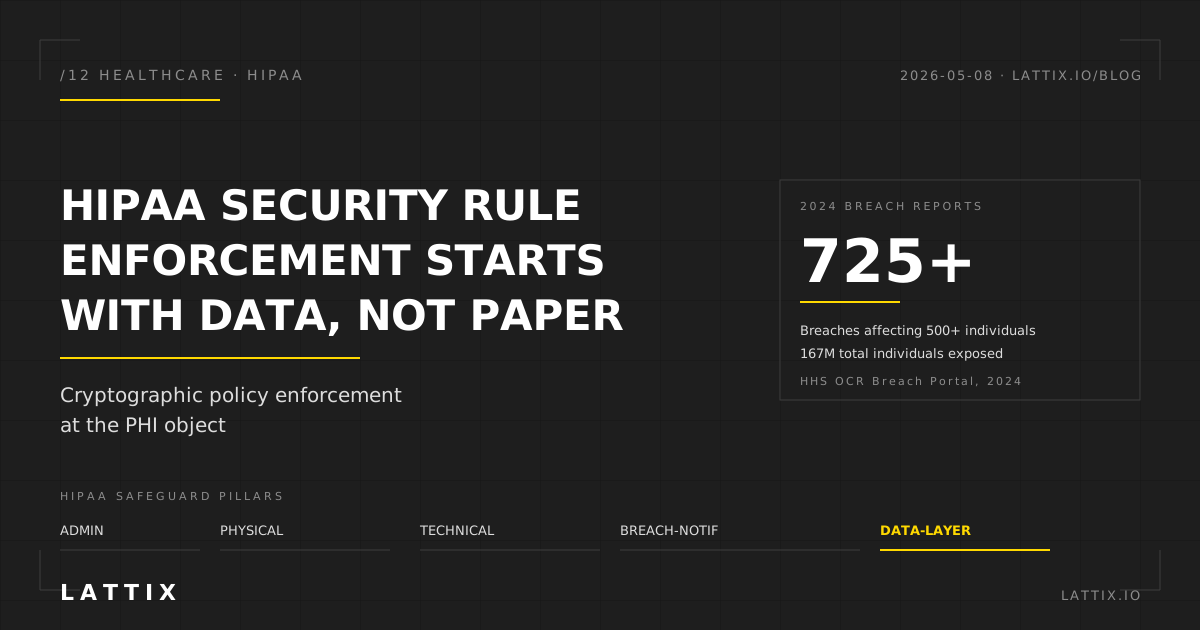
A Business Associate Agreement is a contract. It memorializes what a covered entity will require from a vendor: implement administrative, physical, and technical safeguards. But the moment protected health information leaves the initial system boundary,handed to a research collaborator, shipped to a billing processor, or fed into an AI training pipeline,the BAA becomes unilateral theater. Enforcement requires what the contract cannot provide: cryptographic policy that travels with the data itself, audit trails that prove who accessed what and when, and breach-scope determinism when something goes wrong.
The HIPAA Security Rule (45 CFR 164.302–312) specifies exactly what "safeguards" means. The Business Associate Agreement only specifies what the vendor promises. Those two artifacts have almost nothing to do with each other.
What the Security Rule Actually Requires
The HIPAA Security Rule divides safeguards into three categories: administrative (workforce policies, training, incident response), physical (facility access controls, workstation policies), and technical (45 CFR 164.312). The technical safeguards are where most covered entities stumble. The rule mandates access control tied to role and function (§164.312(a)(2)(i)), audit controls that record and examine access to systems containing PHI (§164.312(b)), integrity controls to ensure PHI has not been altered or destroyed (§164.312(c)(1)), and transmission security ensuring confidentiality and integrity during electronic transmission (§164.312(d)).
Most healthcare infrastructure interprets these requirements at the network perimeter or identity layer: role-based access control (RBAC) at the EHR, firewalls between systems, TLS for transit. This approach creates a critical gap. When PHI is extracted, aggregated, anonymized, or combined with external datasets, the original access control regime stops tracking it. A CSV of de-identified patient records sent to a researcher inherits no policy from its source. A billing processor API receives patient identifiers with no mechanism to enforce the Security Rule's requirement that access be "the minimum necessary." An AI model training on healthcare derivatives operates entirely outside the audit trail.
The Business Associate Agreement Compliance Gap
A BAA obligates the vendor and transfers liability. It does not enforce anything in real time. When the Office for Civil Rights (OCR) investigates a breach, the BAA becomes evidence in a post-incident forensic audit. The covered entity can produce the document and ask the OCR investigator: "Do you see? We contractually required safeguards." The investigator can then produce evidence that the vendor's implementation did not match the contract's terms.
In the Anthem breach (2015, $115M OCR settlement), the BAA promised technical safeguards. The BAA did not prevent the breach. In the Premera breach (2015, $74M settlement), the same pattern held: contract promising safeguards, infrastructure failing to deliver them in real time. The HITECH Act (42 U.S.C. §17932) makes the covered entity liable for breaches caused by business associates. The BAA does not change liability; it only clarifies who owes what. If the associate fails, the covered entity pays.
The audit trail the OCR wants to see,who accessed what PHI, when, for what reason, from where,exists almost nowhere in traditional healthcare infrastructure. A SIEM can log successful logins. It cannot track whether a specific patient record was accessed, by whom, and whether that access violated the patient's express restrictions. The 6-year retention requirement (45 CFR 164.316(b)(2)(i)) applies to records of information systems activity. Most organizations retain application logs; they do not retain proof of data access at the object level.
De-Identification: Safe Harbor Myths and Real Limits
The Safe Harbor de-identification method (45 CFR 164.514(b)(2)) permits covered entities to remove 18 categories of identifiers and treat the result as non-PHI. Zip code, date of birth, gender,stripped away. The assumption is mathematical: with enough identifiers removed, re-identification becomes computationally impractical.
This assumption broke in 2019. MIT researcher Latanya Sweeney demonstrated that 87% of Americans can be uniquely identified by the combination of Zip code, date of birth, and gender alone. Safe Harbor's list is outdated. The Expert Determination method (45 CFR 164.514(b)(1)(ii)) offers an escape: hire a statistician, document their analysis, and treat the result as de-identified if re-identification risk is "very small." But expert determination is expensive, slow, and binds the covered entity to a statistical conclusion that may not hold if the data is later combined with external datasets.
Data-centric zero trust adds a layer that de-identification cannot. Even if a dataset is anonymized to clinical standards, it can still be wrapped in a policy: this data may be used only for research on diabetes treatment, only by employees of Institution X, only from IP ranges controlled by Institution X, and access must be cryptographically audited. When the derivative is shared or combined with external data, the policy travels with it. The original covered entity can revoke access retroactively, know precisely how long each access lasted, and supply that audit trail to OCR.
Cross-Institutional Research and Data Sharing
Clinical research now demands data movement across organizational boundaries. Cancer registries, genomics consortia, multi-site clinical trials,all require protected health information to move between covered entities and business associates with entirely different infrastructures, compliance postures, and risk profiles. HIPAA permits such sharing under its research exception (45 CFR 46.102–46.109 for Common Rule; 45 CFR 164.501–164.508 for HIPAA Authorization).
But moving data between institutions means moving it beyond the original covered entity's technical safeguards. The receiving institution has its own HIPAA compliance program. It may have stronger or weaker access controls, audit logging, or incident response. The covered entity that transmitted the data remains liable for breaches at the receiving end.
This is where data-centric zero trust with cryptographic enforcement changes the game. A Lattix solution wraps PHI in a Zero-Trust Data Format (ZTDF): the data is encrypted, signed, and bound to a policy artifact (a PDP decision) that describes who may access it, under what conditions, and for how long. When the data moves across the network to the research collaborator, the policy moves with it. The collaborator's infrastructure cannot decrypt or access the data without a fresh proof of authorization, which can only be granted if the original covered entity's Policy Decision Point (PDP) approves. If the covered entity revokes access, the researcher's local copy becomes unreadable. The audit trail is cryptographically anchored; it cannot be backfilled or forged.
Audit Trails That Regulators Actually Verify
The OCR expects to find evidence. When a breach is reported, the covered entity must be able to explain the scope: how many individuals were affected, what information was exposed, for how long, and who had access. The HITECH Act breach notification rule requires notification "without unreasonable delay" (45 CFR 164.404). That phrase turns on scope determination. If a healthcare organization cannot prove that access did not occur, they must assume it did and notify.
Most healthcare SIEM logs cannot answer the question: "For patient X, who accessed what records, and when?" A traditional audit log records login events, database queries, and system-level transactions. It does not record which patient records were accessed by which user in which context. A researcher running a SQL query against a de-identified cohort may access millions of records; the log shows one query execution, not 1 million access events.
Cryptographically anchored audit logs change this. Every access to protected data generates a signed, immutable record. The record includes the user identity, the patient identifier, the timestamp, the data elements accessed, and the authorization token or decision that permitted it. The covered entity can retrieve all accesses to patient X within a 6-year window and produce them to OCR investigators in minutes. The FDA cybersecurity guidance for medical devices (21 CFR Part 11) expects similar levels of rigor in device audit trails. Healthcare regulations are converging on the principle: if you cannot prove access happened, you cannot prove it did not happen.
Data-Centric Policy at the Object Level
Lattix's approach inverts the traditional model. Instead of securing the perimeter and trusting everything inside, data-centric zero trust assumes the network is hostile and the data object itself carries the security boundary. Protected health information is wrapped in cryptographic policy (a Policy Enforcement Point, or PEP). Access decisions are made by a Policy Decision Point (PDP) that evaluates the request against ABAC (Attribute-Based Access Control) rules.
A rule might read: "Patient-Identifiable Data may be accessed only by healthcare providers with a valid treatment relationship, only from healthcare facilities, only during business hours, only if the request is audited and encrypted, and only if the patient has not revoked consent." The PDP checks every one of these attributes before granting decryption keys. The EHR does not have to understand these rules; the data itself enforces them. A business associate's system receives the encrypted blob and cannot access it without contacting the PDP and proving compliance.
The audit trail is atomic. Every grant decision is recorded, signed, and timestamped. Revocation can be immediate. If a privacy officer discovers that a business associate violated a patient's access restrictions, the covered entity can revoke all keys in real time, and the BAA's liability clauses become concrete evidence rather than theater.
Closing: From Paper Compliance to Enforced Compliance
The HIPAA Security Rule is 25 years old. Its technical safeguard categories,access control, audit, integrity, transmission security,map directly to what data-centric zero trust delivers. A Business Associate Agreement is a necessary legal artifact; it is not sufficient. Real HIPAA compliance requires technical enforcement at the data object, cryptographic proof of authorization, and audit trails that satisfy the OCR's forensic standards.
Covered entities that continue to rely on BAAs and infrastructure-layer controls will face escalating breach costs and OCR penalties. The trend in healthcare enforcement is clear: NIST SP 800-66 Rev 2 (HIPAA implementation guidance) now explicitly recommends zero-trust architecture. The FDA's medical device guidance includes requirements for audit logging that approach cryptographic standards. The healthcare industry is moving toward data-centric security not because it is fashionable, but because BAAs and perimeter controls no longer work.
References
- HIPAA Privacy Rule, 45 CFR 164.500–164.534. U.S. Department of Health and Human Services.
- HIPAA Security Rule, 45 CFR 164.302–164.318. U.S. Department of Health and Human Services.
- Breach Notification Rule, 45 CFR 164.400–414. U.S. Department of Health and Human Services.
- Health Information Technology for Economic and Clinical Health (HITECH) Act, 42 U.S.C. § 17932. U.S. Congress.
- NIST SP 800-66 Rev 2: HIPAA Security Rule Guidance and Implementation. National Institute of Standards and Technology, 2024.
- Sweeney, L. "Matching Known Patients to Health Records in the National Burn Repository." HRI '19, 2019. (87% re-identification with Zip+DOB+gender.)
- Office for Civil Rights Breach Portal. U.S. Department of Health and Human Services. hhs.gov/ocr/privacy.
- FDA Guidance on Medical Device Cybersecurity. Center for Devices and Radiological Health, 2023.
- HIPAA de-identification: Safe Harbor method, 45 CFR 164.514(b)(2) vs. Expert Determination, 45 CFR 164.514(b)(1).
- Anthem Settlement Agreement, 2015 (HHS Settlement for $115M). Office for Civil Rights.