Federated Learning: Training AI Without Surrendering Data
Most useful AI models need more data than any single organization holds. Healthcare systems need records from multiple hospitals. Fraud detection needs patterns across multiple banks. Predictive maintenance needs sensor data from multiple manufacturers. The traditional pooling approach collides with privacy law, competitive sensitivity, and the reality that centralized repositories become honeypots. Federated learning inverts the architecture: the model travels to the data, each participant trains locally, and only model updates are shared. Data-centric zero trust makes this pattern defensible at audit time rather than just at architecture-review time.
The Federated Learning Flow
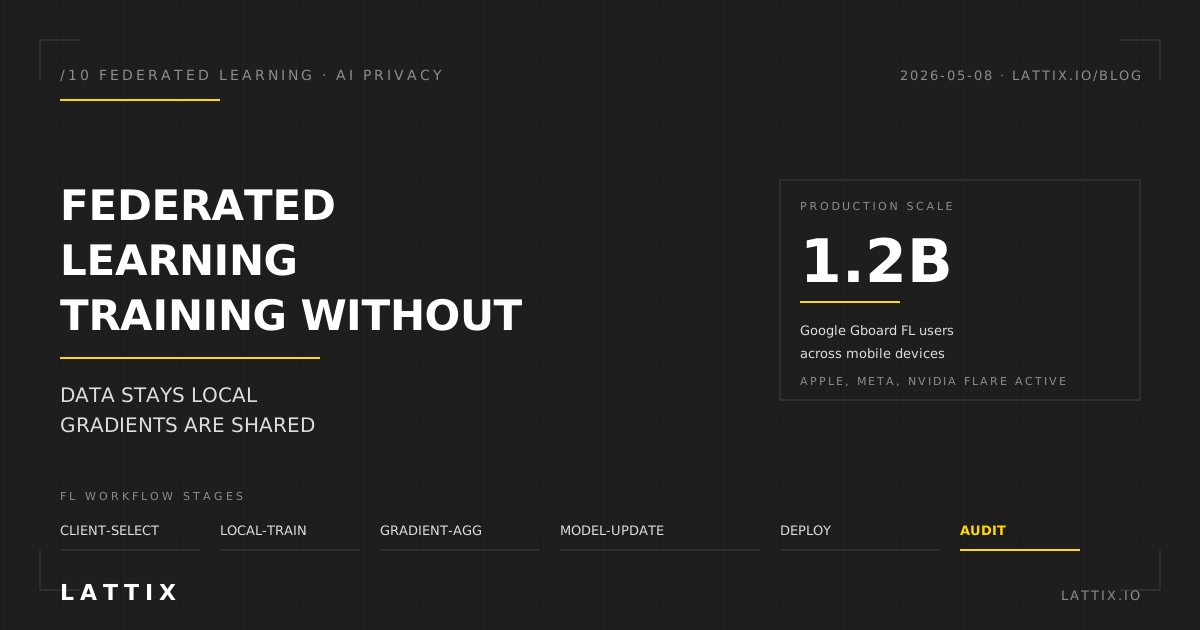
Federated learning decouples data from model training through a five-step cycle. In the client-select phase, a central coordinator selects participants based on availability and model state. Each participant performs local training on its data without moving that data from its system; this is the core privacy anchor. Participants compute gradients (parameter updates) reflecting what the model learned from their local data. Those gradients aggregate at the coordinator using secure aggregation primitives, which ensure the coordinator learns only the summed parameters, never individual participant updates. Finally, the global model incorporates these updates and the cycle repeats.
McMahan et al. 2017 formalized this pattern as Federated Averaging (FedAvg), establishing the mathematical foundation that makes gradient-based federated training practical. The architecture reduces data exposure compared to centralized training, but it does not eliminate the threat surface. Gradients carry information about training data. Participant lists create provenance records. Model versions correspond to specific training rounds. Each of these points requires protection.
Gradient Leakage and the Privacy-Utility Frontier
Early federated learning claims that raw data never leaves participants proved optimistic. Subsequent research revealed that gradients themselves can leak training examples under certain conditions. Deep Leakage from Gradients (DLG) attacks and membership inference attacks showed that an adversary with access to gradient updates could reconstruct sensitive examples or infer whether a specific data point participated in training.
These attacks motivated multiple defenses operating in parallel. Gradient clipping limits the magnitude of parameter updates, reducing the signal available to attackers. Noise injection adds differentially private perturbations to gradients before aggregation. Secure aggregation uses cryptographic protocols to prevent any single party from observing individual gradients. None of these defenses alone is sufficient; defense-in-depth applies all three.
Differential Privacy as the Mathematical Baseline
Differential privacy quantifies what an attacker can infer about any individual's presence in a dataset. The central parameter is epsilon (ε), which bounds the information leakage in probabilistic terms. An ε value of 1.0 guarantees strong privacy protection; values above 3.0 weaken that guarantee significantly. Claims of "differential privacy" without a stated epsilon are meaningless.
NIST SP 800-226 establishes differential privacy as the gold standard for protecting individual-level data in statistical releases. DP-SGD (Abadi et al. 2016) applies differential privacy to stochastic gradient descent, ensuring that model training adds noise proportional to the batch size and gradient sensitivity. Lattix organizations deploying federated learning must establish privacy budgets before training begins, allocate those budgets across training rounds, and lock the final epsilon value before releasing the model. This is a technical decision with regulatory consequences.
Secure Aggregation: Cryptographic Enforcement
Secure aggregation ensures that only the sum of gradient updates reaches the coordinator, never individual participant updates. Bonawitz et al. 2017 described practical secure aggregation protocols using secret sharing and additive masking. Each participant masks its gradients with a secret; these secrets are distributed among other participants in a way that cancels during summation, leaving only the true aggregate.
These protocols trade computational cost for cryptographic guarantees. Participants must store and manage shares of secrets. Coordinators must handle the aggregation machinery. If participants drop out mid-round, some protocols require recomputation. NVIDIA FLARE and OpenMined PySyft provide production implementations of these protocols, demonstrating that secure aggregation is no longer purely theoretical.
Lattix treats gradients as first-class data artifacts with the same provenance and audit requirements as the training data itself. Each gradient contribution is attributed to its source participant. Each aggregation step is logged. The complete lineage from training data to gradient to model update remains immutable for audit.
Policy and Provenance at Every Step
Federated learning requires operational bookkeeping that most organizations underestimate. Which participants contributed to this model version. What privacy budget was consumed in each round. What policy constraints applied to each participant's data. Which participants dropped out or misbehaved. Whether the model meets regulatory requirements for audit.
This is not governance overhead; it is the technical foundation of defensible federated learning. Data-centric zero trust applies immutable audit and attribute-based access control (ABAC) to every artifact in the federated pipeline. Training data is classified and policy-bound before it ever enters the model. Gradients carry cryptographic proof of their origin participant and training round. Final models are signed and lineage-anchored against the training-set participants and privacy budget used to derive them. Policy enforcement points (PEP) and policy decision points (PDP) lock these constraints at the system boundary.
Real-World Deployments and Their Trade-Offs
Google Gboard deployed federated learning for next-word prediction across billions of mobile devices in 2017. Training happens locally on user keyboards; only parameter updates return to Google's servers. Apple extended this pattern to on-device learning for Siri and keyboard prediction, adding additional noise to protect individual device privacy. Meta CrypTen and NVIDIA FLARE enable healthcare organizations and pharmaceutical consortia to train models across patient cohorts without pooling raw medical records. Owkin's secure aggregation platform trains oncology AI across hospital networks.
These deployments share a pattern: they accept the computational overhead of federated training because the privacy gain is concrete and regulatory value is measurable. They also all rely on secure aggregation, differential privacy, and immutable audit. The research phase is over. Federated learning is operational infrastructure.
Lattix's Role in Federated Deployments
Lattix does not build federated learning trainers. Lattix secures the data-plane around federated workflows. This means: classifying training data and enforcing policy at rest before model training begins; treating gradients as sensitive intermediate artifacts with their own Merkle-tree lineage and policy attribution; signing and anchoring final model artifacts against the complete training set and privacy budget used to derive them; generating immutable audit records that prove which participants contributed which gradients in which round; enforcing post-quantum key encapsulation (ML-KEM-768 and ML-KEM-1024) to protect model signing keys against future cryptanalysis.
Lattix's cryptographic enforcement and fail-closed design make federated learning auditable at scale. Organizations deploying federated learning across thousands of participants, millions of data points, and multiple regulatory jurisdictions cannot rely on manual bookkeeping. They need automated, tamper-proof lineage, automated policy decision-points (PDP) for each aggregation step, and automated denial of service if any step violates policy constraints.
References
Bonawitz, K., Ivanov, V., Kreuter, B., Marcedone, A., McMahan, H. B., Patel, S., ... & Ramage, D. (2017). "Towards Federated Learning at Scale: System Design." Proceedings of the 16th USENIX Symposium on Networked Systems Design and Implementation. https://arxiv.org/abs/1902.01046
McMahan, H. B., Moore, E., Ramage, D., Hampson, S., & Aguerri, B. A. (2017). "Communication-Efficient Learning of Deep Networks from Decentralized Data." Proceedings of the 20th International Conference on Artificial Intelligence and Statistics. https://arxiv.org/abs/1602.05629
Abadi, M., Chu, A., Goodfellow, I., McMahan, H. B., Mironov, I., Talwar, K., & Zhang, L. (2016). "Deep Learning with Differential Privacy." Proceedings of the 23rd ACM SIGSAC Conference on Computer and Communications Security. https://arxiv.org/abs/1607.00133
Fredrikson, M., Jha, S., & Ristenpart, T. (2015). "Model Inversion Attacks That Exploit Confidence Information and Basic Countermeasures." Proceedings of the 22nd ACM SIGSAC Conference on Computer and Communications Security. https://arxiv.org/abs/1412.1903
Zhu, L., Liu, Z., & Han, S. (2019). "Deep Leakage from Gradients." Advances in Neural Information Processing Systems. https://arxiv.org/abs/1906.04970
NIST. (2023). "SP 800-226: Guidelines for the Evaluation and Assessment of Differential Privacy Protections in Statistical Databases." National Institute of Standards and Technology.
NIST. (2023). "AI Risk Management Framework." National Institute of Standards and Technology. https://airc.nist.gov/
Geyer, R. C., Klein, T., & Nabi, M. (2017). "Differentially Private Federated Learning: A Client Level Perspective." Advances in Neural Information Processing Systems Workshop on Private and Secure Machine Learning.