Data Sovereignty Beyond Storage: Policy-Bound Access in Multi-Cloud
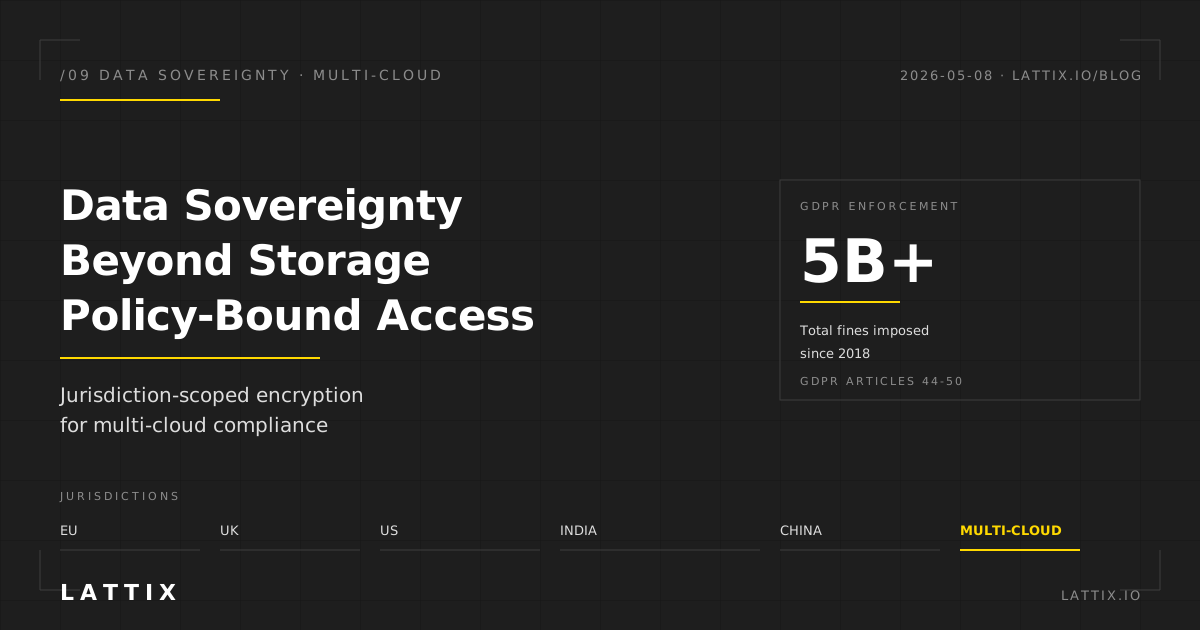
Data sovereignty regulations have undergone a fundamental shift. The notion that data stored in a country is subject to that country's laws has become insufficient. Cloud adoption and extraterritorial regulatory regimes have made the simple version obsolete. Data physically stored in a European data center remains subject to the US CLOUD Act if the provider is American. Data processed in one jurisdiction can fall under another jurisdiction's rules if the subjects are located there. Enterprises operating across borders now face a more complex question: not where data lives, but under whose legal reach it sits, and whether the access controls match that reach.
The practical implication is stark. Infrastructure-level data residency, region-locked buckets, and geographically constrained compute are necessary but insufficient. Policy-bound data, paired with attribute-based access control at the data layer, is becoming the operational standard for multi-cloud sovereignty compliance.
Regulatory Mandates Have Shifted the Burden
The past five years have produced a convergence of sovereignty and compliance regulation. GDPR Articles 44-50 and the Schrems II decision (CJEU C-311/18) established that EU data can flow to non-adequacy jurisdictions only under Standard Contractual Clauses paired with supplementary technical safeguards. The EU Cloud Code of Conduct, NIS2, and the EU Data Act codify a single principle: organizations must demonstrate control at the data layer, not merely assert compliance in policy documents.
This pattern repeats globally. India's DPDP Act 2023 requires lawful basis for cross-border data transfer. China PIPL mandates data localization with limited exceptions, and EU and India have both signaled enforcement momentum. The Trans-Atlantic Data Privacy Framework and US Executive Order 14086 attempt to address Schrems II gaps, but technical enforcement mechanisms remain the responsibility of the data custodian.
The Three Access-Control Problems
Picking a region in a cloud console satisfies none of these regulations. Three specific failure modes dominate real-world deployments.
First, the support-personnel problem. Cloud provider staff operate globally. A US-based engineer debugging an issue can legally access customer data stored in an EU region if the access is permitted by the provider's internal policies, regardless of contractual terms with the customer. Lattix addresses this through per-jurisdiction policy authorities and attribute-bound access, where the data object itself refuses to decrypt for requesters whose attributes (corporate location, clearance, lawful basis) fall outside the approved set.
Second, the auditor access problem. Big-Four accounting firms, third-party security auditors, and regulatory inspectors often operate across multiple jurisdictions. Allowing them read access to sensitive EU or India customer data during an audit, even with NDAs in place, creates legal friction under GDPR Article 48 and analogous provisions in India DPDP. Data encryption with jurisdiction-scoped key release bypasses this entirely: auditors can verify the data object's presence and the access log without decrypting the payload.
Third, the cross-border subpoena problem. The US CLOUD Act permits US authorities to compel US-based cloud providers to disclose customer data regardless of its storage location. A data object that refuses decryption outside specified jurisdictions, enforced through cryptographic key encapsulation tied to policy decision points, makes such disclosure technically infeasible. The data is compliant by design.
Why Infrastructure Alone Falls Short
Enterprises often default to infrastructure solutions: region-locked S3 buckets, in-region Snowflake clusters, VPC endpoints without external egress. These are operationally sound and necessary. They do not, however, address the three problems above. Backups replicate data outside the region for disaster recovery. Support access is mediated by the provider's software, not the customer's policy. Analytics queries may be served by global edge-compute layers.
The regulatory question is fundamentally about access control, not physical storage topology. GDPR Article 44 permits transfers only to countries with "adequate protection" or with supplementary safeguards. Standard Contractual Clauses are supplementary safeguards. The supplementary safeguards are not regional infrastructure; they are cryptographic enforcement of jurisdiction-bound access.
Policy-Bound Data as the Enforcement Primitive
A data-centric zero trust data fabric (ZTDF) inverts the architecture. Rather than trusting the storage layer and the access control layer, the fabric wraps data in policy-bound encryption. The policy decision point (PDP) and policy enforcement point (PEP) sit at the data object itself, not at the infrastructure boundary.
Operationally, this works as follows. A customer data object tagged with attributes (subject jurisdiction: EU, classification: PII, lawful basis: Article 6(1)(b) contract) is encrypted with a per-object key derived from policy. The key is bound to the data's attribute set via cryptographic key encapsulation; Lattix uses ML-KEM-768 and ML-KEM-1024 for post-quantum key wrapping. A requester with attributes (location: Dublin, employer: Lattix customer, clearance: support) attempts to decrypt. The data object's embedded policy evaluates the requester's attributes against the data's access rules. If the requester's location does not match the data's jurisdiction restriction, the key release fails. The attempt is logged.
This is demonstrable sovereignty. The organization has enforced control at the layer where data assets live, not merely at the perimeter.
Multi-Cloud Without Duplication
Modern enterprises run workloads across AWS, Azure, Google Cloud, and sovereign regional clouds simultaneously. Each cloud provider operates under different regulatory frameworks and legal obligations. A simple architecture would duplicate data per cloud, creating a separate compliance boundary for each provider. This is operationally expensive and auditorially complex.
Policy-bound data with attribute-based access control enables a single data copy to live in multiple clouds without fragmenting compliance responsibility. The encrypted object moves to AWS, Azure, GCP, and a sovereign cloud in parallel. Each cloud's storage is simply storage; the access control logic and cryptographic enforcement sit in the data object itself and in the customer's key management fabric. The policy decision point remains independent of the underlying cloud provider.
This model also addresses the key management problem. Standard Lattix deployments use geographically-scoped key access servers, where the key material for EU data is held in EU-resident servers and released only to requesters meeting EU-based policy rules. The same encrypted data object can be accessed from any cloud; the key release decision remains anchored in the customer's policy authority.
Building Sovereign Multi-Cloud Deployments
Lattix Technologies enables this architecture through configurable policy authorities per jurisdiction, attribute-based access control with cryptographic enforcement, and a zero trust data fabric that operates independently of the underlying cloud provider. Deployments integrate with existing identity providers for attribute enrichment and with cloud-native key management systems (AWS KMS, Azure Key Vault) for key wrapping and escrow.
The path to compliance is no longer region selection in a cloud console. It is architecture: wrapping data in policy-bound encryption, placing policy decision authority in the customer's infrastructure, and using cryptographic key encapsulation to enforce jurisdiction-specific release rules. Multi-cloud becomes operationally viable, auditorially defensible, and legally sound.
References
-
CJEU C-311/18 (Schrems II). "Case C-311/18, Data Protection Commissioner v Facebook Ireland and Maximilian Schrems." Court of Justice of the European Union, July 2020.
-
General Data Protection Regulation, Articles 44-50 (Standard Contractual Clauses and International Transfers). European Union, 2018.
-
EU Data Act (Regulation (EU) 2024/943). "On harmonised rules on fair data access and use." European Parliament and Council, December 2023.
-
EU Cloud Code of Conduct. "Promoting Trust and Security in Cloud Computing in the EU." Version 2.0, European Commission, February 2023.
-
NIS2 Directive (Directive (EU) 2022/2555). "Network and Information Security." European Parliament and Council, October 2022.
-
DORA (Directive (EU) 2022/2554). "Digital Operational Resilience for the Financial Sector." European Parliament and Council, December 2022.
-
India Digital Personal Data Protection Act, 2023. Ministry of Electronics and Information Technology, Government of India, August 2023.
-
China Personal Information Protection Law (PIPL). National People's Congress, August 2021.
-
US CLOUD Act (Clarifying Lawful Overseas Use of Data Act, 18 U.S.C. 2521-2523). Public Law 115-141, March 2018.
-
Executive Order 14086 ("Improving the Competitiveness of the United States Chip and Science Industry"). The White House, August 2022 (privacy framework guidance).