Data Classification: The Foundation You Can't Skip
Every zero trust program eventually collides with the same problem: the policies the architects want to enforce cannot be written because nobody knows what the data is. Personally identifiable information is mixed with operational telemetry. Export-controlled engineering files sit in the same bucket as marketing copy. Protected health information lives in a spreadsheet on someone's laptop. Without classification, every policy becomes an approximation and every audit becomes a search. Classification is not the glamorous part of data security, but it is the part that makes the rest possible.
Why Classification Projects Usually Fail
Classification efforts fail because they start as taxonomy exercises and end as committee output that no system enforces. The pattern is consistent across mid-size enterprises and federal agencies alike: a working group convenes, debates the right number of tiers, produces a policy document, and disbands. Six months later the data is no more classified than it was, because no application reads the policy and no pipeline applies a label.
The breakdown is operational, not strategic. NIST SP 800-60 (the federal data classification reference) is concise on the structure of classification levels but silent on the mechanics of attaching them to actual data objects. Each agency that adopts SP 800-60 builds the enforcement layer itself, and most never finish.
A better starting point inverts the order. Pick one regulated data type with a well-defined boundary (PHI, CUI, payment card data) and tag every storage, pipeline, and access path that touches it. Build the classification system around real flows, not around an abstract hierarchy. The taxonomy emerges from what the systems actually need; it is not designed in isolation.
Manual vs Automated Classification
Manual classification scales linearly with human attention, which is to say it does not scale. IDC's Global DataSphere Forecast tracks enterprise data growth at roughly 22% per year compounded, while security headcount grows at single digits. The gap is unbridgeable by hand.
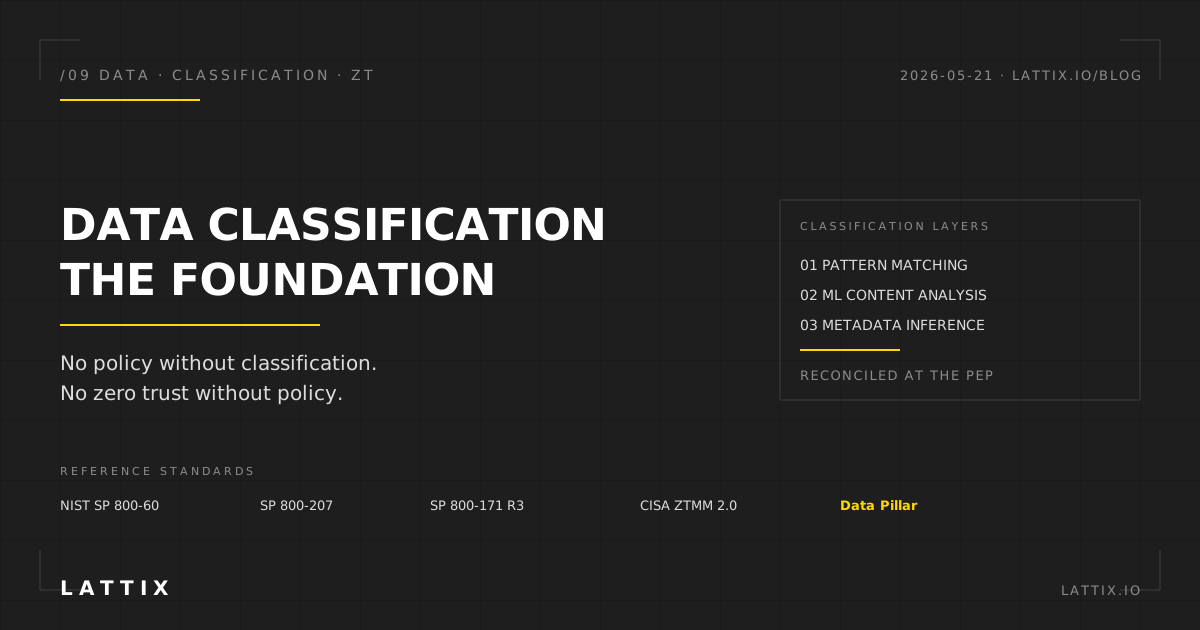
Automated classification covers three layers. Pattern matching catches the well-known formats (Social Security numbers, credit card PAN, ICD-10 codes, export-controlled identifiers) using regex and validating checksums. Machine-learning content analysis classifies free text against trained models for sensitivity (proprietary, internal, public) and topic (financial, legal, engineering). Metadata inference assigns labels based on the source pipeline, the storage location, the producing application, and the requesting user's role.
None of these layers is sufficient alone. Pattern matching has high false positive rates on conversational text. ML content analysis struggles with mixed documents that contain both classified and unclassified material. Metadata inference fails when source systems are themselves misclassified. Architectures that work in production combine all three and reconcile their outputs against a confidence threshold.
Classification at Creation vs Classification at Rest
Classifying data the moment it is created is exponentially cheaper than classifying it months later in a data lake. The application that generated the record knows the most about it: who requested it, what API parameters drove it, what schema it conforms to, what compliance regime governs the operation. That context is destroyed once the record lands in storage with only its column values intact.
Classification at creation requires architectural intent. The application either calls a classification API as part of the write path, or the write path itself emits a labeled object that downstream storage preserves. NIST SP 800-207's data pillar guidance treats this as the target maturity level: classification is a property of the record, not a property of the storage system that holds it.
Classification at rest is the recovery path for data that did not get labeled at creation. It is more expensive and less accurate, but it is necessary because production data lakes already exist and contain unlabeled records. The right architecture uses classification at rest to bootstrap, then shifts the labeling left to the application layer over time, with an explicit goal of zero unlabeled writes from any new system.
From Classification to Policy
Once a data object carries a label, policy can reference the label instead of the object. This is the handoff between data governance and access control. Attribute-based access control (ABAC) policies expressed against classification labels are stable across schema changes, storage migrations, and replication. The policy says "no read of classification=PHI from a device without HIPAA training metadata," not "no read of patients_v3.diagnosis from device X."
The label-bound policy survives data lifecycle events that would break a column-bound policy. A schema migration that splits one table into three preserves the labels on each derived row. A replication event that copies data across regions carries the labels with it. A pipeline transformation that derives an aggregate from labeled inputs propagates the highest classification of any input to the output.
None of these properties holds for policies written against table or file paths. The label-bound architecture is the only one that survives the kinds of changes data infrastructure goes through routinely, which is the reason CISA's Zero Trust Maturity Model 2.0 names the data pillar as one of five required maturity dimensions instead of folding it into application or network controls.
How Lattix Approaches Automated Tagging
Lattix Technologies treats classification as a property bound to the object through cryptographic enforcement. The policy decision point (PDP) consults the object's classification metadata before releasing the wrapping key. Pattern matching, ML content analysis, and metadata inference all feed into the classification step at the policy enforcement point (PEP). The label travels with the object across storage, transit, replication, and trust-boundary crossings.
The architecture closes the gap between governance committees and operational enforcement. The label that the committee approves is the same label the policy evaluates. There is no translation layer to drift, no enforcement system that lacks the metadata, no audit gap between declared classification and actual access. Merkle-tree lineage records each classification event in a tamper-evident audit trail that satisfies the data-pillar evidence requirements in CMMC 2.0 and the CISA Zero Trust Maturity Model 2.0.
The classification policy is the access policy. That equivalence is the architectural property zero trust needs and that traditional governance programs cannot deliver on top of perimeter-bound storage.
References
- NIST SP 800-60, Guide for Mapping Types of Information and Information Systems to Security Categories
- NIST SP 800-207, Zero Trust Architecture
- NIST SP 800-171 Rev. 3, Protecting Controlled Unclassified Information in Nonfederal Systems
- CISA Zero Trust Maturity Model v2.0
- IDC Global DataSphere Forecast
- NIST Cybersecurity Framework 2.0